Garage Floor Chip Blend Chosen With Cabinets
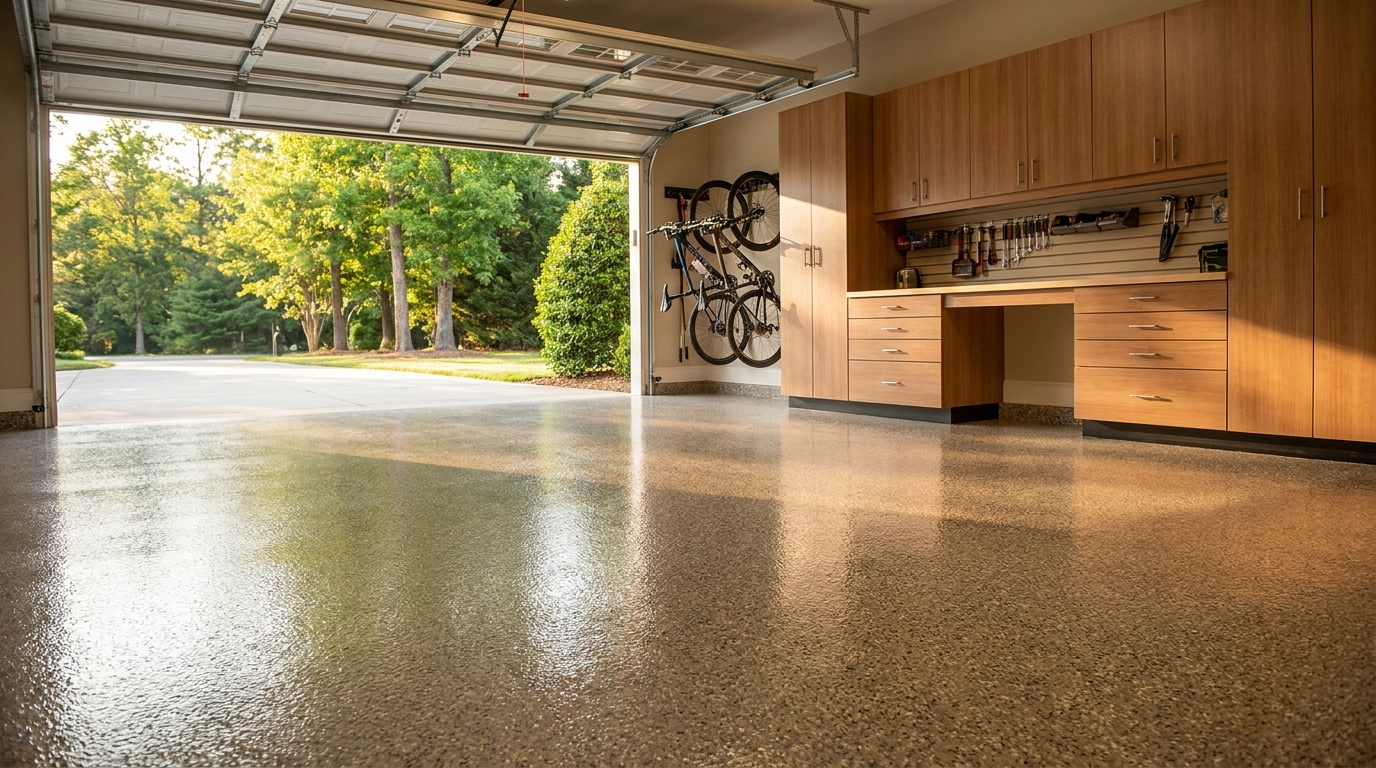
A finished Charlotte garage looks like a real room when the glossy floor and the cabinet run share a palette. That happens when the garage floor chip blend is chosen with the cabinet finish, not after the boxes are already on the wall. Color is not a property of the floor by itself. It is the light that reaches the chips, plus the way a glossy top coat throws highlights, plus the nearby cabinet doors that your eye reads in the same glance.[1][2] Our team designs those pieces together so the bay feels chosen, not assembled.
The look we are after: one room, not two products
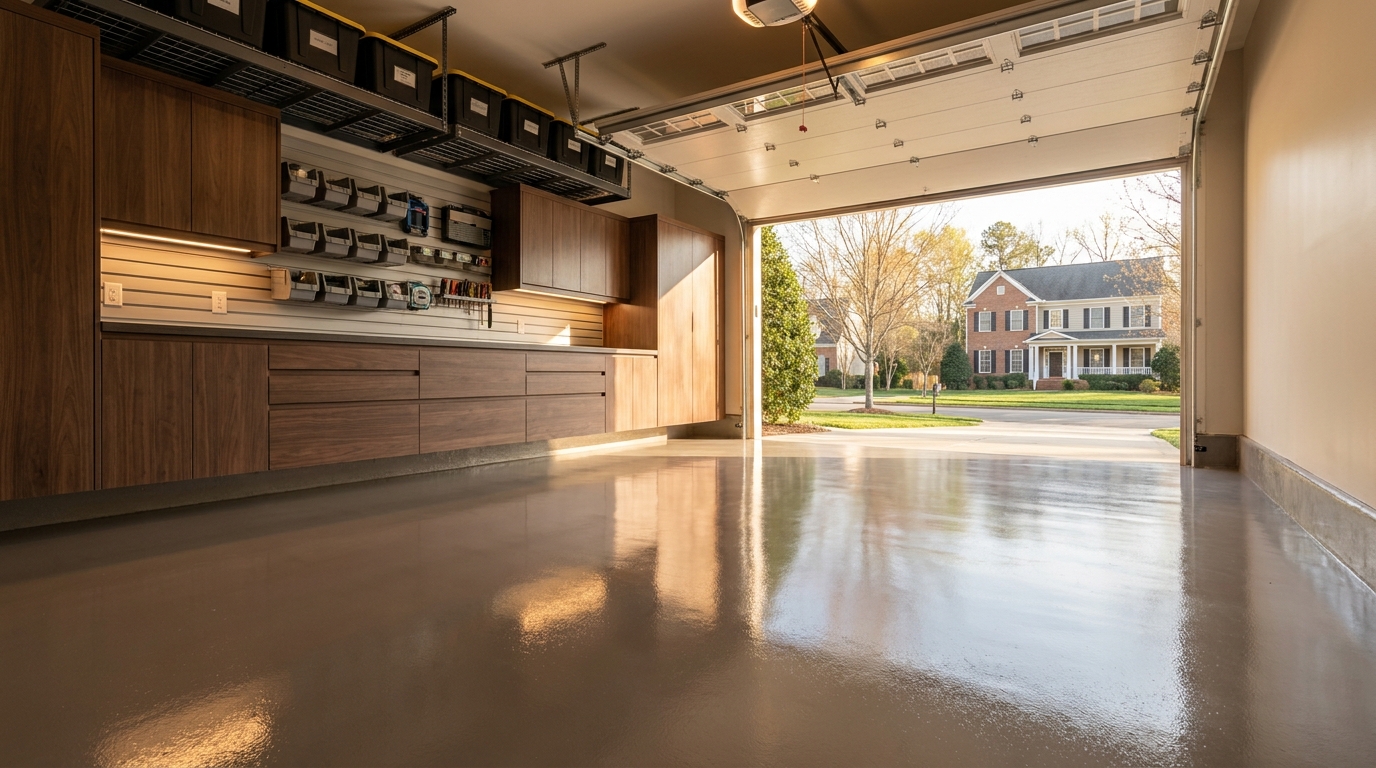
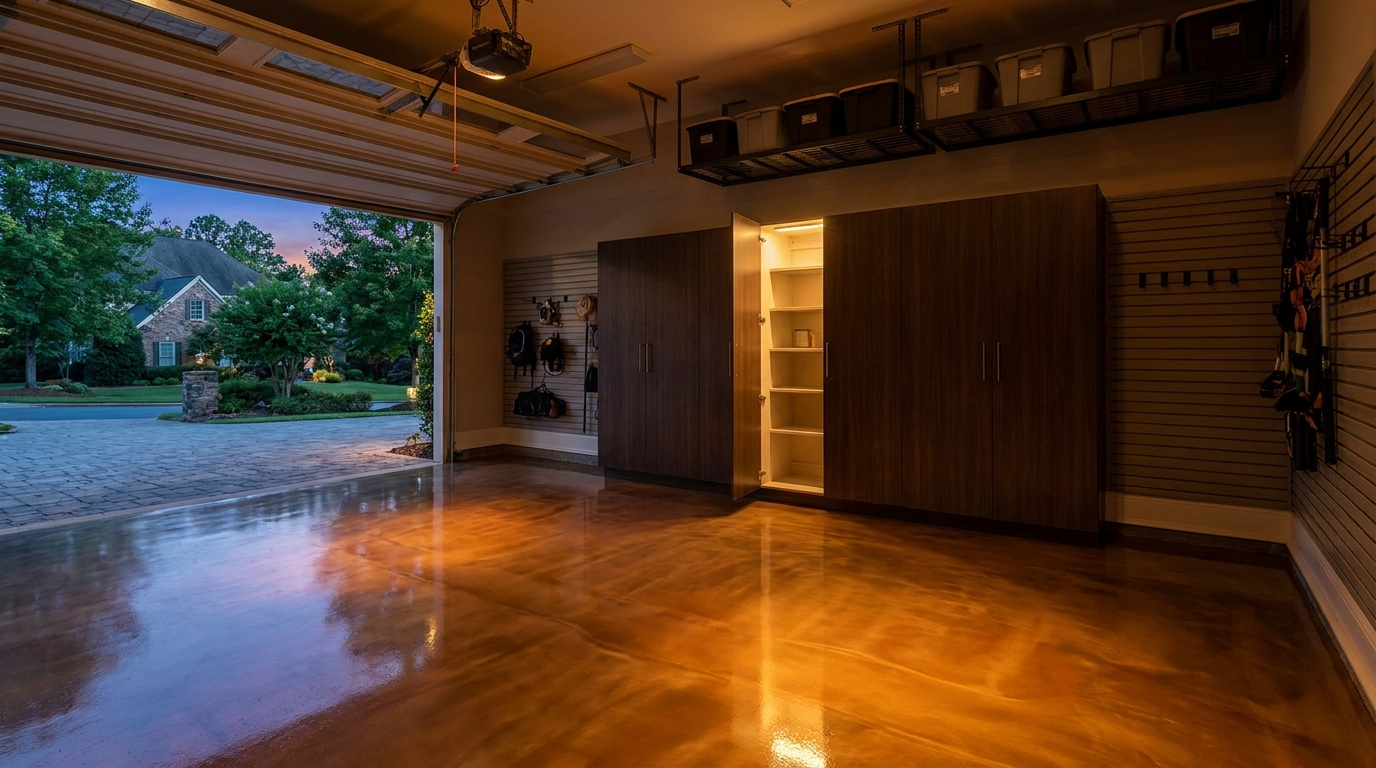
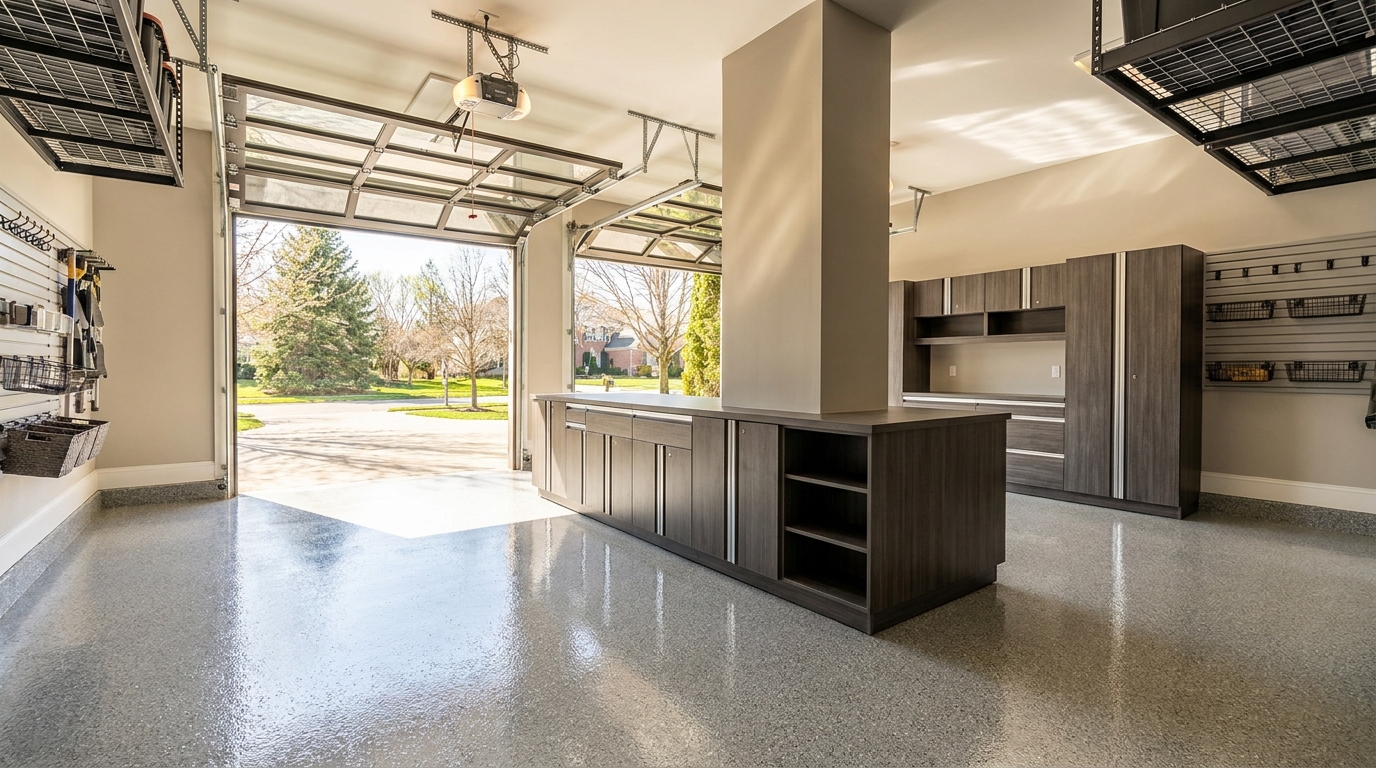
Walk into a garage in Waxhaw, Matthews, or north Mecklenburg that was specified as a single interior, and the first thing you notice is the quiet match. Warm wood-pattern doors sit over a tan and brown chip field. Navy cabinets sit over a cool granite blend. The floor is not a leftover surface under the cars. It is the largest color in the room, and it either supports the cabinets or fights them.
That is a design decision, not a leftover. The American Concrete Institute's current decorative concrete guide treats color, texture, overlays, sealers, and coatings as choices that affect the overall aesthetics of a project, not as afterthoughts once the slab is in place.[3] A coated garage floor is a large, continuous interior finish. It deserves the same coordination you would give a kitchen counter and cabinet door.
Our coordinated design visits start from that idea. We measure the bay, talk through how you use the space, and put cabinet finishes next to floor samples before anyone orders product. The 3D layout is useful, but the physical samples in your actual light are what tell the truth.
What a chip blend actually is
A chip blend is not a single paint color. It is a mix of colored vinyl chips, broadcast into a wet base coat, then locked under a clear top coat. The chips sit in the resin rather than sitting loose on top of it, and the pattern is random, which is why the floor reads more like stone than like a repeating tile.[4]
That mix is the point. One chip color is rarely the whole story. A blend named for granite or shoreline usually carries several hues at once: a light field, a mid-tone, and a darker accent. Your eye averages those chips from a few steps away, then sees individual flecks when you look down at the walking lane. Cabinet doors, by contrast, are a more even field of color. The room works when the floor's average tone sits near the cabinet finish, and when one or two chips in the blend pick up the door, the hardware, or the wall.
Chip size changes that reading. A larger chip shows more of each color and looks bolder next to a strong cabinet. A micro blend reads quieter and more even, closer to a fine granite. We carry both, including blends such as Saddletan, White Granite, Shoreline, Creekbed, Teton Greige, Dolphin Pearl, Marble, Cobalt Blue, Race Day Red, and the micro versions of Saddletan and Marble. On larger projects we can mix a custom blend against a cabinet sample or a paint chip you already like. Those names live on our garage flooring page because they are the library we actually install, not a generic chart.
The clear top coat is what makes the floor glossy. Gloss is not just "shiny." It is specular reflection: a direct bounce of the light source off the surface, mixed with the colored, diffuse reflection that carries the chip color.[5] That mix is why a sample board on a desk and the same blend under a finished top coat in a sunny bay do not look identical.
Pair the blend with the cabinet run, not with a photo
Cabinet finishes in our library run in three families: metal patterns such as Pewter, Bronze, and Silver Frost; wood patterns such as Breakwater, Fort, Ore, River Rock, Seared Brown, Timber Gray, and Warm Sand; and solids such as Charcoal, Slate, London Gray, Black, White, Antique White, Navy, and Cobalt Blue. Hardware can land in brushed chrome, black, or oil-rubbed bronze. Those options are on our garage cabinets page, and they are the colors we hold in our hands next to floor chips.
A few pairings we see work in Charlotte homes:
- Warm wood patterns (Seared Brown, Warm Sand, Fort) sit naturally over Saddletan, Creekbed, or Teton Greige. The floor should carry tan, brown, and a little gray, not a cold white field that makes the doors look yellow.
- Cool solids (Slate, London Gray, Charcoal, Black) sit well over White Granite, Marble, Dolphin Pearl, or Shoreline. The floor can be lighter than the doors. That contrast keeps a dark cabinet run from swallowing the bay.
- Navy or Cobalt Blue cabinets can share a family with a Cobalt Blue chip blend, or they can sit over a quiet granite so the color lives in the doors, not in every square foot of floor. A whole-room cobalt floor plus cobalt cabinets can feel louder than the photos suggest, especially when the door is open to afternoon sun.
- Metal-pattern doors (Pewter, Silver Frost) like a blend with a silver or gray fleck, not a heavy brown field that turns the metal look muddy.
None of those pairings is a rule you have to obey. They are starting points. The real test is the cabinet door sample standing on the actual slab, next to a chip board, with the garage door open and the shop lights on. A coating and a cabinet finish are different materials. Two surfaces can look matched under one light and drift apart under another, which is the classic metamerism problem color labs watch for when a coating and a plastic or laminate part are supposed to live in the same room.[6]
That is why we do not pick a floor from a printed card after the cabinets have already been ordered. Printed cards are approximations. Lighting, gloss, texture, and the size of the area all shift how a blend reads, which is why coating manufacturers warn that a color card is not the finished floor.[4][7]
How light on a glossy floor changes the look
A garage is a hard lighting room. You get three different sources in a single afternoon: the shop lights, the daylight through an open overhead door, and the bounce off cars and cabinet faces. Each one changes what you see.
Object color depends on which wavelengths the material absorbs or reflects. Daylight is a broad spectrum. Many LED lamps, including the ones already in a lot of Charlotte garages, have a spikier spectrum, which means they carry fewer hues and give your eye less information about the chips and the doors.[1] The color appearance of objects under artificial lighting is one of the main reasons lighting labs still spend so much time on color rendering. ANSI/IES TM-30 exists specifically to evaluate how a light source will render object colors, and to help people choose a source they will actually prefer in a real interior.[2][8]
Gloss adds a second layer. Because a glossy floor reflects the light source itself, a bright rectangle of sky in an open door becomes a moving highlight on the coating. As you walk, that highlight slides. Research on color and gloss under varied lighting found that people are fairly stable on hue, but gloss constancy is particularly poor. The same physical gloss can look more or less shiny when the lighting environment changes.[5] In a garage, that is not a lab curiosity. It is the difference between a floor that looks rich at 10 a.m. with the door up and a floor that looks darker and more mirror-like at night under a single LED shop fixture.
Color temperature of the lamps matters too. Cooler light can make a room feel cooler. Warmer light can make wood tones and tans feel richer. Lighting practice even treats "match room finishes" as a reason to tune white light rather than treating lamp color as an afterthought.[9] If your garage already has 5000 K "daylight" LEDs, a warm Saddletan blend and a Warm Sand cabinet will look cooler and grayer than they did in a showroom under 3000 K lamps. If you plan to keep those fixtures, we should pick the blend under that light, not under a different one.
Oversaturation is a trap in the other direction. A light source that pushes chroma too far can make finishes look cartoonish. A source that undersaturates can make a carefully chosen palette look drab and grayed-out.[9] A chip blend already contains several hues. A lamp that exaggerates the red chips in a brown blend, or that flattens the gray chips in a granite blend, will pull the floor away from the cabinets even if both products were "right" on paper.
There is also geometric metamerism: a match that fails when the viewing angle or the illumination angle changes, especially on textured or metallic surfaces.[6] A flake floor is both glossy and textured. Stand at the threshold and the blend averages out. Crouch near a cabinet toe-kick and you see individual chips plus a stripe of reflected light. If the cabinet door was chosen under a desk lamp at 45 degrees, and the floor is judged from standing height with the overhead door open, you are not looking at the same color event.
Choose the palette in the bay you will live with
The practical method is simple, and it is the opposite of picking a floor last.
First, stand in the garage at the time of day you actually use it. Leave the overhead door the way you usually leave it. Turn the shop lights on and off. Notice whether the bay is north-facing and cooler, or south and west-facing and full of late-day sun. Union County and south Charlotte homes with long afternoon light will push a glossy floor harder than a shaded Huntersville side-load bay.
Second, put a cabinet door sample and a chip board on the slab together. Look from the house door, from the driveway, and from a crouch at cabinet height. If you already have a kitchen or laundry finish you want the garage to echo, bring that sample too. Different pigments in different materials are exactly when metamerism shows up.[6]
Third, decide how much movement you want in the floor. A bold Cobalt or Race Day Red blend is a statement. It can look wonderful under the right cabinet, and it can dominate a quiet gray door. A micro granite blend recedes and lets the cabinet run be the color. Neither is wrong. They are different rooms.
Fourth, remember that the top coat will raise the gloss and deepen the chips. A dry chip board is a starting point. The finished coating is the product you will live with. ACI's decorative work is explicit that sealers, coatings, and other treatments belong in the aesthetic conversation, not only in the durability conversation.[3]
Fifth, lock the pair before either product is built. Cabinets have lead time. Floors have a prep and coating sequence. If the floor is chosen after the cabinets are already in production, you are matching to a decision you can no longer change. That is how garages end up with a handsome cabinet run sitting on a floor that almost works.
Practical takeaways
- Specify the garage floor chip blend and the cabinet finish as one palette, in the garage, under the lights and daylight you actually have.
- Treat the floor as a mix of several chip colors, not as a single paint chip. Match the average tone to the doors, then check that one accent chip agrees with the hardware or the wall.
- Expect a glossy top coat to change the look. Specular highlights from an open door and from shop lights are part of the finished room, not a defect.[5]
- Do not trust a match that you have only seen under one lamp. A coating and a cabinet finish can agree in daylight and drift under a warm or cool LED.[6]
- Use the 3D layout to confirm the run of cabinets and the field of floor. Use physical samples to confirm color.
- If you already love a cabinet finish, bring that sample to the flooring conversation. Custom chip blends exist for a reason.
How we can help
We design Charlotte-area garages as finished rooms: cabinets, floor coating, and the rest of the storage system as one plan. On a typical visit we measure the bay, set cabinet finishes next to chip boards in your light, and show you a 3D layout before anything is ordered. Have more questions or want to get in touch? Contact our team and we will walk the space with you.
Citations
- National Institute of Standards and Technology, "A Standard for Lighting Color Preference?" (2017-03-10, page updated 2025-02-03)
- U.S. Department of Energy, "TM-30 Frequently Asked Questions" (2026)
- American Concrete Institute, "ACI/ASCC PRC-310-25: Decorative Concrete Guide" (2025-03)
- Sherwin-Williams High Performance Flooring, "Epoxy Flake and Epoxy Chip Flooring" (accessed 2026-08-25)
- Morimoto et al., Journal of Vision, "Color and gloss constancy under diverse lighting environments" (2023-07-11)
- Konica Minolta Sensing, "Lighting, Standard Illuminants, Metamerism and Colour Inconstancy" (2026-06-02)
- Sherwin-Williams High Performance Flooring, "Deco Flake – 1/8\" Flake Color Card" (2026-04)
- National Institute of Standards and Technology, "Color rendering of light sources" (updated 2022-02-17)
- U.S. Department of Energy, "Understanding LED Color-Tunable Products" (accessed 2026-08-25)