A Battery Charging Drawer in the Cabinet Run for Packs and Tools
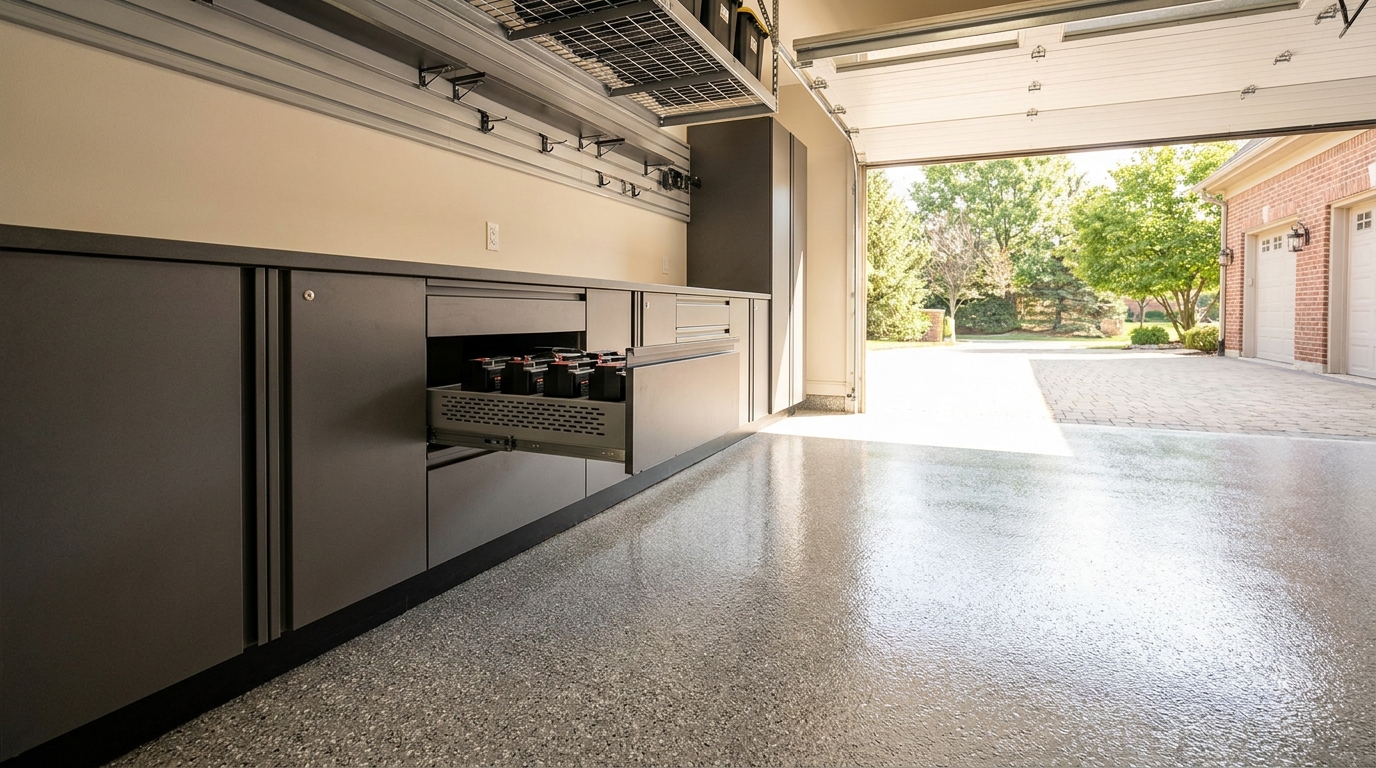
A garage battery charging drawer is a ventilated, outlet-fed drawer (or a dedicated charging cubby) built into the cabinet run so 18V, 20V, and 40V tool packs and their chargers live behind a finished face. The workbench stays a work surface. The wall still looks like furniture. In a Charlotte, Waxhaw, or Monroe garage, our team designs that millwork around a circuit a licensed electrician installs. It is not a fastener drawer, and it is not an EV charging stall.
The finished look of a charging drawer
Picture the working wall of a two-car garage in south Charlotte or Union County. Cabinets run from the house door toward the overhead door. One drawer in that run has the same heat-fused laminated face, the same edge profile, and the same hardware as every door beside it. You open it and the chargers are docked, the packs stand in a row, and the cords are managed inside the box. You close it and the wall is furniture again.
That is the design decision. Packs and chargers belong in a module that was drawn with the rest of the run, not on the maple or stainless worktop, and not in a mixed drawer with bits and screws. Our garage cabinets use heat-fused laminated melamine, Signature Series 3/4-inch doors, drawer fronts, and side panels, and a finish library that includes metal patterns, wood patterns, and solids. The charging drawer uses that same door style so it does not read as a different product.
A dedicated cubby is the other finished version of the same idea: a shallow opening in the run, chargers on a shelf, a matching door or an open face that still lines up with the adjacent boxes. Either way, the workbench remains the landing for the project. Our garage workbench cabinets post is about that landing. This drawer is the charging zone that keeps those chargers off it.
Distinct from fastener drawers and from an EV stall
Drawer banks for fasteners, bits, and measuring tools are storage. A charging drawer is storage plus a listed receptacle and a planned air path. Mixing those two jobs in one box is the wrong furniture. DeWalt's 2024 charger manual is direct about metal in a drawer: do not store, carry, or transport a pack so that nails, screws, keys, coins, or hand tools can contact exposed terminals [11]. A dedicated charging drawer keeps the packs with their chargers. The fastener stack stays next to it, in its own full-extension boxes.
An EV charging stall is a different circuit and a different piece of equipment. The 2024 International Residential Code requires each outlet installed to supply electric vehicle supply equipment greater than 16 amperes or 120 volts to be on an individual branch circuit, and it treats those charging loads as continuous [2]. That is Level 2 EVSE in a parking bay. A garage battery charging drawer feeds 18V, 20V, and 40V tool chargers on a 120-volt receptacle. We keep those two ideas on separate drawings so a car charger never borrows the millwork we built for packs.
In-drawer outlets, listed hardware, and GFCI
Electrical work is by a licensed electrician. We design the millwork around the circuit: drawer depth, cable travel, ventilation openings, and a face that matches the run. The electrician selects listed devices and applies the code the jurisdiction has adopted.
Garage receptacles need ground-fault circuit-interrupter protection. The 2021 IRC, section E3902.2, requires GFCI protection for 125-volt through 250-volt receptacles installed in garages and in grade-level unfinished accessory buildings used for storage or work, on single-phase branch circuits rated 150 volts or less to ground [1]. The 2024 IRC keeps that garage GFCI rule and requires the GFCI device itself to sit in a readily accessible location [3]. Protection can live at the breaker, at an upstream receptacle, or at a listed device the listing allows in that furniture. The reset stays reachable after the cabinets are in.
The parking bays still keep their own outlets. The 2021 IRC requires not less than one receptacle outlet, in addition to any provided for specific equipment, in each vehicle bay, not more than 5.5 feet above the floor [1]. Receptacles located within cabinets or cupboards do not count as those required outlets [1]. The charging drawer is extra power for the packs. It does not steal the bay receptacle, and a cabinet toe-kick does not cover it.
The 2024 IRC also requires at least one 120-volt, 20-ampere branch circuit to supply the garage receptacle outlets required by E3901.9. That circuit shall not have other outlets, with limited exceptions [2]. A licensed electrician decides whether the charging drawer rides on that required garage circuit, on an additional receptacle circuit, or on an individual branch circuit of its own. We locate the box during the design visit so the millwork leaves it accessible.
The device in the drawer has to be listed for the way it is used. UL Solutions describes furniture power distribution units as indoor assemblies, rated 250 V AC or less and 20 A or less, secured to a furnishing, with a cord and plug meant to connect to a permanently installed branch-circuit receptacle. The U.S. standard used to investigate those products is UL 962A, and the receptacle outlets on an FPDU must comply with UL 498 or be additionally evaluated [5]. Hard-wired pop-up and countertop assemblies follow a different listing path (UL 498, and UL 943 when they include GFCI) under NEC 406.5(E) [6]. The 2021 IRC requires receptacle assemblies in countertops and work surfaces to be listed for that application [4]. A moving drawer is not a kitchen counter, and a hardware-store power strip is not an FPDU. The electrician specifies a listed in-drawer outlet or cubby receptacle, with cord management rated for the open-and-close cycle, on a GFCI-protected garage circuit. We leave space in the box for that listed hardware.
Ventilation is part of the furniture
Chargers make heat. DeWalt's 2024 DCB1106 instruction manual says the charger and pack may become warm to the touch while charging, and that this is a normal condition. Do not place any object on top of the charger or set it on a soft surface that might block the ventilation slots. The charger is ventilated through slots in the top and the bottom of the housing. On fan-cooled models, never operate the charger if the fan does not run or if those slots are blocked [11]. Milwaukee's 2018 charger manual is equally plain: charge in a well ventilated area, and do not block charger vents [12].
NFPA's consumer lithium-ion guidance says to charge on a hard surface, not under a pillow, on a bed, or on a couch where fabric can trap heat. Keep batteries at room temperature when possible. Do not charge them below 32°F (0°C) or above 105°F (40°C). Store batteries away from anything that can catch fire. Stop charging once the pack is full, and use only the charging equipment that came with the device or that the manufacturer has approved [7][8]. OSHA's 2019 Safety and Health Information Bulletin on small lithium battery devices (dated here because it is older than two years) adds the same habits: follow the manufacturer's instructions, use chargers tested to a standard such as UL 2054 and, where applicable, certified by a nationally recognized testing laboratory, store packs in dry, cool locations, and remove them from the charger once they are fully charged. That bulletin also flags charging below freezing [15].
Those sentences are the cutout, not a leftover gap. We design the charging drawer so air can enter, pass across the charger housings, and leave: a slotted or louvered back, a raised charger shelf that keeps the bottom vents open, side gaps that do not show from the room, and no rags or paper packed around the housings. A dedicated cubby with an open or louvered face does the same work with fewer moving parts. Decorative grille strips in a matching laminate keep that path looking like cabinetry.
Charlotte weather is why the air path matters. NOAA's 1991-2020 normals for Charlotte Douglas International Airport put July's average daily high at 90.3°F and January's average daily low at 31.8°F [13][14]. An unconditioned garage follows those swings. DeWalt specifies the longest life when the pack is charged with air between 65°F and 75°F, and it warns not to store or use the tool and pack where the temperature may reach or exceed 104°F [11]. Milwaukee tells you not to store a pack where temperatures may exceed 120°F, and its charger waits until a hot or cold pack is back in range [12]. A ventilated drawer on a side wall, off the slab and out of the sun stripe from the overhead door, is the furniture version of those instructions. Follow the manual for the charger you actually own.
Packs live in the run, off the floor
The charging drawer also gives packs a home when they are not on a charger. EPA's consumer guidance is to store lithium-ion batteries at room temperature, not in a refrigerator, and to avoid long periods of extreme cold or heat. Long exposure to those temperatures can damage the battery [9]. EPA notes that rechargeable lithium-ion cells are commonly found in power tools, and that packs which come off the tool should go to a battery recycler or household hazardous waste program at end of life, not into household trash or the curbside recycling bin [10]. NFPA's 2025 Fire Prevention Week materials make the same recycle point [8].
Off the floor is a design choice. The slab in a Charlotte garage sees wet shoes, a hose, and the occasional storm that backs up at the overhead door. A pack in a dedicated drawer is in a dry box, at a height you actually use, behind a face that can take a lock if you want one. Our cabinet line offers lock-and-key options on configurations that hold things you want available but out of easy reach. A charging drawer can take the same hardware.
Keep that box dedicated. DeWalt's fire-hazard note about coins, keys, and nails in a drawer is about shorted terminals [11]. Milwaukee tells you a pack will short if a metal object bridges the contacts [12]. Fastener drawers stay fastener drawers. The charging drawer holds chargers, packs, and the listed outlet. Damaged, swollen, or leaking packs do not belong in either one. NFPA says to stop using a battery that shows odor, a change in color, too much heat, a change in shape, leaking, or odd noises, and, if it is safe, to move it away from anything that can catch fire [7][8]. EPA's swollen-battery advice is to store the unit away from flammable materials until you have a disposal path [9]. That is a quarantine, not a cabinet accessory.
Matching fronts so the wall still looks like furniture
The furniture look comes from the face, not from the chargers. Signature Series uses 1-inch melamine tops, bottoms, and fully adjustable shelves, with 3/4-inch doors, drawer fronts, and side panels. Heat-fused laminate resists scratches, oil, and impact better than painted MDF or stained wood. Hardware is brushed chrome, black powder coat, or oil-rubbed bronze, the same three finishes as the rest of the run. Full-extension stainless steel roller-bearing glides are standard, with optional soft-close slides, so a loaded charging drawer opens all the way and the back row of packs is as usable as the front.
Fillers and alignment do quiet work. The charging drawer lines up with the drawer bank beside it. The reveal matches. The toe-kick is continuous. If we use a cubby, the door is the same style as the locker doors, or the open face is trimmed so you see a planned opening. Wall-mounted boxes with optional legs keep the floor clear for cleaning and keep the charging zone off the damp line at the slab. We leave headroom above the charger housings so the top vents stay open.
How we plan the drawer with the rest of the run
Our process starts in the garage. We measure the wall, the ceiling height, the door clearances, and the outlet locations. We note which stall you park in and where a charging drawer can sit without crowding a car door or a walking path. Then we draw the charging module as one box in the cabinet run: drawer size, fillers, ventilation openings, the listed outlet, and the path back to a GFCI-protected circuit.
You see that layout in a 3D rendering before anything is built. The drawer's front matches the rest of the heat-fused laminated cabinetry. The ventilation openings are drawn as design, not as a leftover gap. That is the same discipline as our coordinated design work. The charging drawer is one zone in a room that also has a work surface, slatwall, overhead racks, and a finished floor. Manufacturing is in the United States. Install is our local crew, typically one to two days on site once the cabinets arrive. Signature Series boxes and finishes carry a lifetime warranty. Classic Series carries a seven-year limited warranty. Both transfer with the home.
Practical takeaways
- Treat the charging zone as a module in the cabinet run, with a matching drawer front or cubby door, so packs and chargers live behind a finished face and the workbench stays a work surface.
- Keep this drawer distinct from fastener and bit drawers, and from an EV stall. Do not store packs with loose metal that can bridge the terminals [11][12]. Level 2 EVSE greater than 16 amperes or 120 volts needs its own individual branch circuit [2].
- Have a licensed electrician install listed in-drawer or cubby devices (UL 962A furniture power distribution units or other listings that match the application) on a GFCI-protected garage circuit, with the GFCI reset readily accessible [1][3][5]. Bay outlets stay in each vehicle bay [1].
- Design ventilation into the box so charger vents stay open [11][12]. Charge at room temperature when you can. NFPA's 2025 tips say not to charge below 32°F or above 105°F. DeWalt's 2024 manual prefers 65°F to 75°F and warns against storage or use at or above 104°F [8][11]. Charlotte's 1991-2020 July high (90.3°F) and January low (31.8°F) are why an unconditioned garage needs that air path [13][14].
- Store spare packs in the same dedicated drawer, off the slab, away from anything that can catch fire [7][9]. Recycle spent power-tool packs at a battery drop-off, not in household trash [10].
- Match drawer fronts, hardware, and fillers to the rest of the heat-fused laminated run so the charging zone reads as furniture.
How we can help
Our team designs the charging drawer as part of the cabinet run, then builds the millwork around a circuit a licensed electrician installs. Have more questions or want to get in touch? Visit our contact page and we will measure the wall, mark the outlets, and show you how packs and chargers can sit behind a finished face in a Charlotte, Waxhaw, or Monroe garage.
Citations
- International Code Council, "2021 International Residential Code, Chapter 39 Power and Lighting Distribution" (2021)
- International Code Council, "2024 International Residential Code, Chapter 37 Branch Circuit and Feeder Requirements" (2024)
- International Code Council, "2024 International Residential Code, Chapter 39 Power and Lighting Distribution" (2024)
- International Code Council, "2021 International Residential Code, Chapter 40 Devices and Luminaires" (2021)
- UL Solutions, "Power Strips Testing and Certification" (Furniture power distribution units / UL 962A)
- UL Solutions, "Pop-up Receptacle Assemblies for Kitchen Countertops" (NEC 406.5 / UL 498 / UL 962A)
- National Fire Protection Association, "Lithium-Ion Battery Safety"
- National Fire Protection Association, "Lithium-Ion Battery Safety" tip sheet (2025)
- U.S. Environmental Protection Agency, "Frequent Questions on Lithium-Ion Batteries" (updated 2026-04-14)
- U.S. Environmental Protection Agency, "Used Lithium-Ion Batteries" (updated 2026-03-20)
- DeWalt, "DCB1106 12V/20V Max/FLEXVOLT 6 Amp Charger Instruction Manual" (APR24, copyright 2019, 2024)
- Milwaukee Tool, "48-59-2818 Li-Ion/NiCd Battery Charger Operator's Manual" (document dated in source as 2018)
- National Weather Service, Greenville-Spartanburg, "Charlotte NC Climatological Data, July Daily Normals 1991-2020"
- National Weather Service, Greenville-Spartanburg, "Charlotte NC Climatological Data, January Daily Normals 1991-2020"
- Occupational Safety and Health Administration, "Preventing Fire and/or Explosion Injury from Small and Wearable Lithium Battery Powered Devices" (SHIB 06-20-2019)