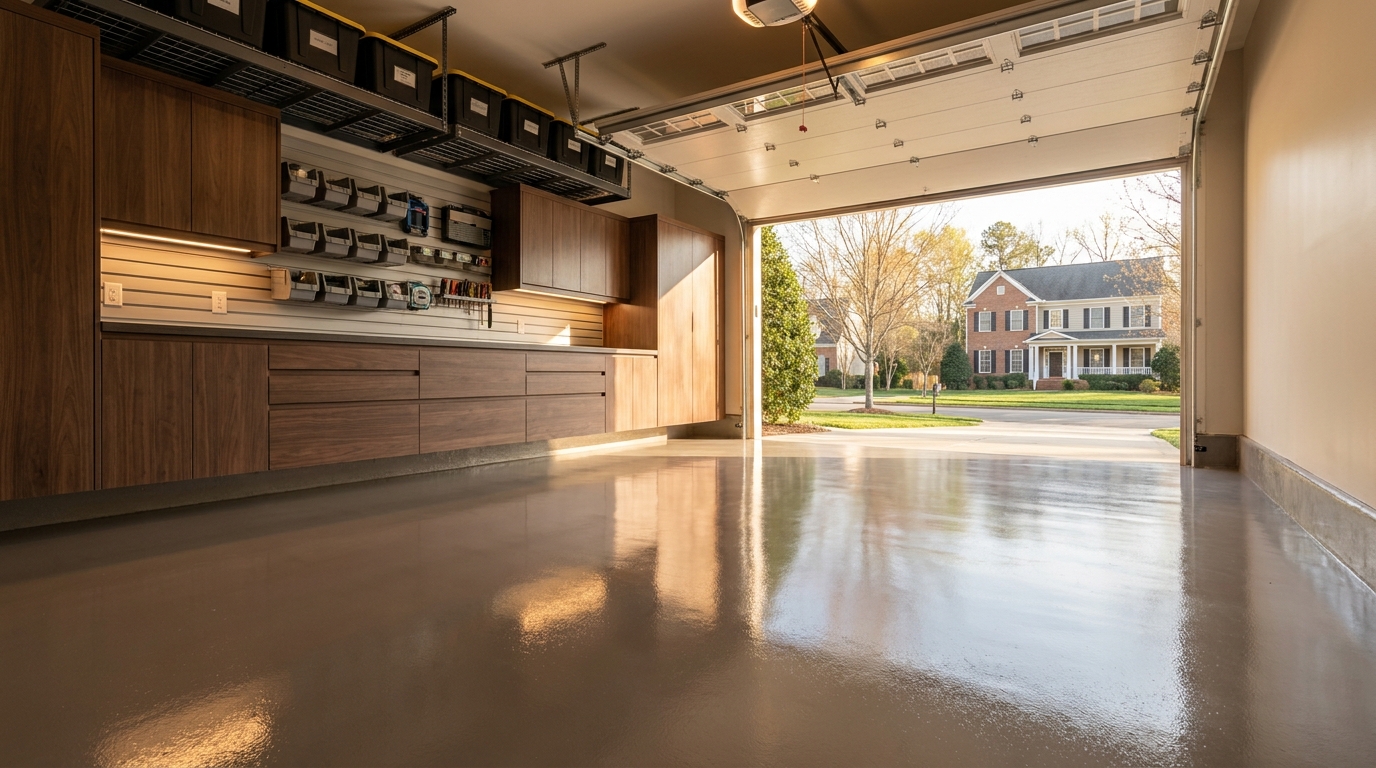
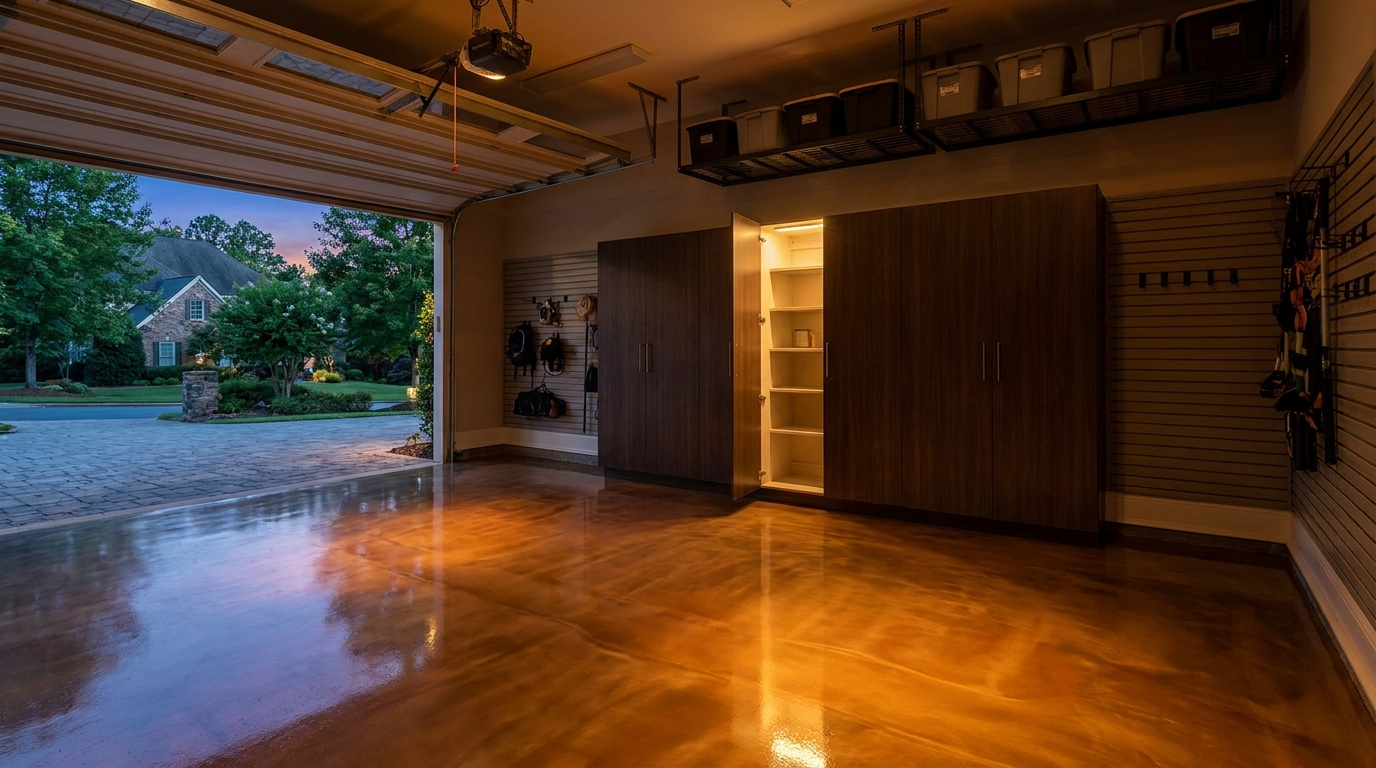
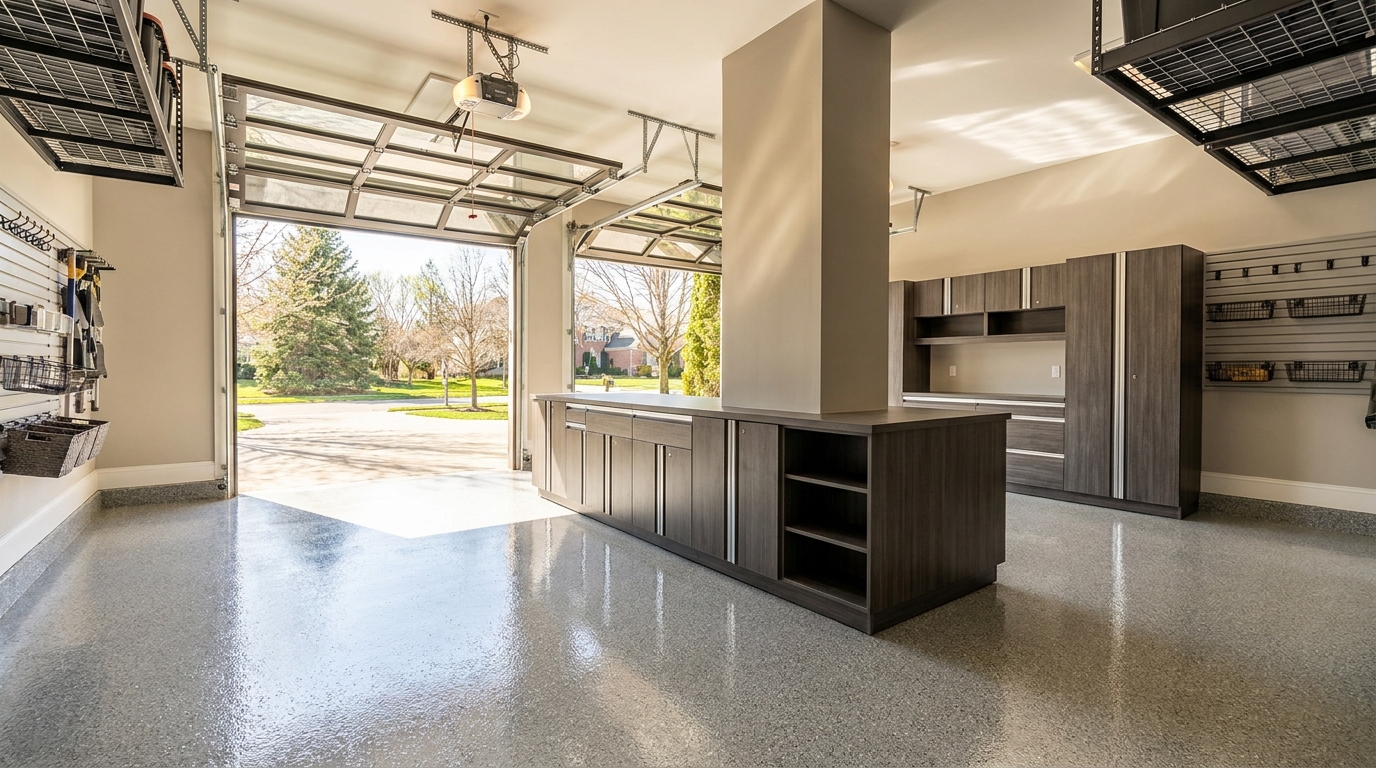
Hot Tire Resistant Garage Floor: Why Coatings Peel
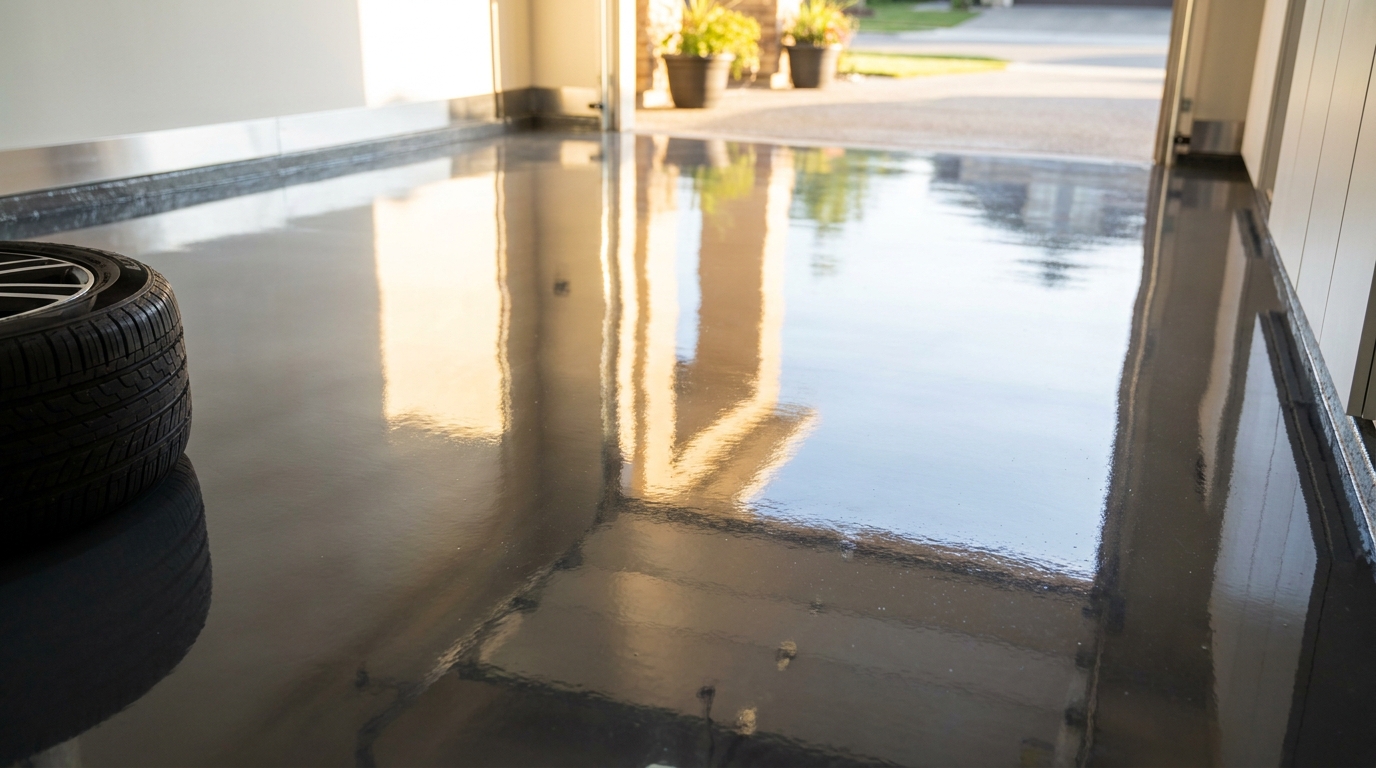
Hot-tire peel is not a random defect. It is heat plus parked weight hitting a film that never had a strong mechanical bond to the slab. After a summer drive, the rubber is warm, the same parking spots take the load every day, and a thin DIY coat can soften, stick, and lift. A hot tire resistant garage floor is not a thicker paint. It is a prepped concrete surface, a primer that locks into that profile, and a top coat meant to stay put when the tires come in hot.
Charlotte makes that test more common than people expect. Official 1991 to 2020 climate normals for Charlotte Douglas International Airport put the typical July high at 90.3 degrees Fahrenheit, with about 18 July days at or above 90 degrees. August still averages an 88.6 degree high and about 13 to 14 days at or above 90.[1][2] Air temperature is only the start. Dark pavement in the sun runs much hotter than the air above it, and that heat rides into the garage on the tires.[3][4]
What hot-tire pickup actually is
Homeowners usually notice it the same way. You back out and see a pale, ragged patch where the coating used to be. Sometimes a flake is still stuck to the tread. Sometimes the film is still on the floor but has wrinkled, printed a tire pattern, or lifted at the parking-spot edges.
The industry name for that failure is hot-tire pickup (or hot-tire resistance when a product is tested against it). It is common enough that Green Seal's GS-11 standard for paints, coatings, stains, and sealers treats it as a required performance check for floor coatings that will see tire traffic. The 2021 edition (with corrections issued in January 2023) says those products must show no loss of adhesion at 140 degrees Fahrenheit, under a force that matches the marketed use.[5]
That 140 degree number is a lab condition, not a promise about your particular car. It names the real stress: a warm, loaded tire sitting still. Highway flexing, braking, and a sun-baked street all add heat to the rubber. When you park, that heat and weight sit on one small area of the film. If the coating is already soft, thin, or poorly bonded, the tire can grab it.
Pickup is different from ordinary wear. Wear thins a film over years. Pickup is a bond failure. The coating leaves the concrete in sheets or patches, usually in the same two rectangles you park in every day.
Charlotte heat is more than the air temperature
A garage floor does not live at the airport thermometer reading. The slab, the driveway, and the street each have their own surface temperatures.
The U.S. Environmental Protection Agency notes that hard urban surfaces such as roads, parking lots, and roofs absorb and re-emit the sun's heat more than trees or water. In U.S. cities, that heat-island effect typically raises daytime air temperatures about 1 to 7 degrees Fahrenheit above nearby outlying areas, and nighttime air about 2 to 5 degrees.[6] Surface temperatures move even more. EPA summarizes a 2021 City of Phoenix and Arizona State University pilot in which conventional asphalt reached as high as 152 degrees Fahrenheit at mid-day.[3] That study is Arizona pavement, not a Charlotte garage, but the mechanism is the same: dark paving soaks up sunlight and gets much hotter than the air.
Lawrence Berkeley National Laboratory's Heat Island Group puts the absorption in plain terms. Dark pavements absorb about 80 to 95 percent of sunlight. In one thermal image they publish, a light pavement segment ran about 30 degrees Fahrenheit cooler than a dark segment next to it.[4]
On a typical Charlotte afternoon the official July high is already around 90 degrees.[1] The street and driveway can run far hotter in the sun. The tires roll on that surface, then onto your slab. If the garage door is open, sun also hits the first several feet of the floor. An unconditioned garage holds that heat. The coating then has to stay bonded while warm rubber sits on it for hours. That is why peel shows up in July and August more than in January. The chemistry of a cheap film does not suddenly change in summer. The heat load does.
Why a thin DIY coat fails first
Most box-store kits are one or two thin coats rolled onto whatever the slab looks like that Saturday. They can look fine for a season, then a hot week and a daily parking pattern pull them apart.
Several things stack against a thin DIY coat.
There is often no real surface profile. Concrete that has been troweled, painted, or left with laitance (the weak, dusty skin on a slab) is a poor glue surface. Industry practice for bonded coatings is to create a mechanical profile, then verify it. ICRI Guideline 310.2R describes Concrete Surface Profile (CSP) chips used to judge that roughness. Grinding is the method associated with a CSP 2 profile, which is a light, uniform scratch pattern rather than a slick surface.[7] Skip that step and the film is sitting on dust, old paint, or a glassy trowel finish. Heat and shear then peel it.
A thin film has little thermal mass. A light coat warms quickly when a hot tire lands on it. If the resin also softens as it warms, the tire can print into it or stick to it. A professional system is still a coating, not a tile, but it is built in layers (primer plus body plus top coat) so the film that meets the tire is not a single skim.
The same two parking spots take the load every day. Hot-tire pickup is a fatigue problem as much as a one-day problem. The first pull may only print the tread. The twentieth pull starts a lift. The fiftieth pull takes a patch.
Prep shortcuts show up as peel. Oil, tire dressing, curing compound, and old paint all block adhesion. A degreaser and a broom do not replace grinding.
None of that means every epoxy product is doomed. It means a thin coat on an unopened slab is being asked to do a job it was never built for. A hot tire resistant garage floor starts with the concrete, not with the color chip.
Moisture under the film makes heat more destructive
Heat is the trigger people see. Moisture is often the weakness underneath.
The National Ready Mixed Concrete Association's CIP 28 practice sheet (published 2004, still posted by NRMCA) is blunt: slab moisture can cause bond-related failures of non-breathable floor coatings. Residual mixing water can take anywhere from about six weeks to a year or longer to leave a slab under ordinary conditions. Groundwater and vapor from damp soil can keep feeding the slab if drainage is poor or if there is no vapor retarder under it.[8]
A garage floor coating is, by design, a tight film. Once it is down, vapor that used to leave through the open concrete has fewer places to go. If the emission rate is high, pressure builds at the bond line. AMPP (the Association for Materials Protection and Performance, the coatings body formed from SSPC and NACE) calls moisture the most common issue that can compromise concrete and the coating on it. AMPP walks through the usual tests: the plastic-sheet check (ASTM D4263), calcium chloride vapor emission (ASTM F1869), and in-slab relative humidity probes (ASTM F2170). Visible condensation under a taped sheet is enough, AMPP notes, to put a coating at risk of failure.[9]
CIP 28 adds that manufacturers often want moisture vapor emission in a range of about 3 to 5 pounds per 1,000 square feet per 24 hours on the calcium chloride test, and that in-slab relative humidity in the 75 to 80 percent range is a common target before moisture-sensitive coverings go down.[8] Those numbers belong to the test methods and the coating manufacturer's instructions, not to a guess on your slab. The homeowner takeaway is simpler: a wet slab plus a tight film plus a hot tire is a stacked failure. The heat does not have to "melt" the coating if the bond is already being pushed off from below.
Charlotte humidity and summer storms do not help. A slab that sat open to weather during construction, a garage that floods at the door, or a house without a working vapor retarder under the slab can keep moisture in play years after the pour. A serious coating visit starts with the concrete, not with a color chart.
What a primer-plus-top-coat system is meant to resist
A professional garage coating is a system. The names on the cans matter less than what each layer is there to do.
The slab has to be opened. Diamond grinding removes paint, failed epoxy, and the weak surface paste. It leaves a profile the primer can key into. That is the mechanical half of adhesion. Without it, you are asking chemistry to glue a film to a dirty, smooth plate.
The primer is the bond layer. Its job is to wet the profile, lock into the concrete, and give the next layer something to grab. On our garage floor coating work, that primer is a tinted base coat rolled onto a diamond-ground slab after cracks and control joints are filled. The live process is four steps: grind, primer, decorative chip broadcast, then a clear top coat.
The top coat takes the abuse. Tires, UV through an open door, oil, and cleaners hit the top film first. A top coat is there so the primer does not have to be the wear surface. It is also where heat resistance and chemical resistance are supposed to live. Green Seal's 140 degree Fahrenheit check is aimed at this kind of traffic, not at a wall paint.[5]
The system should wear, not sheet off. A well-bonded coating, if it ever wears, should wear thin on the surface. It should not come up in the parking spots. When we talk about a hot tire resistant garage floor, that is the behavior we mean: the film stays attached when the rubber is warm and the car sits still.
We use polyurea base and top coats on the coating page, and on the broader flooring page we describe a polyurea or epoxy primer under a polyurea top coat. We will not pretend a brand name is magic. Chemistry helps, prep decides. The same pages are honest about DIY kits: they usually roll over an unprepped slab, and they peel.
A primer-plus-top-coat system is also meant to handle the quieter summer problems: UV through an open door, oil drips, and water at the threshold after a storm. Those are not hot-tire pickup, but they are why a single thin coat is a poor match for a working Charlotte garage.
How we evaluate a slab that already peeled
If the floor already failed, the question is not "which color hides it." The question is why it let go.
We look at the peel pattern first. Clean rectangles in the parking spots, with the rest of the floor still stuck, point to heat and load on a weak bond. Widespread bubbling or a film that lifts in random islands often points to moisture or contamination. Peeling from the garage-door threshold inward can be both: sun, weather, and the first place hot tires land.
We also look at what is under the film: old paint, a previous kit, a smooth trowel finish, or oil that wicked into the paste. If a prior coating is already failing, we do not coat over it. Our flooring and coating pages both say the same thing. We diamond grind to remove the old film first. If the existing coating shows peeling, hot tire pickup, or chemical damage, full removal is the path to a finish that lasts.
Moisture belongs in that visit. AMPP's advice is to use more than one test method and to follow the coating manufacturer's limits.[9] CIP 28 says to test the slab in conditions like the ones it will see in service, and not to treat a dry-looking surface as proof the slab is dry below.[8] We check cracks, spalling, prior coatings, and moisture before we recommend a system.
Practical takeaways
- Treat peel in the parking spots as a bond problem. If the film comes up on the tire, the coating lost adhesion. Painting over that patch will fail again.
- Do not judge a garage floor by air temperature. Charlotte's official July high is about 90 degrees, and paved surfaces in the sun run hotter than that.[1][3][4]
- A thin DIY coat fails for stacked reasons. No grind, no profile, no moisture check, and a film that is too thin to take repeated heat and load.
- Hot-tire resistance is a real test, not a slogan. Green Seal's GS-11 standard asks tire-traffic floor coatings to hold adhesion at 140 degrees Fahrenheit.[5] Ask what was tested, not only what was advertised.
- Moisture and heat work together. NRMCA and AMPP both treat slab moisture as a leading cause of coating bond failure.[8][9] A tight film on a damp slab is already under stress before the car comes home.
- Prep is the difference you cannot see in a product photo. ICRI's CSP scale exists because smoothness is the enemy of adhesion. Grinding is how a light, even profile is made on a residential slab.[7]
- If an old coating already picked up, remove it. Coating over a failed film leaves the weak layer in place.
- A primer-plus-top-coat system has jobs for each layer. Primer bonds. Top coat takes heat, UV, and chemicals. One rolled coat tries to do all three.
How we can help
Our team coats garage slabs across the Charlotte metro. On a typical visit we measure the floor, look at cracks and old coatings, and talk through how you use the bays. If a coating is the right call, the work follows the process on our garage floor coating page: diamond grinding, a primer base coat, a full decorative chip broadcast, and a clear top coat. That build is what we mean by a hot tire resistant garage floor: a system on a prepped slab, not a kit rolled over builder concrete.
If the existing film is already peeling, we grind it off. If tile is a better fit than a coating, we will say so.
Have more questions or want to get in touch? Visit our contact page.
Citations
- National Weather Service, Greenville-Spartanburg, "Charlotte NC Climatological Data, Daily Normals for Years 1991-2020, July" (1991-2020 normals)
- NOAA National Centers for Environmental Information, "U.S. Monthly Climate Normals (1991-2020), Charlotte Douglas AP, NC US (USW00013881)" (1991-2020)
- U.S. Environmental Protection Agency, "Using Cool Pavements to Reduce Heat Islands" (citing Middel et al. 2021 Phoenix / ASU study)
- Lawrence Berkeley National Laboratory, Heat Island Group, "Cool Pavements" (page current; dark-pavement absorption figures as published)
- Green Seal, "GS-11 Standard for Paints, Coatings, Stains, and Sealers, Edition 4.0, section 2.4.6 Hot Tire Resistance" (2021; corrections January 2023)
- U.S. Environmental Protection Agency, "What Are Heat Islands?" (page updated 2025)
- KTA-Tator, "Let's Talk Measuring Concrete Surface Profile" (ICRI Guideline 310.2R CSP chips; grinding as CSP 2)
- National Ready Mixed Concrete Association, "CIP 28 - Concrete Slab Moisture" (2004)
- AMPP (Association for Materials Protection and Performance), "Concrete moisture testing and mitigation" (accessed 2026)