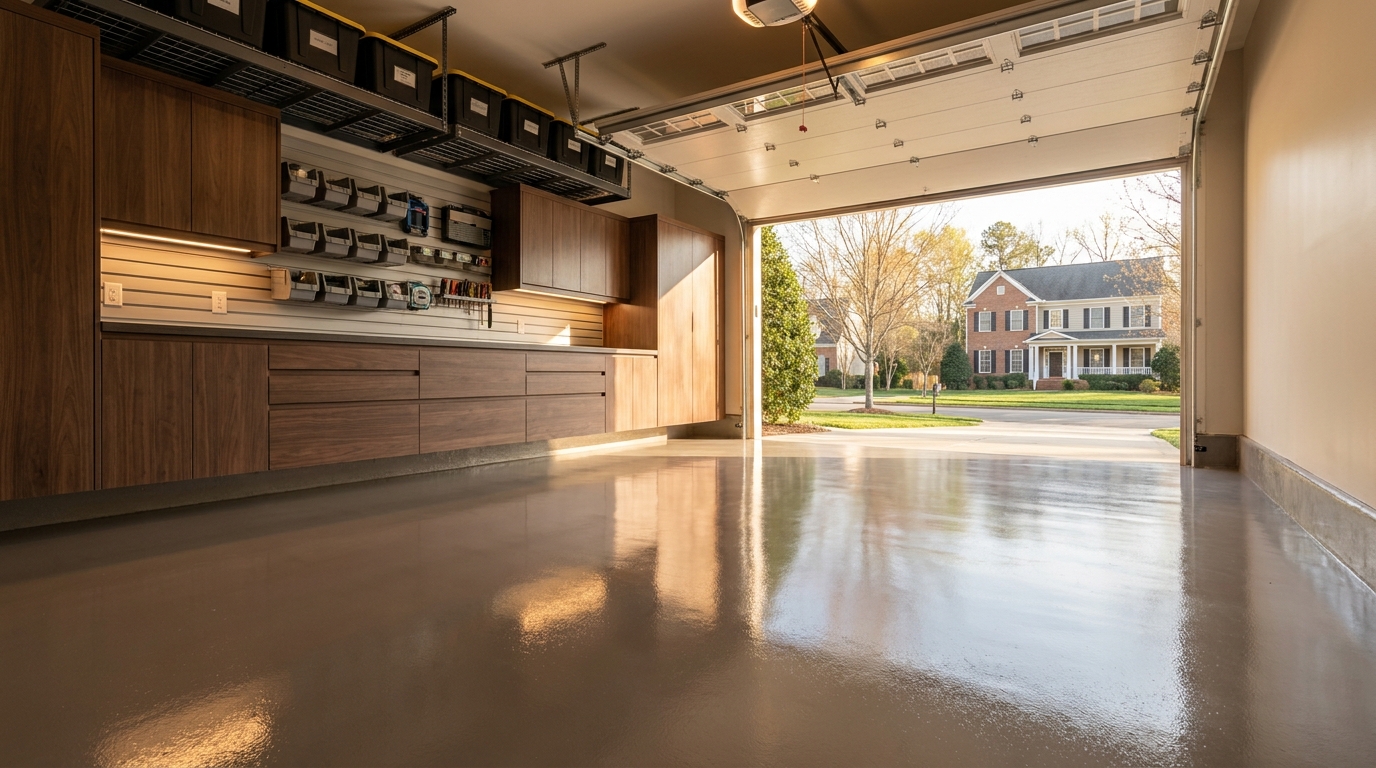
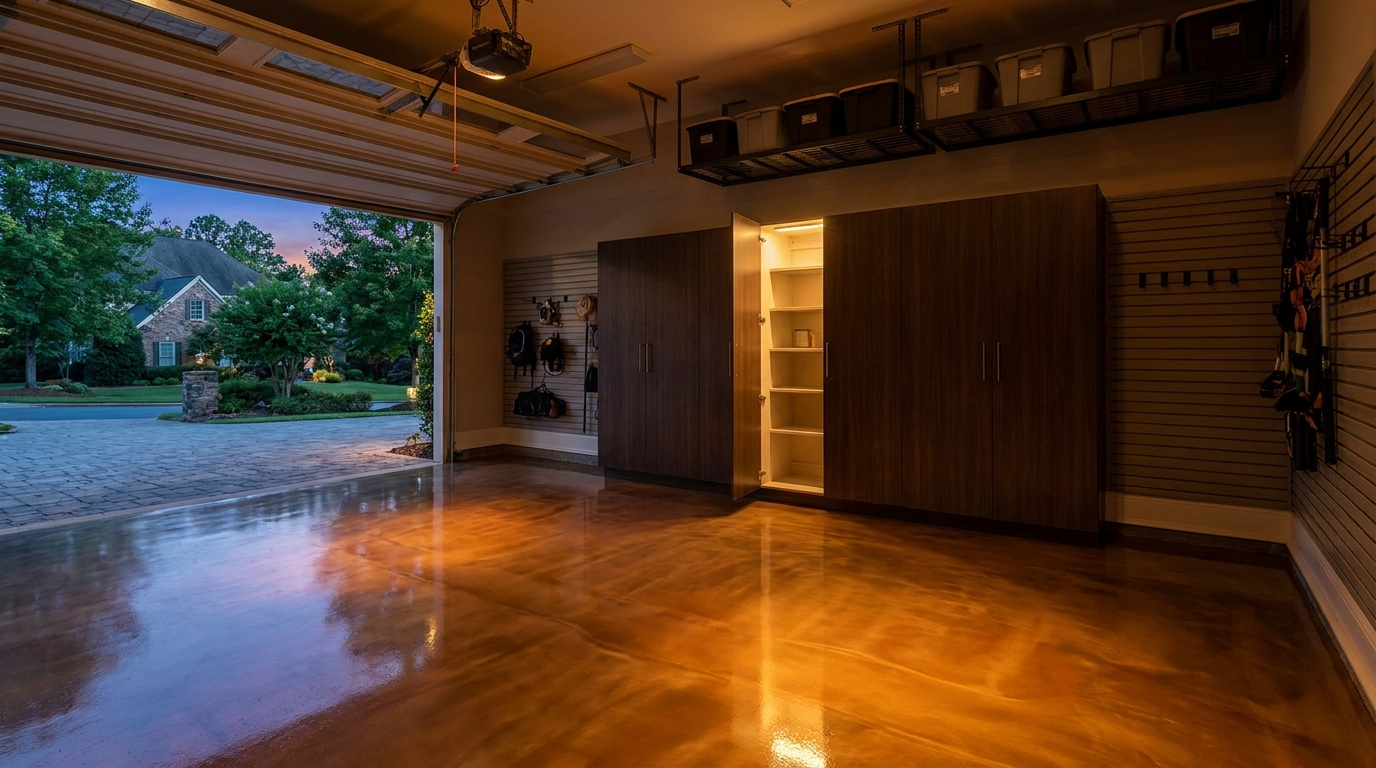
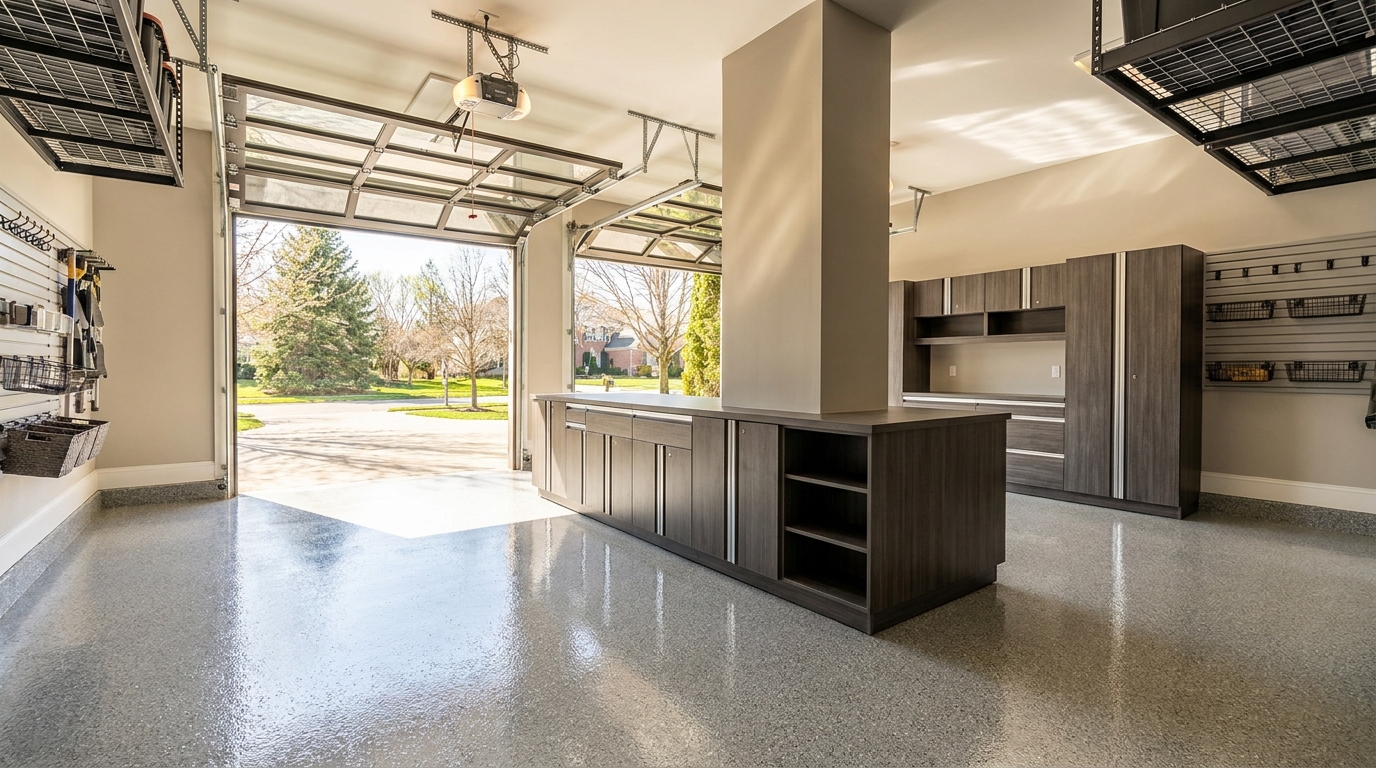
A Garage Floor That Keeps Its Color in Charlotte Afternoon Light
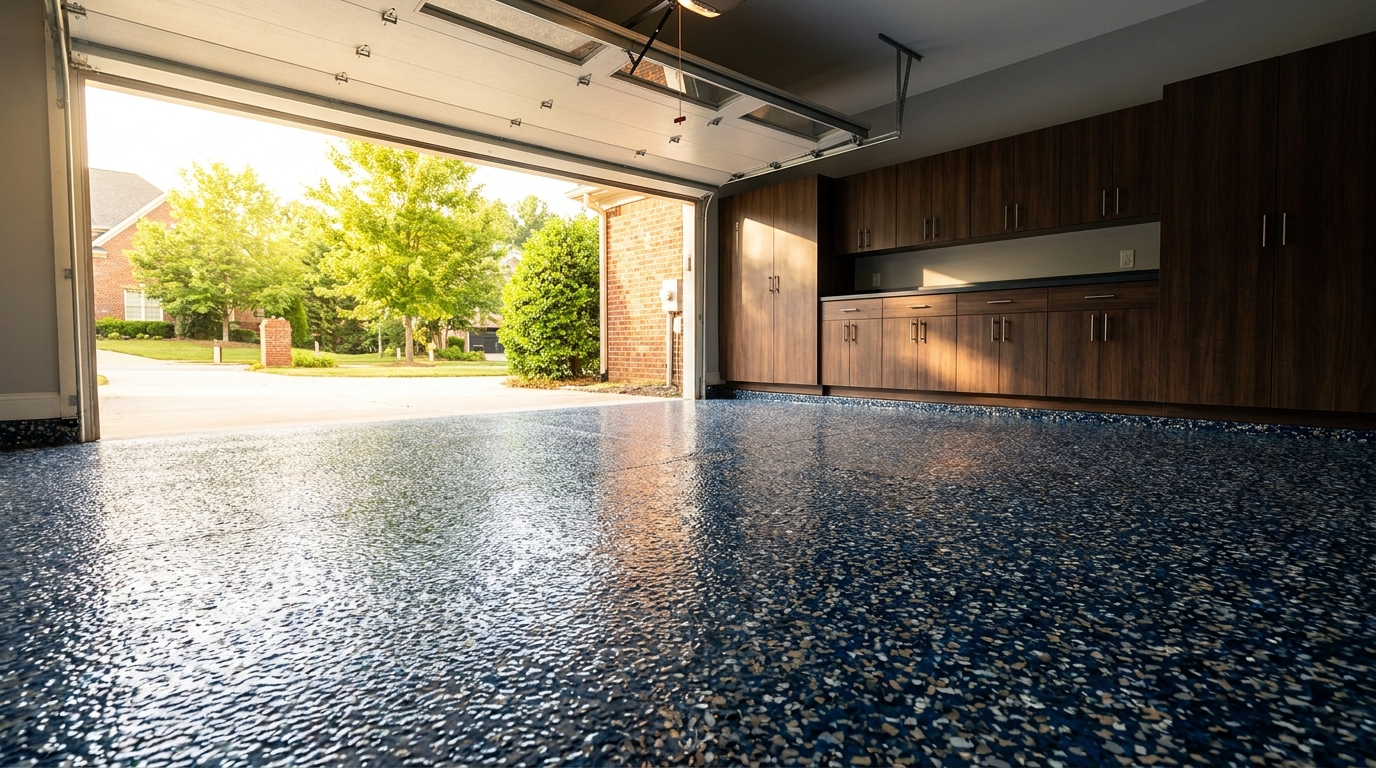
When a Charlotte garage door stands open on a bright afternoon, the light should land on the color you chose, the chip blend still reading as Saddletan or White Granite or Cobalt Blue, not as a film that has drifted. A UV stable garage floor is the design choice for a south-facing bay that lives with that door up: an aliphatic polyaspartic top coat over the decorative chip system, so the finished color holds in the same sun that makes the room feel complete. Charlotte gives that light a long season to work. NOAA's 1991-2020 climate normals for Charlotte Douglas Airport put the typical July high at 90.3°F, with about 49 days a year at or above 90°F. [1] The World Health Organization's UV Index measures the level of ultraviolet radiation from the sun, and the daily peak occurs in the four-hour window around solar noon, which, depending on location and daylight saving time, falls between noon and 2 p.m. [2] Early afternoon in an open bay is still inside that window. We specify the top coat for that light on purpose.
Design the floor for afternoon light
Our team starts with the finished picture, not with a product name. The door is up. A car is half in, half out. Someone is standing on the slab talking, or rolling a bin, or looking for a helmet. South and west light comes in low enough to rake the floor. That is the hour a garage either looks like a room or looks like leftover space.
In Mecklenburg and Union County, a lot of two-car and three-car bays face the drive, and a lot of those drives sit in the sun. Waxhaw, Monroe, Ballantyne, and south Charlotte streets do not hide a garage the way a north-facing alley might. If you keep the door open after lunch, the slab is in the weather even though it is still "inside." We treat that as a lighting condition to design for, the way a kitchen designer treats a window wall.
The color you pick is part of that lighting. A warm granite blend should still look warm in August. A cooler gray should still look cool in October, when the sun is lower and the door is still open on a Saturday. Our garage flooring page is built around that finished surface: diamond-ground prep, a bonded base, a full broadcast of decorative chips, and a clear top coat chosen so the blend you signed off on is the blend you keep seeing.
That is why we talk about a polyaspartic top coat as a design decision. It is the last film the sun hits. It is also the film you see. If the clear coat is the wrong chemistry for daylight, the whole room reads tired even if the cabinets and slatwall are new. If the clear coat is the right chemistry, afternoon light becomes an asset. The chips catch. The edges stay crisp. The bay looks like it belongs to the house.
Choose an aliphatic polyaspartic as the sun-facing coat
Polyaspartic is not a marketing nickname for "stronger paint." In coating specification language it is a two-component film based on a polyaspartic ester binder and an aliphatic polyisocyanate hardener. As it cures, it forms an aliphatic polyurea network. The British Coatings Federation's January 2026 guidance on protective coating technologies describes that network as combining the high gloss and sunlight and weather resistance of polyurethane topcoats with strong chemical and adhesion performance, at higher solids and with a cure that is less dependent on application temperature. [3] The same note treats 2-pack epoxy as the primer and first coat, not as the final finish, because epoxy coatings tend to degrade when they are left in direct sunlight. Standard practice is to overcoat them with a different topcoat technology. [3]
That split, primer versus weather-facing finish, is the design logic we bring to a Charlotte garage. Epoxy and related build coats can do useful work down on the slab: they wet into a diamond-ground surface, they hold a broadcast of chips, they help the system read as one field of color. They are not the coat we want sitting in the open-door sun. A 2021 National Institute of Standards and Technology study of an amine-cured epoxy (a diglycidyl ether of bisphenol A resin mixed with 1,3-bis(aminomethyl) cyclohexane) exposed films in a QUV-340 chamber and tracked early photodegradation with slow positron annihilation spectroscopy. Near the surface, the detectable half-life of those photodegradation reactions was on the order of 100 hours. [4] That is laboratory light, not a calendar of Charlotte afternoons, and it is not a prediction of when a floor "fails." It is evidence that epoxy chemistry responds to UV at the surface, which is exactly why coating practice puts a different film on top when sunlight is part of the room.
Aliphatic chemistry is that different film. A 2023 open-access study in Polymers (reviewing the weathering of a polyurethane matrix) notes that aliphatic polyisocyanates are used in paints and coatings because of their better lightfastness, and that aliphatic systems based on hexamethylene diisocyanate (HDI) are considered particularly stable. In that work, the pure aliphatic polyurethane matrix stayed almost colorless under irradiation, which the authors tied to the established lightfastness of HDI-based polyurethanes. [5] We are not coating a laboratory electrolyte. We are coating a garage slab. The chemistry point still holds: if the sun-facing film is aliphatic, color is a property you can specify, not a hope.
That is the difference between a generic "polyurea floor" pitch and a color-hold specification. Polyaspartic is a polyurea family member built with an aliphatic hardener so the clear coat can live in daylight. Our system description on the flooring page calls that last layer a UV-stable polyurea clear coat. When we are standing in a south-facing bay in Charlotte, we mean an aliphatic polyaspartic in that role. The chips stay the chips. The gray stays gray. The red stays red.
Match the chemistry to Charlotte's summer sun
Charlotte is not a desert climate, and it is not a dim one either. The 1991-2020 normals at Charlotte Douglas, the current official 30-year set NOAA issued in 2021, give July a mean temperature of 80.1°F and a mean daily maximum of 90.3°F. August still averages an 88.6°F high. Across the year, the station records about 18 July days, 14 August days, and 10 June days with a maximum at or above 90°F. [1][6] Those are heat numbers, not a UV forecast, but they describe the season when the garage door stays open and the slab sits in the weather.
UV is the part of that weather that acts on a polymer film. The WHO UV Index is reported as the maximum daily UV level during the four hours around solar noon. At a UVI of 3 to 7, the WHO advises shade in midday hours. At 8 and above, it advises people to avoid being outside during those hours. [2] A garage floor is not skin. The same clock still matters. If you open a south-facing door at 1 p.m. in July, you are opening it inside the peak UV window. If you leave it open until late afternoon, you are still feeding the slab a long dose of sunlight, even as the index falls off the midday peak. West light then takes over and keeps the film in view.
We do not guess at that exposure. Coating labs reproduce sunlight, moisture, and heat with documented practices. ASTM G154 (the 2023 active edition) is the standard practice for operating fluorescent ultraviolet lamp apparatus for exposure of materials. It is intended to reproduce the weathering effects that occur when materials are exposed to sunlight, either direct or through window glass, and to moisture as rain or dew. The apparatus is meant to induce property changes consistent with end-use conditions, including the UV portion of sunlight, moisture, and heat. [7] ASTM G155 (the 2021 edition we reviewed) does the same job with an optically filtered xenon arc lamp, again to reproduce weathering from sunlight, either direct or through window glass, plus moisture as humidity, rain, or dew. [8] Neither practice, on its own, "proves" a brand. Both exist because color, gloss, and film integrity in sunlight are measurable design properties, not slogans.
When we say the top coat is there so the color holds, we are pointing at that body of practice. The British Coatings Federation table of technologies lists aliphatic 2-pack polyurethane for gloss and colour retention, and lists 2-pack polyaspartic as a topcoat with the sunlight and weather resistance of those PU systems, plus faster drying. It lists 2-pack epoxy's drawbacks as poor gloss and colour stability and "not for topcoat use (sunlight degradation)." [3] A Charlotte garage with the door up is not a steel bridge. It is still a sunlit, coated surface. We specify accordingly.
Build color as a system, not a last-minute roll-on
Color hold is not a single can. It is a stack.
First we diamond grind the slab. Old paint, old coating, and surface contamination come off so the new system has a mechanical bite. Cracks, spalls, and control joints get structural line filler so the finished field reads as one plane. That prep is not a UV topic. It is the reason the color you see is attached to the concrete instead of sitting on dust.
Then we roll a tinted polyurea or epoxy primer. The tint is the ground color under the chips. It keeps the field from flashing bare concrete if a chip ever moves, and it sets the undertone of the blend.
Then we broadcast decorative chips at full coverage. Our library includes Saddletan, White Granite, Shoreline, Creekbed, Teton Greige, Dolphin Pearl, Marble, Cobalt Blue, Race Day Red, Micro Saddletan, and Micro Marble. Those names are the design conversation: warm or cool, busy or quiet, a floor that recedes under cabinets or a floor that reads as stone. Light colors show daylight more honestly. Darker blends hide dust and still need the same clear coat, because the clear coat is what the sun hits first.
Then we scrape the excess, sand, and lock the field with the aliphatic polyaspartic (UV-stable polyurea) clear. That is the coat that has to take Charlotte afternoon light, the open door, and the view from the driveway. Our flooring page describes coating installs as typically one to two days on site, with about 24 hours of cure before vehicle traffic, and walk-ready in a few hours after the top coat. Temperature and humidity at install set the exact clock. We will tell you that clock the day we are there.
None of that is a lecture on failure. It is how you get a floor that still looks like the sample board when the four o'clock sun is on it. If you have ever looked at a kitchen backsplash in late day light and liked it more, you already understand the goal. The garage deserves the same standard.
Keep the rest of the room in the same light
A color-fast floor does more work when the rest of the garage is designed with it. Wall cabinets, locker columns, slatwall, and overhead storage take the clutter off the slab, so the light can actually land on the finish. If totes and seasonal bins still live on the concrete, you never see the color you paid to hold.
We measure the door swing, the path from the house door to the driver's door, and how far the afternoon sun reaches into the bay. A south-facing two-car in Matthews does not light the same as a deeper three-car in Huntersville with a longer overhang. An open door with a west drive gets a longer wash of low sun. Those are layout notes, not chemistry notes, and they belong in the same conversation as chip color. The top coat is what keeps the color. The layout is what lets you live with it.
If you are also planning cabinets or overhead storage, we draw the floor as the field those pieces sit on. Matching the undertone of a chip blend to door color is a small decision that pays every afternoon you leave the garage open. The floor should not fight the cabinets. The cabinets should not float over a slab that was never meant to be seen.
Practical takeaways
- Treat afternoon light in an open, south-facing Charlotte garage as a design condition. Specify a UV stable garage floor so the color you picked is the color the sun lands on, not a film that has shifted. [2]
- Put an aliphatic polyaspartic (aliphatic polyurea) clear coat in the sun-facing role. Coating guidance treats that chemistry as a weatherable topcoat and treats epoxy as a primer that is overcoated when sunlight is in the picture. [3]
- Use epoxy or a related build coat where it belongs, on the ground and in the chip broadcast, not as the last film in a bay that sits open after lunch. NIST work on amine-cured epoxy shows photodegradation at the surface under fluorescent UV exposure. [4]
- Date the local climate. NOAA's 1991-2020 normals for Charlotte Douglas still describe the season you are designing for: a 90.3°F typical July high and about 49 days a year at or above 90°F. [1][6]
- Ask how color was tested, not whether a label says "UV." ASTM G154 and G155 are the common laboratory practices for reproducing sunlight, moisture, and heat on coating films. [7][8]
- Pick the chip blend in the light the garage will actually see. Warm granite, cool gray, and a strong color like Cobalt Blue or Race Day Red all depend on a clear coat that holds.
- Clear the slab so the finish can do its job. Cabinets, slatwall, and overhead storage keep the field open. The top coat holds color. Storage keeps that color visible.
How we can help
Our team designs the floor for the light your garage actually gets, then installs a decorative coating system finished with an aliphatic polyaspartic top coat so the color holds when the door is open. Have more questions or want to get in touch? Visit our contact page and we will measure the slab, talk through color and sun exposure, and show you how a UV-stable top coat can keep the afternoon light on the finish you picked.
Citations
- NOAA National Centers for Environmental Information, "Summary of Monthly Normals 1991-2020, Charlotte Douglas AP, NC US (USW00013881)" (1991-2020, generated 2026-08-25)
- World Health Organization, "Radiation: The ultraviolet (UV) index" (2022-06-20)
- British Coatings Federation, "Protective Coating Technologies for Steel (Guidance Document G 022, Version 3)" (2026-01)
- National Institute of Standards and Technology, "Study of Photodegradation of Epoxy Polymer by Using Slow Positron Annihilation Spectroscopy" (2021-10-12)
- Polymers (PMC/NLM), "Weathering of a Polyurethane-Based Gel Electrolyte" (2023-03-14)
- NOAA National Centers for Environmental Information, "NOAA Delivers New U.S. Climate Normals" (2021-05-04)
- ASTM International, "G154-23 Standard Practice for Operating Fluorescent Ultraviolet (UV) Lamp Apparatus for Exposure of Materials" (2023)
- ASTM International, "G155-21 Standard Practice for Operating Xenon Arc Lamp Apparatus for Exposure of Materials" (2021)