A Stone-Look Garage Floor Specified With the Room, Not a Sample Card
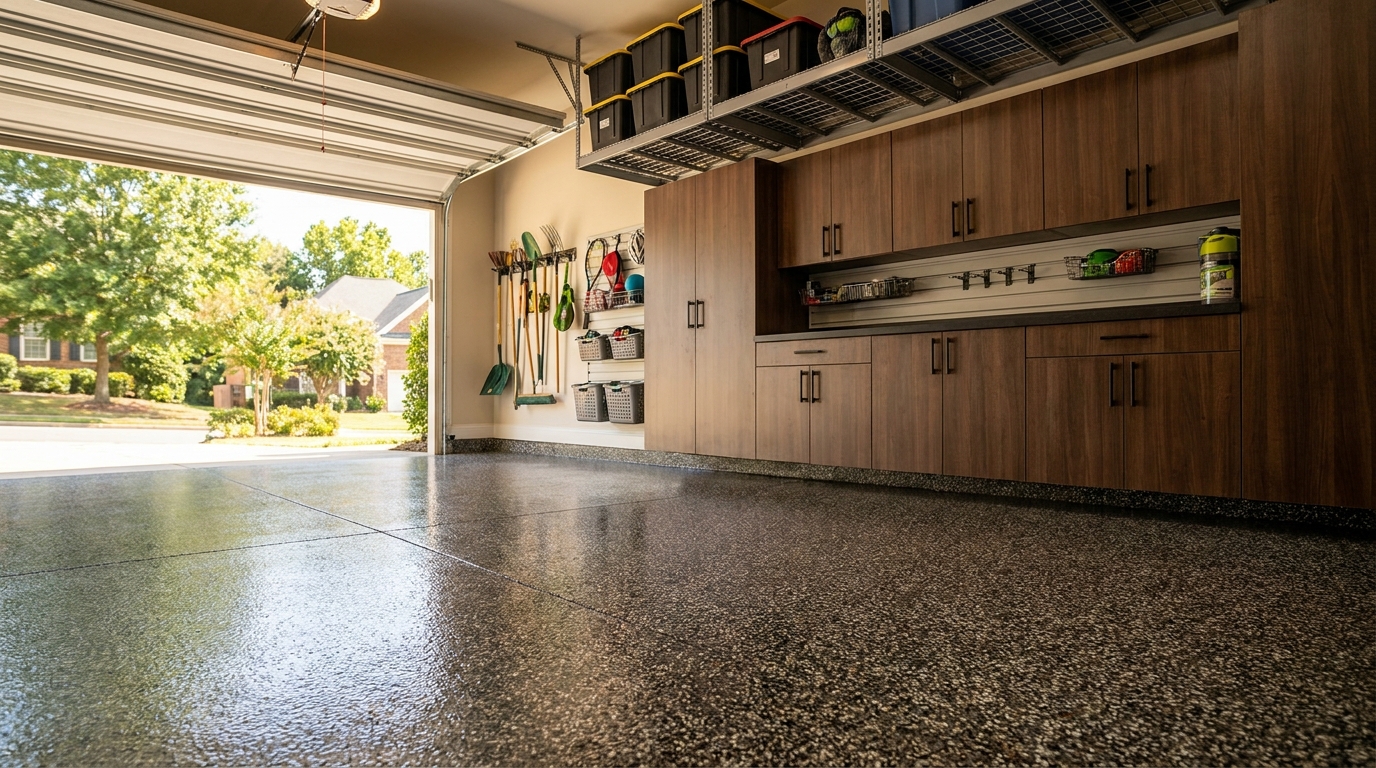
A stone look garage floor is a coated slab whose flake scale and granite-style mix of lights, midtones, and darks make the floor read as a material, the way real granite reads as quartz, feldspar, and mica sitting together, not as a printed plastic sheet. [1][2] We specify that scale with the room in front of us: the daylight that comes through an open garage door, the cabinet faces on the wall, and the view you get when you walk in from the house. Matching chip colors to cabinets, keeping color stable in afternoon sun, and adhesion under hot tires are all real topics, and they are different conversations from this one.
The finished room we are designing toward
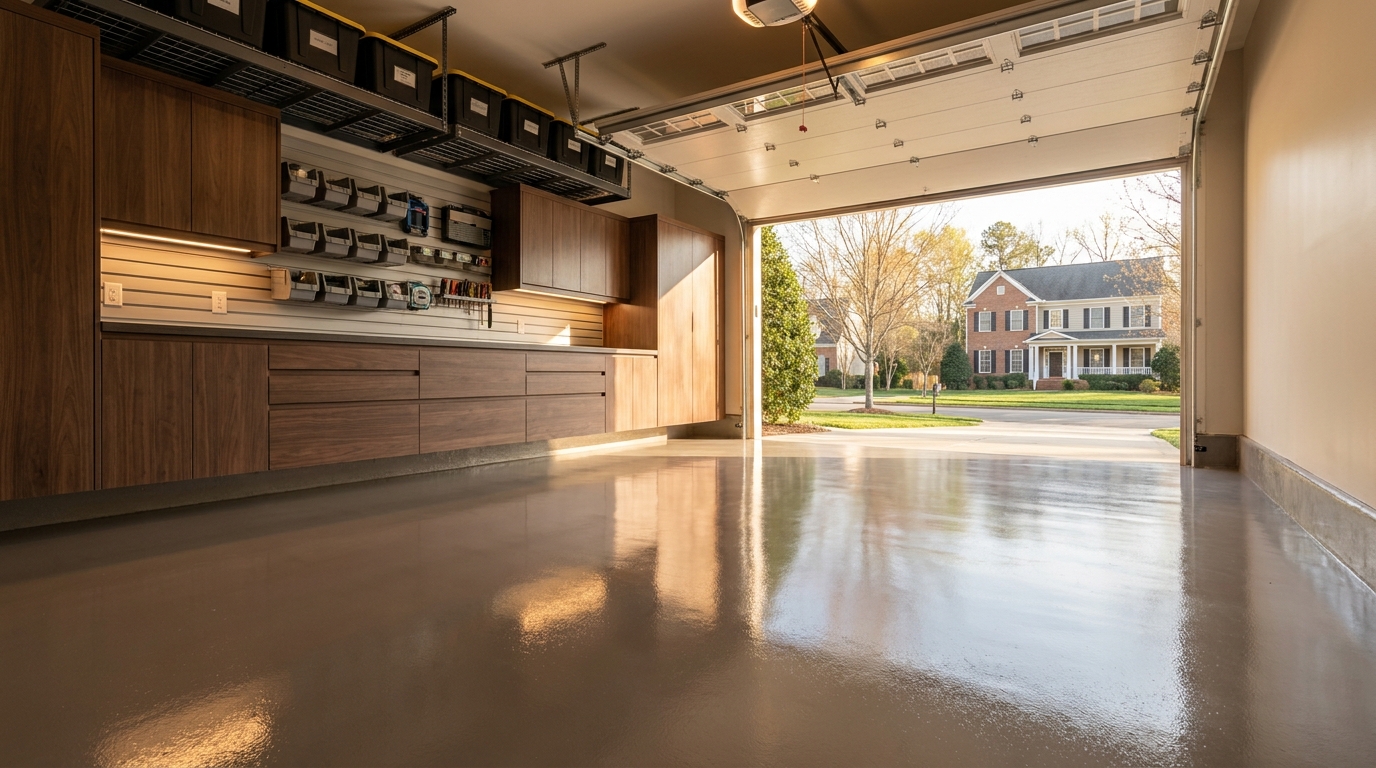
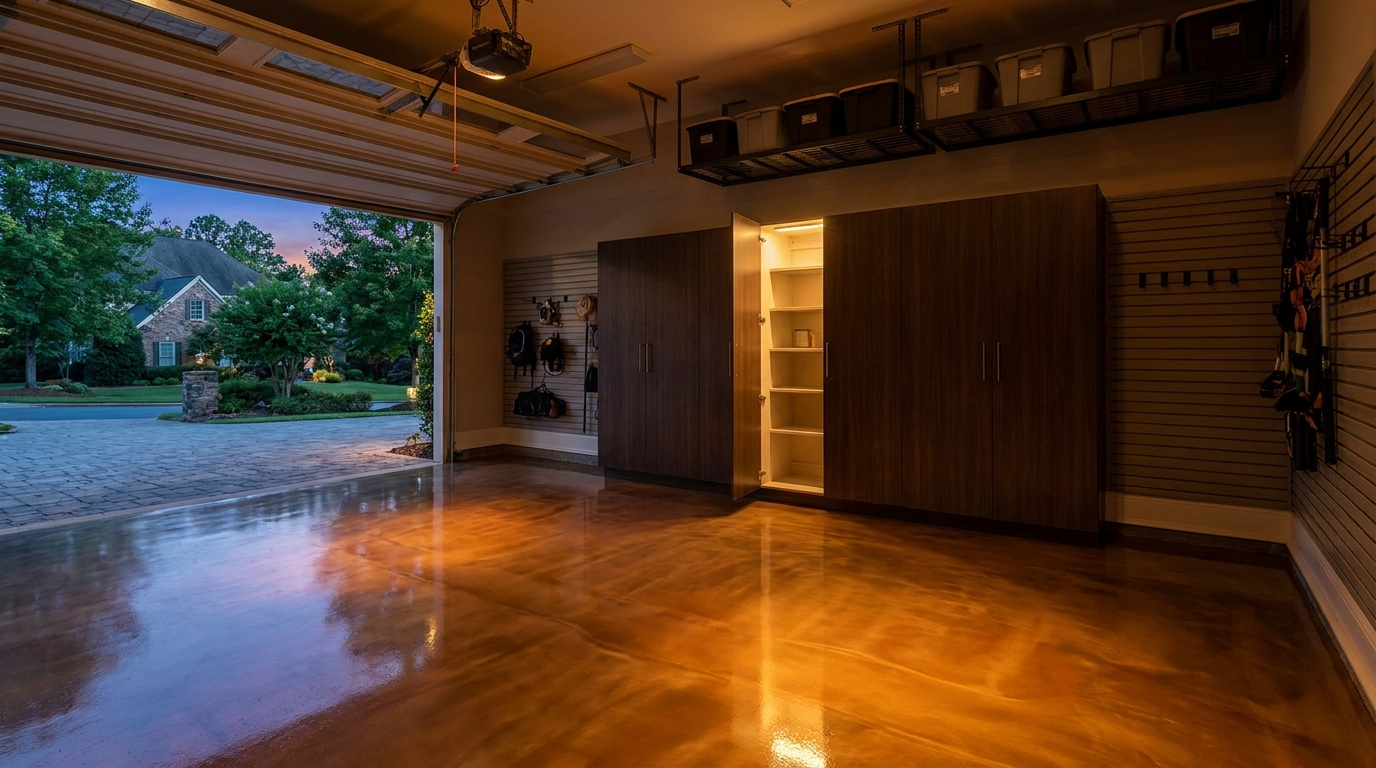
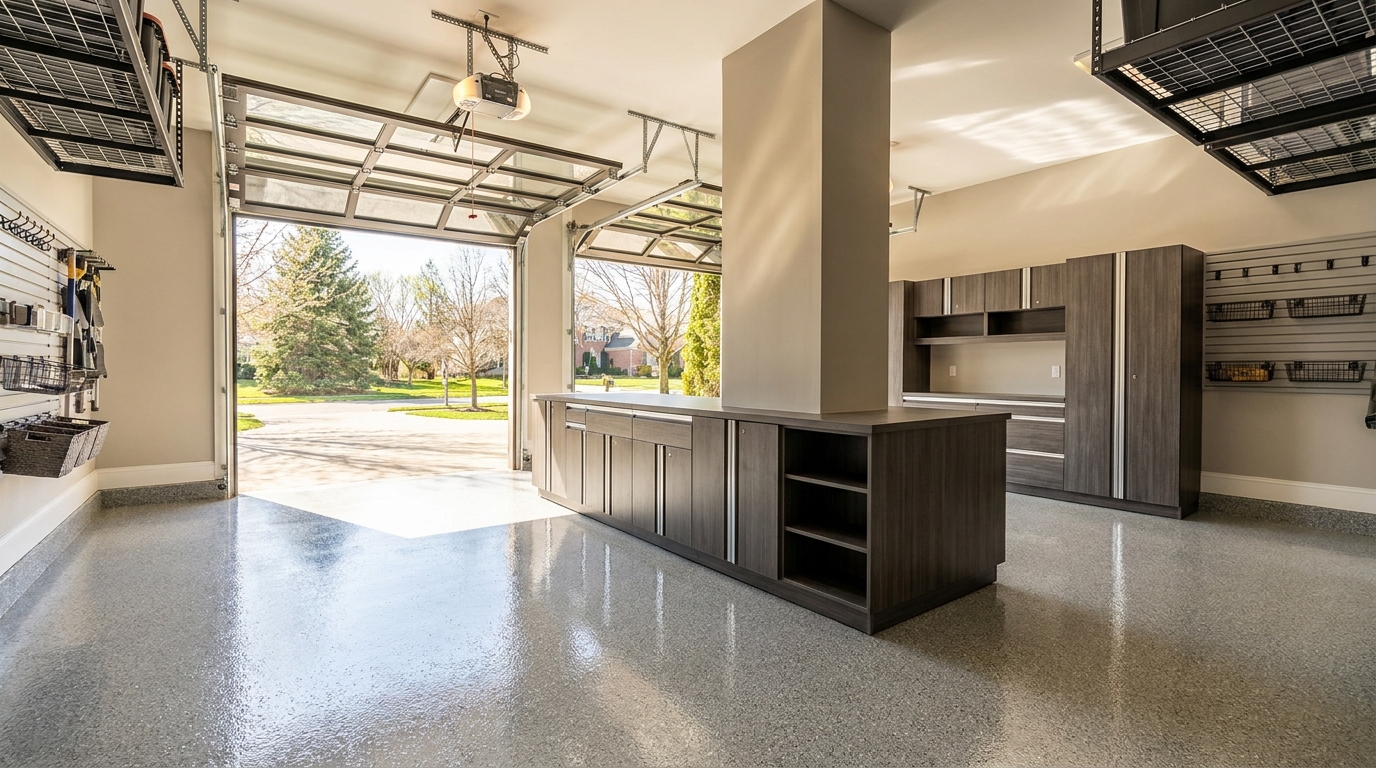
Walk a Charlotte, Waxhaw, or Monroe garage after our crew has finished, and the floor is the first thing that holds the room together. Cars sit on a field of stone-look chips. Heat-fused laminated melamine cabinets (Signature or Classic, wall-mounted, in finishes you actually live with, from River Rock and Timber Gray to Pewter or Charcoal) read against that field. Overhead storage and slatwall can join later. The floor is already making the garage feel like part of the house.
That is the design decision. We are not picking a chip off a sample card in isolation and hoping it still looks like stone at four hundred square feet. We are choosing flake scale, and a granite or stone look, so the coated floor reads as a material at room scale.
Our garage floor coating is a four-step polyurea system: diamond-ground prep, a tinted polyurea base coat, a full decorative chip broadcast, and a UV-stable polyurea top coat. Eleven blends are on the board, including White Granite, Marble, Creekbed, Shoreline, Teton Greige, and the finer Micro Marble and Micro Saddletan options. This post is about the visual spec on top of that system: how large the chips are, how densely they cover, and how that combination sits next to your cabinets and your daylight.
What granite actually looks like, and why the floor should copy that
Granite is not a solid color. It is a light-colored igneous rock whose grains are large enough to see with the unaided eye, made mainly of quartz and feldspar with smaller amounts of mica, amphiboles, and other minerals. Those minerals usually give the rock a red, pink, gray, or white field with darker grains running through it. [1] Change the grain size and the mix of lights and darks, and it still looks like granite. Flatten it into one even color and it starts looking like something else.
The Natural Stone Institute treats granite as a floor material as well as a countertop material, chosen for hardness, abrasion resistance, and a wide range of colors. [3] That is the visual target: a field of mixed minerals, not a painted plane with a few chips sprinkled on for effect.
Resinous floors have been chasing that look for a long time. The National Terrazzo and Mosaic Association defines terrazzo as a composite of cement or resin with marble, granite, onyx, glass, or other aggregate, poured, cured, and ground. [4] A decorative chip broadcast is a thinner cousin of that idea. Vinyl or acrylic color chips, in several sizes, are thrown into a wet base coat so the finished surface can read like granite or terrazzo rather than like a solid film. [2][5] The chips are not stone. The floor still has to behave like a material at room scale.
Flake scale is the grain size of the floor
In natural stone, grain size is what you notice first from a few feet away. Fine granite looks tight and even. Coarse granite shows individual crystals. Pegmatite, with crystals more than a centimeter across, looks like a different rock even when the minerals are the same. [1]
Decorative flooring uses the same lever. NTMA grades terrazzo aggregate by the screens it passes and the screens it sits on. A No. 0 chip passes a 1/8-inch screen and is retained on 1/16 inch. A No. 1 chip sits between 1/4 inch and 1/8 inch. A No. 2 chip sits between 3/8 inch and 1/4 inch. Epoxy terrazzo at a 1/4-inch thickness typically uses No. 0 and No. 1. A 3/8-inch topping can take No. 2. Venetian terrazzo steps up to No. 3 through No. 5 (1/2 inch to 3/4 inch). [4] The number is the size of the grains you will live with.
A 2004 Portland Cement Association guide on decorative concrete makes the same point for exposed-aggregate slabs. The architect selects the aggregate source and specifies its size. Sample panels are made to judge the finished appearance, and those panels become the basis for the work. For driveways, sidewalks, and patios, 3/8-inch pea gravel is a common size. Larger stone reads bolder. Smaller stone reads finer. [6]
On a coated garage floor, flake scale is that same choice. A finer broadcast (the Micro blends on our board) tightens the field the way fine granite does. A standard 1/4-inch-class chip, closer to NTMA No. 1, shows individual pieces the way typical granite shows crystals. A much larger chip starts to look like Venetian terrazzo, which can be handsome in a big three-car bay and busy in a tight one-car garage. The right answer is the scale that still looks like stone when you stand at the kitchen door and look across the whole slab.
Full broadcast so the floor is a field, not a sheet
Scale only works if the chips actually occupy the surface. A 2020 Concrete Network overview of garage coatings describes two very different looks. Chips can be applied lightly, so the tinted base color shows through, or heavily, for more coverage. A colored base with chips or quartz thrown down to refusal covers the slab as a continuous decorative field. A medium or light broadcast is a different design, with more of the base coat in view. [5]
That difference is the line between a stone look and a plastic sheet with confetti on it. Real granite does not have a painted background peeking through the crystals. The minerals are the surface. A full chip broadcast, which is how we install, lets the blend become the floor. The polyurea top coat then locks that field in place. [7] We scrape and sand the cured chip bed first, so the material looks like stone under glass, not like loose gravel.
Specified with the room, not the card
A sample card is a few square inches under indoor light, often held in the hand, often next to nothing that will sit in the garage. A garage floor is hundreds of square feet, seen from standing height, next to cabinet faces, under overhead lighting and the daylight that pours in when the door is up.
The International Commission on Illumination documented this gap in CIE 208:2014. Neither the standard colorimetric observers nor the CIECAM02 model predict the color-size effect: large color fields (greater than 20 degrees of visual angle) do not look the same as a small standard sample. In laboratory tests, the large stimulus tends to look higher in lightness and higher in chroma than the small one, and hue can shift as well. [8] In plain language, the card is not the floor. The floor will usually look a little lighter and a little more colorful than the chip you held in your hand.
That is why decorative-concrete practice has always insisted on sample panels and mockups, not catalog pictures. PCA tells specifiers to make panels that show the actual aggregate and finish, then use those panels as the basis for the work. [6] GSA's terrazzo repair specification, last updated in 2026, requires test patches, then mockup panels, then approval of those mockups as the quality standard, with aggregate matched in color and size. [9] We are not restoring a 1930s lobby. We are using the same discipline. The sample that matters is the one you see in your garage, next to your cabinets, in your light.
What we look at on site:
- Door-open view. Most Charlotte-area garages are used with the overhead door up. NOAA's 1991-2020 climate normals for Charlotte Douglas International Airport put the July mean daily maximum at 90.3°F. [10] That is open-door weather for a large part of the year. The floor is seen in a flood of daylight, not only under a shop light. Flake scale that looked subtle on a card can go busy in that light, or disappear. We want the granite reading to survive both.
- Cabinet faces. Our cabinets are heat-fused laminated melamine, not powder-coated steel. Wood patterns (River Rock, Timber Gray, Warm Sand) have their own grain scale. Metal patterns and solids sit differently against a floor. A Micro Marble floor next to a quiet Slate door is a different room from a larger White Granite next to a busy River Rock. We set the floor's grain so it belongs with those faces.
- The view from the house. The first look is often from the mudroom or kitchen, across parked cars, to the back wall. Fine chips can melt into a single tone at that distance. Larger chips can start to look like a pattern. We pick the scale that still reads as stone from that doorway.
Three conversations this is not
Homeowners often fold three other floor decisions into this one. They are related, and they are not the same spec.
Chip-blend color matching to cabinets is a palette question: whether Saddletan, Teton Greige, or Creekbed sits closer to the cabinet laminate. That is a color conversation. This post is about flake scale, and whether the floor reads as granite rather than as a coated film. You can color-match a blend and still choose a scale that looks plastic.
UV-stable color in Charlotte afternoon light is a chemistry and pigment conversation: whether the top coat yellows, and whether the blend holds in sun through an open door. Our polyurea top coat is specified as UV stable for that reason. [7] That is not the same as choosing how large the chips are.
Hot-tire peel is an adhesion and prep conversation: diamond grinding to the right concrete surface profile, a compatible base coat, and a top coat that can take parked vehicles. A 2019 KTA-Tator technical note describes ICRI Guideline 310.2 (now 310.2R-2013) CSP chips, from a nearly smooth CSP 1 to a very rough CSP 10, as the qualitative standard for how rough the concrete should be before a coating goes down. [11] That work happens before any flake is thrown. It is why the floor lasts. It is not how we choose a granite look.
Keep those three on their own lists. The stone-look spec is scale, blend structure, and the room.
How the system carries the look
A stone look only holds if the coating is a real system. Decorative chips sit in a wet base and are locked under a clear top coat. Concrete Network's 2024 comparison of garage coatings notes a common professional approach: a tinted epoxy or 100-percent-solids polyurea base for the chips, and a clear polyaspartic aliphatic polyurea top coat for chemical resistance, hot-tire resistance, UV stability, and protection of the chips. [7] Polyaspartic is a type of polyurea. Our live system uses polyurea for both the primer base and the clear top coat, with a full chip broadcast between them.
Prep is part of the visual spec as well as the structural one. Diamond grinding opens the slab and sets a profile the base coat can key into. [11] Cracks and control joints are filled so the finished field does not telegraph every line as a dark stripe through the granite. Then the chips go down at full coverage, excess is removed, and the top coat goes over a sanded, even bed.
Texture is part of the material too. ANSI A326.3, as summarized by the Tile Council of North America in 2025, treats dynamic coefficient of friction as one factor among many, and notes that floors with a coating applied after installation should be used in areas that can be kept dry unless the coating manufacturer declares otherwise. [12] A full flake broadcast is not a polished marble slab. It has a fine, even tooth under the clear coat, which is one reason the floor feels sure underfoot.
What we do on a Charlotte-area visit
We come to the garage, measure, and look at the actual light. We set cabinet samples against floor blends in the bay, with the door up and with the door down, and we talk through Micro scale versus a more open granite grain. We render the room in 3D so you can see the floor running under wall-mounted cabinets before anything is ordered.
Typical starting points: a quieter cabinet (Slate, Charcoal, London Gray) with White Granite or Marble at a standard flake scale; a wood-pattern cabinet (River Rock, Timber Gray, Warm Sand) with a Micro blend, so two grains are not shouting at once; a metal-pattern cabinet with Creekbed, Shoreline, or Teton Greige. Those are starting points, not rules. A south-facing three-car garage in Ballantyne sees a different door-open wash than a side-loaded garage in Waxhaw. We specify the stone look garage floor for the room you have.
Practical takeaways
- Choose flake scale the way you would choose granite grain: fine for a tight, even field, standard for visible crystals, larger only if the bay is big enough to carry it. [1][4]
- Ask for a full broadcast if you want the floor to read as stone. A light sprinkle of chips over a tinted base is a different look, closer to a coated sheet than to granite. [5]
- Judge the blend in the garage, next to cabinet faces, with the door open. A 2014 CIE report found that large color fields tend to look lighter and more chromatic than a small sample. [8]
- Treat sample cards as a first filter, then confirm with a panel or a 3D view in the actual room, the same way PCA and GSA treat mockups as the basis of the work. [6][9]
- Keep color-matching cabinets, UV stability, and hot-tire adhesion on separate lists. They support the stone look. They are not the stone-look spec.
- Plan the floor with the cabinets. Wall-mounted, heat-fused laminated melamine and a granite-look coating are one room.
How we can help
Have more questions or want to get in touch? https://garagecharlotte.com/contact/ Our team will come to your Charlotte-area garage, set flake scale and a stone look against your cabinets and your daylight, and leave you with a written plan for a floor that reads as a material, not a sample card.
Citations
- Geology.com, "Granite: Igneous Rock" (accessed 2026-09-12)
- Concrete Network, "12 Best Concrete Floor Finishes for Indoor Spaces" (2024-04-08)
- Natural Stone Institute, "What Is Granite? Technical Data And Best Practices" (accessed 2026-09-12)
- National Terrazzo & Mosaic Association, "Terrazzo Systems Reference Guide" (2023)
- Concrete Network, "Garage Floor Coating & Concrete Finishes" (2020-04-17)
- Portland Cement Association, "Finishing Concrete Slabs with Color and Texture (PA124.02)" (2004)
- Concrete Network, "Best Garage Floor Coating: Epoxy, Polyurea or Polyaspartic?" (2024-08-23)
- International Commission on Illumination (CIE), "CIE 208:2014 Effect of Stimulus Size on Colour Appearance" (2014)
- U.S. General Services Administration, "Terrazzo repair specification" (2026-06-11)
- NOAA National Centers for Environmental Information, "Summary of Monthly Normals 1991-2020, Charlotte Douglas AP, NC USW00013881" (1991-2020 normals, generated 2026-09-12)
- KTA-Tator, "Measuring the Surface Profile of Prepared Concrete" (2019-04-19)
- Tile Council of North America, "Dynamic Coefficient of Friction - Frequently Asked Questions" (2025-08-01)