Soft-Close Hardware Specified Once for the Whole Cabinet Run
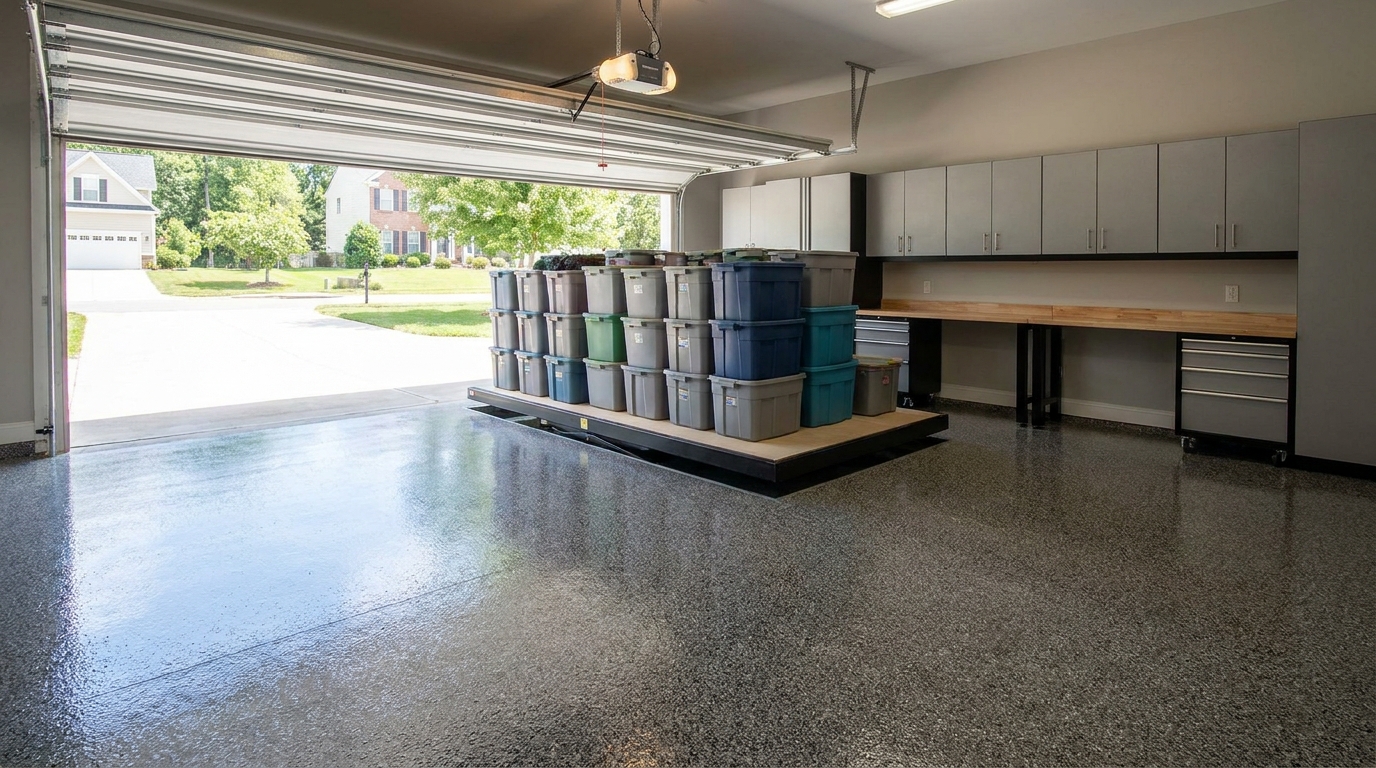
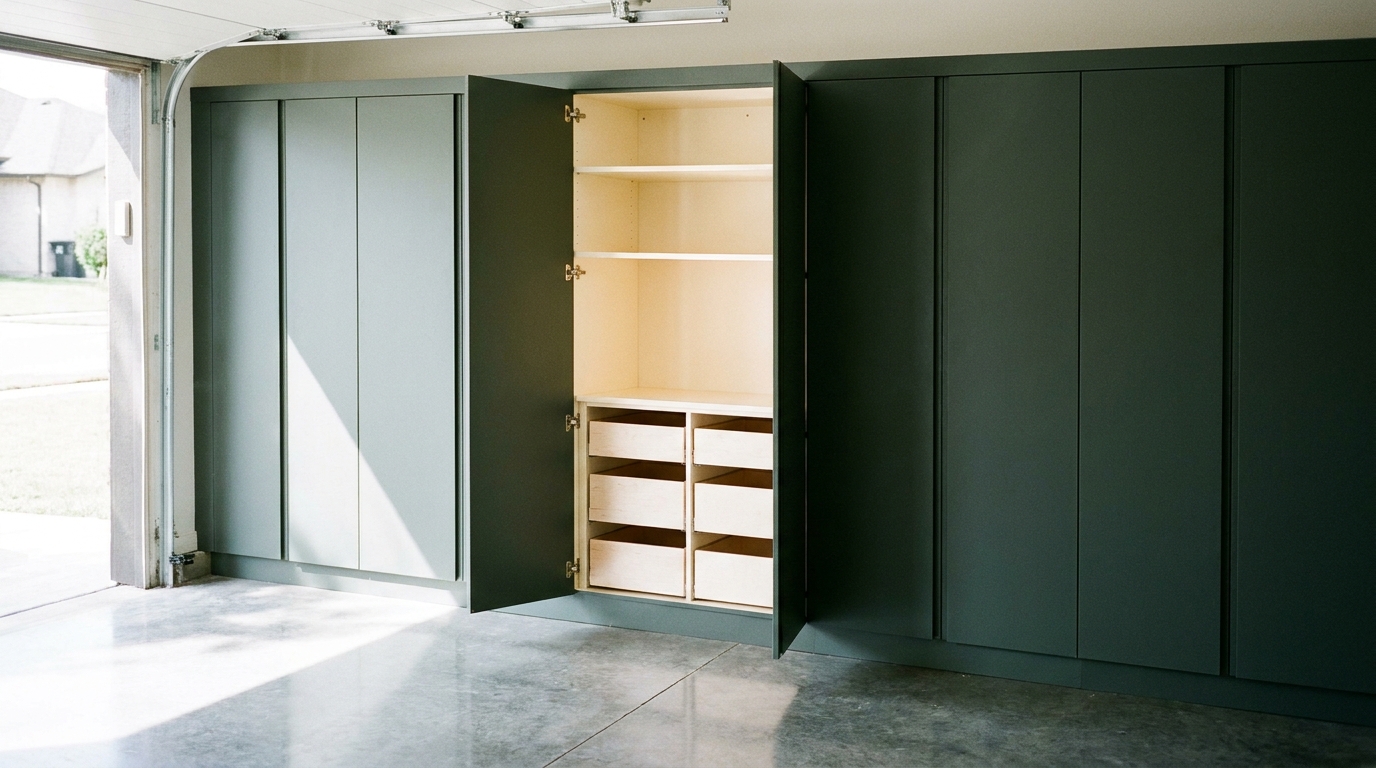
The finished run is the point. A wall of soft close garage cabinets should open and close as one decision: the same hinge on every door, the same slide family on every drawer, and the same pull, in the same finish, from the first box to the last. That is how our team specifies hardware. The garage then handles with the same steady hand as the cabinets inside the house, because the hardware was chosen once for the whole wall.
One decision, written before the boxes are built
A cabinet run shares a top line, a door style, and a set of gaps. Hardware is the part a hand meets. If one door eases shut and the next one does not, or one drawer rolls all the way out and the drawer beside it stops short, the wall no longer reads as a single piece of work.
We pick the hinge, the slide, and the pull, then use that set on every door and every drawer. Fillers and the tall box beside the panel do not get a second family. The small door and the wide door get the same hinge. The shallow drawer and the deep drawer get the same slide specification, including the same answer on whether the close is damped.
Published cabinet standards talk about hardware this way, even though they were written for kitchen and vanity cabinets rather than a garage. The 2022 KCMA A161.1 performance and construction standard says doors and drawers are to be aligned with the cabinet, to close without excessive binding or looseness, and to function with typical industry hardware such as door hinges and drawer-slide systems.[1] Exposed cabinet hardware is to comply with the finishing requirements of the current ANSI/BHMA A156.9 cabinet-hardware standard.[1] The document is a performance standard. It does not dictate a style. It is a way to judge whether a factory-built cabinet, properly installed and normally used, can be expected to perform.[1]
On the cabinets we publish, the hinge is already named. Every door uses a six-way adjustable premium soft-close hinge. The standard glide is a full-extension stainless steel roller-bearing drawer glide, and soft-close drawer slides are the option when the drawers should ease shut the way the doors do. Pulls come from the three hardware finishes we publish: brushed chrome, black powder coat, or oil-rubbed bronze. One of those finishes covers the run. That list is on our garage cabinets page, and it is the list we build from.
The hinge, repeated on every door
A soft-close hinge closes itself and slows the last of the swing. The 2020 edition of ANSI/BHMA A156.9 defines a self-closing hinge as a hinge that incorporates energy, usually a spring, so the door closes from an open position. It defines a self-closing integrated damper hinge as that hinge with a damper in the cup or the arm, and it notes that some damper mechanisms can be switched or adjusted.[2] We do not publish a damper switch on our hinge. We do publish one specification for every door: six-way adjustable, premium, and soft-close. Six-way adjustment is what lets the installer set the door after the box is on the wall, so the gaps repeat and the closed door sits with its neighbors. One hinge means that adjustment works the same way at both ends of the wall.
The 2022 cabinet standard includes the closing device in the door test. It names a spring catch, a magnetic catch, a self-closing hinge, or another device of that kind. The door is swung through 90 degrees and back, with the holding device engaged and released, for 25,000 cycles at 20 cycles per minute, plus or minus 2. Afterward the door has to remain operable, the holding device has to keep it closed, the hinges are to show no visible damage or loss of function, and the screws at the cabinet and at the door are not to have loosened. Sag at the measuring point is limited to 0.065 inch.[1] A separate loading test hangs 65 pounds on the open door, 10 inches from the hinge center, cycles that weighted door 10 times between 90 degrees and 20 degrees, and leaves the weight in place for 10 minutes.[1]
Those counts belong to the cabinet assembly. They are not the hinge-grade test, and the numbers should not be added or swapped. BHMA's 2026 highlights for ANSI/BHMA A156.9 give a Grade 1 hinge as the example that must complete 100,000 cycles without degradation that affects function.[3] A foreword to the 2020 edition, which the association marks as not part of the standard itself, offers a general guide: Grade 1 is the highest and is suited to most institutional use, Grade 3 is suited to most residential use, and Grade 2 is often used across applications.[2] Our cabinet page does not publish a BHMA grade, and we do not invent one. What we specify is a single commercial soft-close hinge on every door, from established hardware suppliers.
The 2020 standard also says its tests are laboratory tests. In actual use, results vary with installation, maintenance, and the environment, and the tests apply to the hardware rather than to a whole cabinet system.[2] A Charlotte garage is hotter and colder than a lab bench. That is a reason to be plain about what a cycle count is, and a reason to keep the hinge identical, so any later tune-up follows one set of instructions.
The slide, chosen once for the bank
A mixed slide shows up the first time someone reaches into the back of a drawer. A 2024 Fine Woodworking article on mechanical slides sorts the common types by travel. Basic bottom-mount slides, the epoxy-coated pair with plastic wheels, typically open about three quarters of the way. Side-mount steel slides with ball bearings are described there as full extension in ordinary form. Undermount slides, hidden under the drawer bottom, are described as full extension too, and as carrying soft-close and full extension as the usual specification. The article notes that all three families can be ordered with a soft-close feature, which pulls the drawer to a gentle stop, and that older kitchens often put the lighter bottom-mount slide on most drawers and a heavier side-mount slide only on the deep ones.[4]
We do not copy that mix inside one run. The glide we publish as standard is a full-extension stainless steel roller-bearing drawer glide. Full extension is the travel: the drawer comes out far enough to use the back of the box. Soft-close drawer slides are optional. When that option is the right close for the garage, every drawer in the run gets it. The upper drawers and the deep drawer finish the same way.
The 2024 article describes one detail of a soft-close slide on an overlay drawer: once the drawer is within about an inch and a half of closed, the mechanism draws it home.[4] That distance is the writer's description, not a measurement we print as our own. It is still a clear picture. The damped close is a short finish, not a slow crawl across the whole travel. The hinge damps a swing. The slide, when we specify it, damps a straight pull. Writing both down, or writing the hinge and the full-extension glide without the damped slide, is one choice made before the boxes are built.
The lab stroke is a different number, and it needs its year. In the 2022 KCMA drawer test, the drawer is loaded evenly at 15 pounds per square foot and run for 25,000 cycles. One cycle opens the drawer two-thirds of its extension and returns it, at about 20 cycles per minute. After the test, still loaded, the drawer has to work, with no failure in the assembly or the operating system, and the bottom must not sag into the path of travel.[1] Two-thirds of extension is the test stroke. It is not a definition of full extension, and it is not how far our drawers travel in daily use. A separate impact test drops a 3-pound steel ball 8 inches onto the drawer-front assembly, 10 times, and checks that nothing in that assembly has loosened in a way that hurts operation.[1]
A January 2023 KCMA article quotes Chuck Arnold, vice president of standards and certification, on the purpose of those methods. "The test methods are designed to simulate a lifetime of use that a typical consumer will subject the cabinets to," he said.[5] That is a simulation of kitchen and vanity use under a written procedure. It is not a calendar promise, and it is not a claim that a garage drawer full of sockets and hardware bins was the specimen. Our published cabinet page does not claim a KCMA certification seal. We use the public tests as a shared language for a loaded drawer that still works after a long series of cycles, and we keep the slide identical so the bank wears as one bank.
The pull, in one finish
The pull is the piece people see first, and it is a loaded part. BHMA's 2026 cabinet-hardware highlights use a pull as the strength example: pulls are to support a 75 pound-force test load without chipping, without coming apart, and without breakage of the part or the screws.[3] That is a laboratory load, not an ordinary tug. It is enough to show why a pull is specified rather than taken from a leftover bin. The same highlights list hinges, knobs, pulls, catches, shelf rests, standards and brackets, rotating shelves, and track for sliding panels, and they show bottom-edge-mounted drawer slides as one of the numbered families. The sheet says it is not a substitute for the full standard.[3]
Finish belongs in the same decision. The 2022 cabinet standard points exposed hardware at the finish requirements of ANSI/BHMA A156.9.[1] A run that mixes brushed metal on the doors with a painted pull on the drawers reads as two purchases. We publish three hardware finishes: brushed chrome, black powder coat, and oil-rubbed bronze. The run gets one. The pull shape is chosen once and lands on door and drawer front alike, at a height and a setback that repeat.
BHMA type numbers sort the kind of part. The 2020 foreword says a type number does not identify size, finish, or design, and is not meant to stand alone.[2] The 2026 highlights treat the number as a category and point readers to the full standard for the list.[3] Someone still has to choose. On our projects that choice is made with the homeowner before the cabinets are released to build. Changing a finish after the doors are machined for one screw spacing is a different order.
A higher test bar is a different document
In October 2024, KCMA published a revised severe-use standard and described it as separate from the A161.1 quality certification. The older specification began in 1993 at the U.S. Department of Housing and Urban Development, for residential kitchens expected to see harder use, including high-turnover apartments and military housing. KCMA's account says the 2024 document left a list of required materials and moved to performance tests meant to predict how a cabinet holds up in that setting.[6]
A garage in Matthews or Huntersville is not that housing, and we do not describe our cabinets as severe-use certified. The useful point is narrower. When harder use is expected, the industry writes a harder test instead of hoping a mixed set of hinges will do. For a homeowner garage, our version of that idea is the specification. Name the hinge. Name the slide, including whether the close is damped. Name the pull and the finish. Then stop adding exceptions.
The 2020 hardware standard is also plain that a published standard does not forbid products that were never tested to it.[2] A cycle count is a benchmark for a defined specimen. We do not treat that benchmark as a seal our cabinet page does not claim.
How our team carries it onto the wall
We measure the wall and draw the run around ceiling height, panels, outlets, and the swing of the overhead door. Hinge side, drawer stack, and pull placement are part of that drawing. Signature and Classic cabinetry, as we publish them, are manufactured in the United States, and the soft-close hinges and drawer glides come from established commercial suppliers. Signature Series uses 1-inch tops, bottoms, and fully adjustable shelves, with 3/4-inch doors, drawer fronts, and side panels. The boxes are wall-mounted, with legs as an option, so the hardware line stays where the drawing put it.
At the walkthrough we check hinge adjustment and drawer alignment with you. Doors in one plane. Reveals that repeat. Drawers that travel the same way and, if soft-close slides were specified, that finish the close the same way. Pulls in one finish. If a door sits proud, we correct it before we leave. Adjustment is normal. A second hardware family is not.
Warranties stay in the words we already publish. Signature Series carries a lifetime warranty on cabinet boxes and finishes. Classic Series carries a seven-year limited warranty. Both are transferable. Those sentences are not a rewrite of a 25,000-cycle procedure, and they are not a BHMA grade. The practical benefit of one specification is simpler: if a glide or a hinge needs attention later, the part on the next door is the same part.
Homeowners often want the garage to feel like the rest of the house. The honest version of that request is about operation. Interior cabinets are usually opened with one kind of hinge and one kind of slide, and the garage can work that way too. The difference is the load and the room, not a reason to scatter three kinds of hardware across one wall.
Practical takeaways
- Specify one soft-close hinge for every door. On our cabinets that is the six-way adjustable premium soft-close hinge we publish.
- Specify one slide family for every drawer. Our standard glide is a full-extension stainless steel roller-bearing glide. Soft-close slides are optional, and if you choose them, they go on the whole bank.
- Specify one pull and one finish. We publish brushed chrome, black powder coat, and oil-rubbed bronze. The 2026 BHMA highlights treat a pull as a tested part, with a 75 pound-force example.[3]
- Keep the cycle counts apart. The 2022 KCMA door and drawer tests use 25,000 cycles on the cabinet assembly. A Grade 1 hinge example in the 2026 BHMA highlights is 100,000 cycles on the hinge.[1][3]
- Keep the lab in the lab. The 2020 hardware standard says real use varies with installation, maintenance, and environment, and a 2023 KCMA note calls the cabinet tests a simulation of typical consumer use.[2][5]
How we can help
Have more questions or want to get in touch? Our team will measure the wall and specify one hinge, one slide family, and one pull for the whole cabinet run. Reach us on our contact page.
Citations
- Kitchen Cabinet Manufacturers Association, "Performance and Construction Standard for Kitchen and Vanity Cabinets, KCMA A161.1-2022" (2022)
- Builders Hardware Manufacturers Association, "ANSI/BHMA A156.9-2020, American National Standard for Cabinet Hardware" (preview, approved 2020-11-12)
- Builders Hardware Manufacturers Association, "A156.9 - 2026 Cabinet Hardware" (2026)
- Fine Woodworking, "Mechanical Drawer Slides" (2024-10-16)
- Kitchen Cabinet Manufacturers Association, "Cabinets Certified to Last" (2023-01-17)
- Kitchen Cabinet Manufacturers Association, "KCMA Releases Significant Overhaul of the Severe Use Standard" (2024-10-04)