Pull-Out Shelves in the Base Cabinets for Heavy Bins
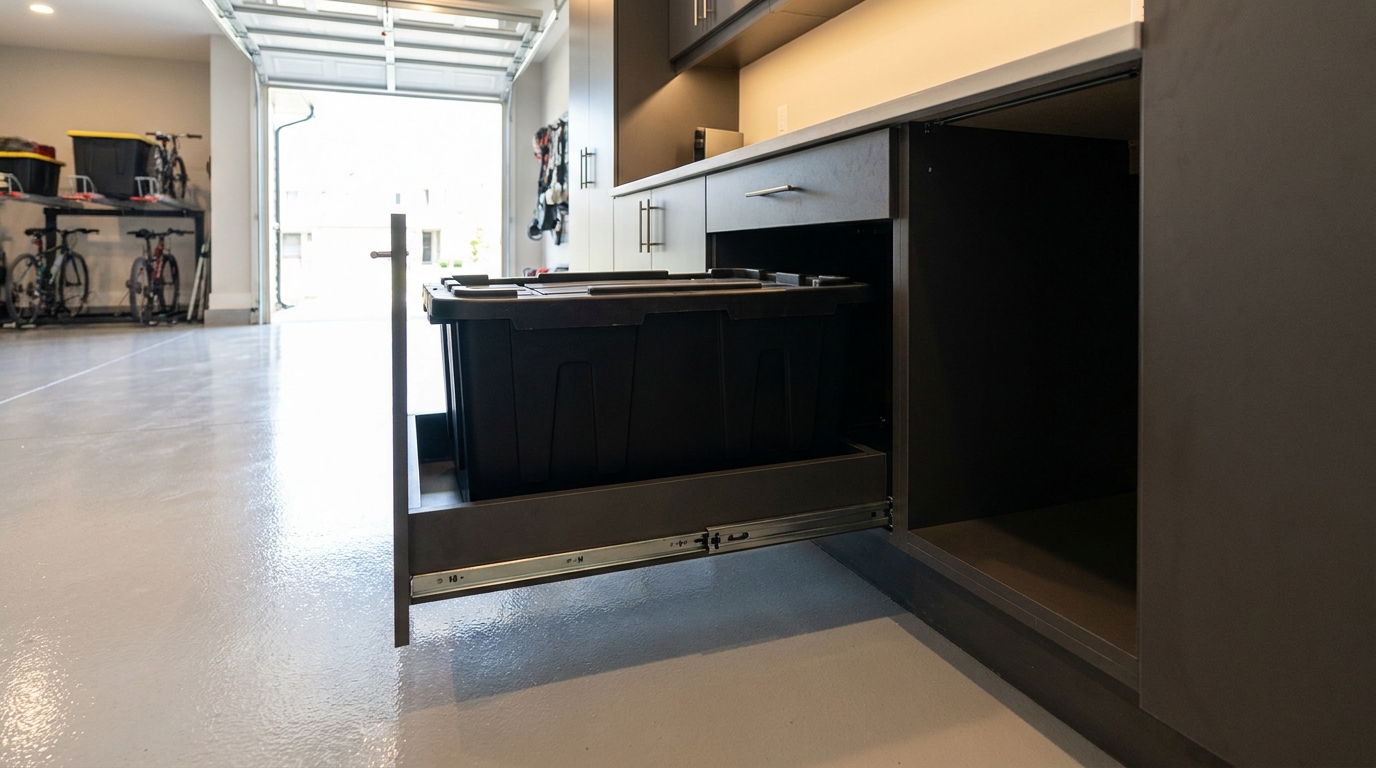
A finished base cabinet is where the heavy bins belong in a garage built as a real room, and the decision that makes those bins usable is pull-out shelves in garage base cabinets. The tote stays on an open shelf that slides to the face of the cabinet, so you meet the bin at the opening instead of lifting it off a shelf that never moves. We treat that shelf as its own specification. It is not an adjustable shelf elsewhere in the run, and it is not a drawer bank for small tools.
The shelf that comes out with the bin
A pull-out shelf is a platform on slides, set inside a base cabinet. The door opens, the platform travels toward you, and the bin rides with it. You can see the bin. The bin is the container you already own. You are not asked to reach past the door and down to the back corner to pick up something dense while you are bent over the opening.
We specify travel that brings the back of the bin clear of the cabinet face. A shelf that stops short still leaves your hands deep in the box. Once the bin is out, you can take what you need while it sits there, or lift the whole tote with both hands at the opening. A 2007 manual handling guide from NIOSH and Cal/OSHA makes the same preference: once a load is at a workable height, slide it instead of lifting it, and take containers out by sliding them.[4]
We do not publish one weight number for every pull-out. The bin, what is in it, and the cabinet box change the load the slide has to carry. On the in-home visit we look at the totes you already own. A holiday bin, a tote of bulk household supplies, a bin of sports gear, and a bin of camping kit are not the same object, even when they look like the same plastic tub. The shelf is matched to that loaded bin. We are not handing you a width chart and a catalog tub to go with it.
One bin sits on one pull-out. A second tote stacked on top of the first is a lift you still have to make, and it traps the bin underneath. If two heavy bins need a home, they need two shelves, or one of them does not belong in that base cabinet.
Put the everyday bin near waist height
The pull-out you reach every week should sit as high in the base as the tote will allow, close to waist height, not on the bottom by default. A base cabinet is a low box. It cannot pretend to be a shelf at the shoulder. What it can do is refuse to park the bin you grab all the time at floor level.
A 2007 NIOSH and Cal/OSHA guide describes a power zone above the knees, below the shoulders, and close to the body, and it says to keep lifts in that zone when you can.[4] The same guide tells planners to avoid lifting loads from the floor, and to store only lightweight or infrequently lifted items down there.[4] A 2016 Washington State Department of Labor and Industries card says to move heavy items to waist level, and to slide instead of lifting.[5] A CCOHS fact sheet on storage layouts, revised in 2023, says to store heavy and frequently used materials at waist height, and it says not to store materials at floor level.[6] That sheet also says to leave the lowest shelf unused if you need to.[6]
We follow that order inside the base run. The everyday heavy bin goes on the highest pull-out the tote will still clear. A bin you touch only a few times a year is the one we will still discuss for a lower pull-out, because the 2007 guide allows infrequently lifted items to live low.[4] The slide does not turn a floor-level start into a waist-level start. It takes away the deep reach, so both hands meet the bin at the face of the cabinet instead of in the back corner.
Vertical travel is part of the same picture. On the 1994 revised NIOSH multipliers, as tabulated by CCOHS on a fact sheet revised in 2023, a lift that travels 25 cm or less keeps the distance multiplier at 1.00, and longer travel lowers it.[3] Sliding a bin out and only then lifting it a short way onto a cart, or not lifting it at all, is a smaller job than hoisting it from the back of a low shelf up and out in one motion.
What the lifting guidance actually measures
Once the bin is at the face of the cabinet, a lift, if you still need one, can be the kind of two-handed move this guidance was written to describe. NIOSH still publishes the revised lifting equation for that job. A CDC page reviewed in 2024 lists the inputs in plain terms: the weight, how far the hands are from the midpoint between the ankles, how high the hands are above the floor at the start, how far the hands travel up or down, whether the body is twisted, how often the lift happens, how long the work goes on, and how good the grip is.[1] The recommended weight limit is the amount most workers can lift during a work shift without the risk of a work-related musculoskeletal disorder such as low back pain, and NIOSH recommends keeping the lifting index at or below 1.0.[1]
That is an occupational tool for a lift you can actually perform. It is not a household law, and it is not a rating stamped on a cabinet shelf. A fact sheet last revised in 2021, explaining the 1994 revised equation, states a load constant of 23 kg (about 51 lb) as the baseline NIOSH set for ideal conditions, described there as a load safe for 75% of females and 90% of males.[2] The 2007 guide says the same ceiling in pounds: the maximum weight to be lifted with two hands, under ideal conditions, is 51 pounds, and the six variables reduce the recommended weight below that.[4] Ideal means close to the body, at a favorable height, with little twist, a decent grip, and a modest pace. A real tote in a garage is rarely that lift, so we do not hand you 51 pounds, or 23 kg, as the weight your bin is allowed to be.
The multipliers are where the cabinet decision shows up. In the 2023 CCOHS table of those 1994 factors, a horizontal distance of 25 cm or less, measured from the midpoint between the ankles to the hands, carries a multiplier of 1.00.[3] At 60 cm that multiplier is 0.42.[3] A start at floor level carries a vertical multiplier of 0.78, and a start at 70 cm carries 0.99.[3] A body angle of 0 degrees keeps the asymmetric multiplier at 1.00, and a 90-degree twist drops it to 0.71.[3] Reaching into a deep base cabinet makes that horizontal distance worse, often while you are bent and turned. Bringing the bin to the face of the cabinet is how you get your feet closer to the load.
The same 2021 fact sheet draws a line around the equation. It does not apply, among other cases, to a one-handed lift, a lift for over 8 hours, a lift while seated or kneeling, a lift in a restricted work space, a push or a pull, or an unstable object such as a bucket or a container of liquid.[2] A reach into the back of a base cabinet is often a restricted, one-handed, stooping move. Sliding the shelf itself is a push or a pull, which this equation does not rate. We do not run the formula on that reach and call the answer a safe bin weight. We change the task. The shelf slides out so that, if the whole bin has to come up, the lift can be two-handed, in a stance you can stand in, close to the body. That is the situation the equation was written for.[2]
Grip is the last of those factors, and it is a bin choice as much as a shelf choice. The 2023 table rates a good grasp, the kind with handles, at a coupling multiplier of 1.00 while standing, and a poor grasp at 0.90.[3] A tote with a real handhold is a better partner for a pull-out than a smooth tub you have to hug. If the contents can shift, the 2007 guide says to test the load and repack so the weight stays balanced, because an unstable container is a different problem from a heavy one.[4] We will ask what is in the bin. We will not guess a number for it.
Adjustable shelves, drawer banks, and pull-outs
These three interiors do different jobs. An adjustable shelf moves up or down and then stays put. Pins or clips set the height. The shelf never comes toward you. That is the right interior for lighter goods, and for a shelf you set once in a tall cabinet. You still pick the object up off a fixed plane.
Our garage cabinets are heat-fused laminated melamine, mounted to the wall studs, with soft-close doors. Signature Series boxes include fully adjustable shelves as part of that construction. The adjustable shelf stays in the plan. It is simply not the piece we assign to a heavy bin. Pin holes are not a reason to park a dense tote on a shelf that will not come out.
A drawer bank is a set of closed boxes. Sides, a bottom, a front, and full-extension glides. That is where small tools, fasteners, bits, and the parts you want sorted next to a workbench should live. The drawer front hides them, which is a virtue for small things and a problem for a tote. A tall bin will not pretend to be a drawer. The sides of a drawer take width the bin needed, and the opening was planned for tools, not for a storage tub. We keep drawer banks for that small-tool job. We do not convert a deep drawer into the home for heavy bins by renaming it.
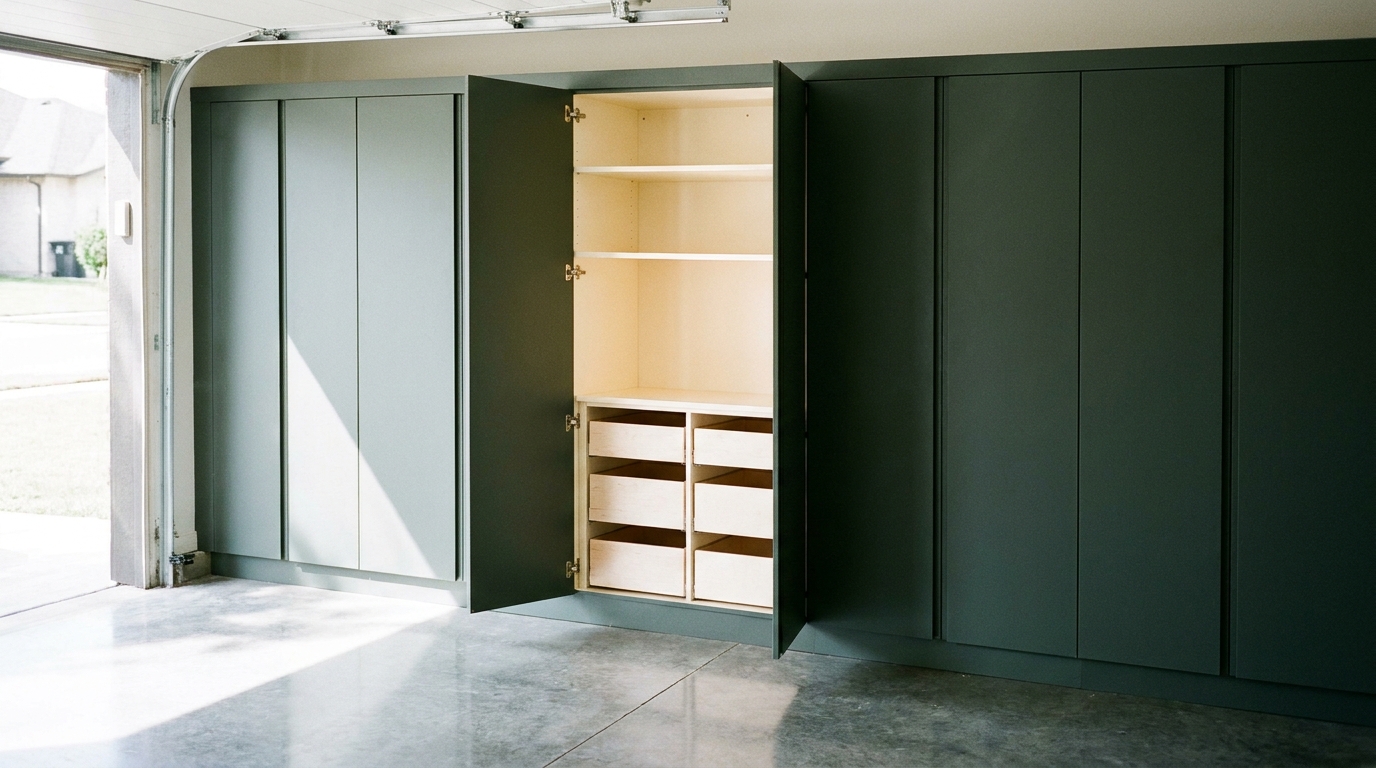
A pull-out shelf is the third interior, an open platform. When the door is open you see the bin, and the bin is the container. Everyday heavy totes go on pull-outs near the top of the base. Lighter items can sit on an adjustable shelf above a pull-out when you can lift them in place. The drawer bank sits at the workbench. Holiday bins, sports totes, and bulk supplies each get a pull-out only when that bin is heavy enough to earn it. Small parts from those same hobbies go in the drawers.
The cabinet has to carry the shelf when it is out
An extended shelf moves weight forward of the back panel. Our base cabinets are wall-mounted, with optional legs, and the boxes are fastened into the wall studs so the load path goes into the framing. Wall mounting also leaves the floor clear under the run. A loaded pull-out asks that fastening to work while the weight is out in front of the box, so the cabinet is mounted before the shelf is loaded. We are not setting a heavy platform on a box leaned against the drywall.
The door has to cooperate. Adjustable soft-close hinges let us set the door so that, fully open, it is out of the slide path, and so it closes without striking a shelf that is still out past the opening. A pull-out that hits the door on the way out is not a finished detail, no matter how smooth the slide feels on a bench. We check that swing with the shelf in the garage, not on a drawing alone.
You also need a place to stand when the shelf is out, feet square to the bin, close enough that a lift stays near your body, with room to step instead of twist. The 2007 guide makes the same point for any handling task: clear access lets you get closer and cuts down reaching, bending, and twisting.[4] In a Charlotte garage, and in Waxhaw and Monroe, we measure that spot with the cars, the house door, and the rest of the run. We do not invent one clearance number for every bay. A bin you open in place is the strongest argument for a pull-out, because the slide replaces the lift. A bin of small parts belongs in the drawer bank, not on that shelf.
Practical takeaways
- Specify a pull-out shelf for each heavy bin in the base cabinets, and keep adjustable shelves for lighter items you can lift in place.
- Put the bins you use often on the highest pull-out in the base that the tote will fit, near waist height. A 2023 storage layout sheet says heavy, frequently used materials belong at waist height, not at floor level.[6]
- Use a lower pull-out for a heavy bin you rarely move, and do not treat that low start as ideal. A 2007 guide reserves the floor for lightweight or infrequently lifted items.[4]
- Give the shelf enough travel that the back of the bin clears the cabinet face, and set the door so it stays out of that path.
- Keep one bin on each pull-out. Do not stack a second heavy tote on top.
- Keep drawer banks for small tools. A tote is not a drawer.
- Mount the cabinet into the wall studs before a loaded shelf is asked to sit out in front of the box.
- Treat 23 kg (about 51 lb) as the 1994 ideal occupational baseline, not as a household limit or a shelf rating.[2][4]
How we can help
Have more questions or want to get in touch? Our team will look at the bins you actually keep and specify the pull-out shelves, the adjustable shelves, and the drawer banks as three different interiors in the same run. You can reach us on our contact page.
Citations
- CDC NIOSH, "Revised NIOSH Lifting Equation" (2024-02-21)
- CCOHS, "NIOSH Lifting Equation - Assessing Relevant Handling Factor" (2021-04-27)
- CCOHS, "NIOSH Lifting Equation - Calculating Recommended Weight Limit (RWL)" (2023-04-26)
- NIOSH, "Ergonomic Guidelines for Manual Material Handling" (2007)
- Washington State Department of Labor and Industries, "Quick Tips for Lifting" (2016-03)
- CCOHS, "MMH - Layouts for Storing" (2023-07-31)