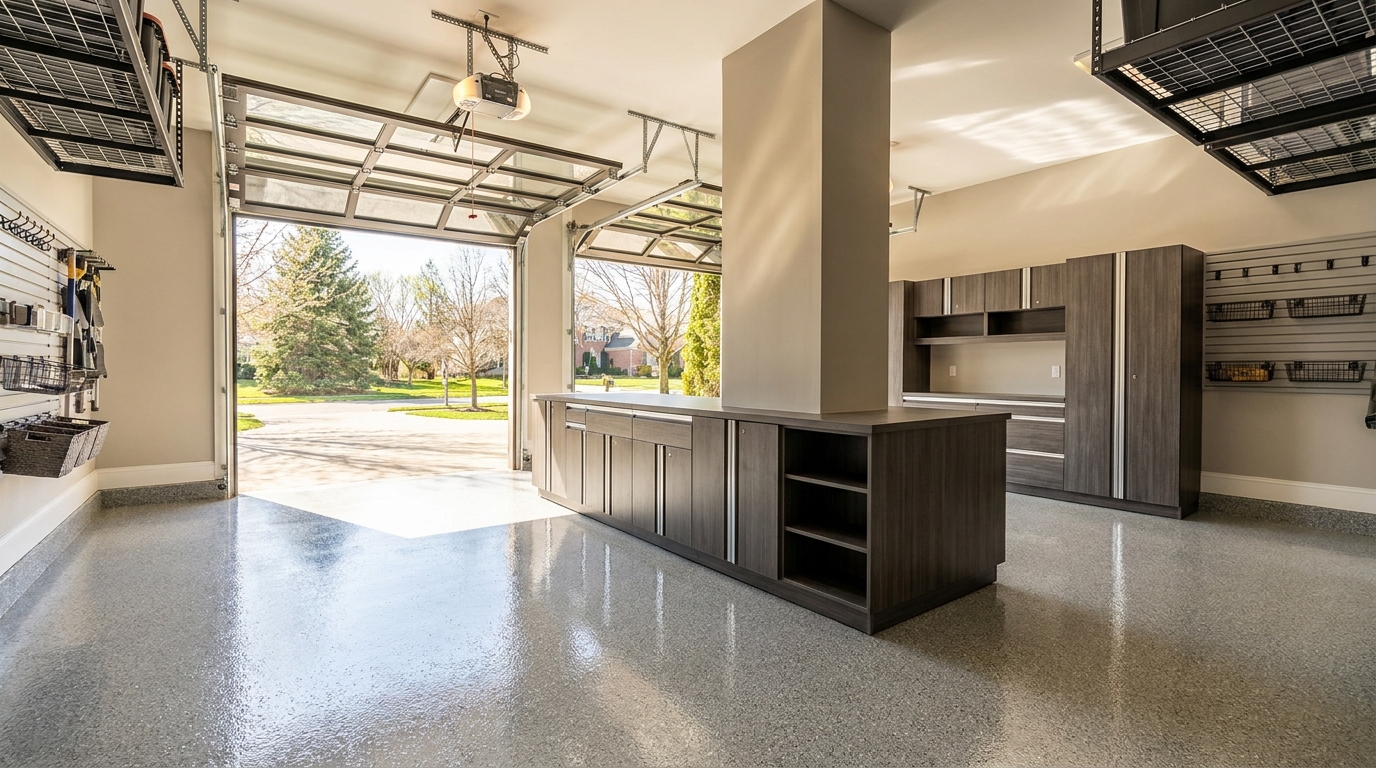
Motorized Overhead Garage Storage vs Static Rack

A static ceiling rack is the better fit when items sit up there for months, the weight is well inside the rack rating, and you are fine loading from the ground or making a rare, careful ladder trip. A button-lower platform is the better fit when you reach those bins often, the load is bulky, or you want the shelf to come down to the slab so nobody climbs. The published weight number is only half the decision. Access, how often you retrieve the load, and what should never go in the air matter as much as pounds. Our team installs both. We match the system to how you actually store.
Practical takeaways
- Treat a rack rating as the product’s listed capacity, not as proof that your joists can take that load. We size the hardware to your stored weight and to the framing we can hit.
- On our service pages we list ceiling-mounted racks up to 750 lb, wall-mounted overhead racks up to 1,000 lb per rack, and motorized platforms with configuration-based ratings (the dedicated platform page lists engineered ratings up to roughly 600 lb; a smaller smart-lift configuration is listed at 350 lb). Those are our service descriptions, not a building-code fact.
- If you climb to a fixed rack with a bin in your hands, you are working against standard ladder practice. Keep both hands free, or skip the climb.
- Holiday totes, camping gear, luggage, and off-season sports equipment belong overhead when they are dry, boxed, and only needed a few times a year.
- Gasoline, propane, paints, solvents, and oily rags do not belong on a rack or a platform. Daily tools and weekly bikes belong on the wall, not eight feet up.
- Motorized overhead garage storage earns its keep when access, bulk, or a no-ladder household is the real problem. A static rack earns its keep when the load is “store and forget.”
Two ways to use the same unused air
Most Charlotte garages have unused air between the parked hood and the ceiling. The question is not whether overhead storage is useful. It is how you get the load up there and back down.
A static ceiling rack is a steel platform that stays put. We locate joists or wall framing, mount the rack, and set the height so it clears the garage door track and the vehicle. Some of our manual racks can be loaded at ground level and then locked into the ceiling position. Others stay at height, which means you load them from a step stool or ladder. The rack does not move after install. That simplicity is the point.
A motorized platform is a steel deck that lives near the ceiling and comes down to you. On the system we describe on our motorized platform page, a wall switch or handheld remote lowers the deck on synchronized steel cables. You load standing on the slab, send it back up, and park under it once we confirm clearance. Travel is slow and controlled. Mechanical safeguards are meant to hold the platform if power drops. We still walk you through the manual procedure at handover.
Those are different tools. One is a fixed shelf in the air. The other is a shelf that visits the floor.
Weight: the number on the page is not the whole story
Homeowners often ask for “the 600-pound one” or “the strongest rack.” That is the wrong first question. Start with what you will put up there, how that weight is spread, and what the ceiling can take at the bolt locations.
On our overhead garage storage page we list standard ceiling-mounted racks up to 750 lb and wall-mounted overhead racks up to 1,000 lb per rack. On the dedicated motorized page we describe engineered ratings that depend on configuration, listed up to roughly 600 lb. That same overhead page also lists a smaller motorized smart-lift rating of 350 lb. Those figures describe the hardware we install. They are not a lab result you can copy onto any garage, and they are not a substitute for looking at your joists.
Residential code tables treat unused attic space as a light live load, not as a warehouse floor. Ohio’s residential code (an International Residential Code-style table used by many states) lists uninhabitable attics without storage at 10 pounds per square foot and uninhabitable attics with limited storage at 20. Habitable attics served by fixed stairs sit at 30. Garage floors in that same table are a different line (50 pounds per square foot, plus a concentrated vehicle load).[1] A hanging rack is a set of concentrated loads at lag-bolt locations, not a uniform attic floor. That is why we never shoot into drywall alone, why we find real framing, and why we will say so if the layout needs a custom mount.
A few rules we use on site: weigh the plan, not the wish (a tote of books is not a tote of wreaths). Spread the load instead of piling one corner. Treat a published “up to” number as a ceiling, not a target. Keep enough height for the car. If you need more capacity than one motorized deck should carry, we often pair a static overflow rack with a motorized bay for the bins you actually retrieve.
Access and ladder risk (this is the real fork)
The functional difference is not “steel versus steel.” It is whether your body has to go up.
NIOSH, last reviewed in March 2024, notes that ladder fall injuries happen at work and at home. Each year in the United States, more than 100 people die and thousands more are injured in ladder-related falls. Recurring causes include a wrong extension-ladder angle (in about 40 percent of cases the base slides out), the wrong ladder, skipped inspection, improper use (overreaching, carrying objects, slips), and a lack of training. Homeowners usually never get that training.[2]
Virginia Tech Environmental Health and Safety restates the workplace burden this way: falls from ladders account for 20 percent of fatal and lost-work-day injuries in general industry. That is a workplace figure, not a garage census, but it is a reminder that a six- to ten-foot climb is not a casual errand.[3]
OSHA’s construction ladder rule is plain about how a person is supposed to climb. A non-self-supporting ladder should sit at roughly a 4-to-1 angle (the base about one-quarter of the working length out from the top support). The user faces the ladder, uses at least one hand to grasp it, and must not carry any object or load that could cause a loss of balance and a fall.[4] OSHA’s 2019 interpretation of the general-industry rule says the intent of the “one hand to grasp” requirement is three-point contact: two hands and one foot, or two feet and one hand, while climbing.[5]
Now picture the typical static-rack moment. You need the Christmas bins. You set a stepladder on a dusty slab, climb with a tote in one hand, lean to clear the 2-inch lip, and try to see over the box. That sequence breaks the “hands free, no carried load, no overreach” pattern in one trip. A ground-load manual rack (load on the slab, then lock the rack up) avoids some of that. A motorized platform avoids the climb entirely for that bay.
We are not saying a ladder is illegal in your garage. We are saying the agencies that study falls keep repeating the same rules, and retrieving a 30-pound bin from a six-foot rack is a textbook way to ignore them. If that retrieval happens twice a year and you are steady on a ladder, a static rack can still be the honest choice. If it happens every month, or if anyone in the house should not climb, motorized overhead garage storage is the system that matches the risk.
Access details that decide installs: frequency (once-a-year decor can live on a static rack; gear you want in March and October is a better motorized candidate), bulk more than pounds (a huge tree box is harder at height than a dense crate), who will actually use it, and whether a motorized deck has a clear landing zone.
What belongs in the air, on the wall, or out of the garage
Overhead storage is for items that are dry, contained, and patient. It is not a second hazardous-materials locker.
Good overhead candidates: holiday decorations in closed totes, camping and beach gear, luggage, off-season clothing bins, archived files, bulk paper goods, and sports equipment you do not need every weekend. On a motorized deck, add the bulky items you refuse to hoist over your head.
Better on the wall or in cabinets: weekly-use tools, bike helmets, extension cords, kid gear you grab after school, and anything that leaks or rusts. A slatwall hook beats a ceiling tote for a rake you use after every storm.
Keep off the ceiling, and often out of the attached garage: gasoline, oil, paints, varnishes, and propane. The U.S. Fire Administration tells households to store oil, gasoline, paints, propane, and varnishes in a shed away from the home, and it notes that garage fires tend to spread farther and cause more injuries and dollar loss than fires that start in other areas of the house.[6] Minnesota’s State Fire Marshal, summarizing NFPA 58 (Liquefied Petroleum Gas Code) for residential occupancies, is more specific on cylinders: containers larger than 1 pound must not be stored or used indoors at a residential property, including attached and detached garages. The 20-pound grill cylinder is the common example. Empty cylinders are treated as full.[7]
A “just the grill tank until Saturday” habit is still indoor LP-gas storage. A ceiling rack does not make it safer. A leaking valve can fill a bay, and a garage already has ignition sources (the opener, a charger, a water heater in some layouts). Fuel stays low, outside, and away from the house. An approved gasoline can on the floor of a detached shed is a different conversation than a can on a platform over the sedan.
If an item can spill, off-gas, or ignite, it does not go in the air. If you need it this week, it does not go in the air either. Closed holiday totes, camping bins, and luggage are the usual ceiling load. Weekly bikes and daily tools stay on the wall. Gasoline, oil, paint, varnish, and any propane cylinder over 1 lb stay outdoors (or in a shed away from the house), never on a rack.
When a static ceiling rack is the right fit
Choose the fixed rack when the problem is volume, not retrieval. Families who box the holidays in January and do not think about those bins until December are the classic static-rack household. The same is true for archived files, extra paper goods, and camping gear that travels twice a year.
Static racks also win on simplicity. There is no motor, no switch, and no travel path to keep clear. Once we set height for the door and the vehicle, the system sits there. Our 8-foot sections can combine into a larger platform, and wall-mounted overhead racks help when ceiling framing is awkward or when you want the load carried back into the wall.
A static rack is a weaker fit if every retrieval means a ladder and a heavy, awkward box, or if the only person who will climb is the one person who should not. Ground-load manual racks sit in the middle: a static shelf once raised, but you load on the slab. If your pattern is “rare, but heavy,” ask about that option before you assume you need a motor.
When motorized overhead garage storage is the right fit
Choose the button-lower platform when the problem is access. Typical tells: you leave seasonal bins on the floor because “we will need those.” Someone in the house should not climb. The items are bulky more than they are dense (tree boxes, stadium chairs, coolers). You want the air above the hood used, and you want to load at waist height. Or you already have static racks and still have a pile you will not climb for.
Our motorized platform is built around that use. You stand on the slab, load, and send it up. You do not wrestle a tote at the top step. For bikes, kayaks, and Jeep tops, we also install dedicated motorized lifters so those pieces do not consume the main deck.
Motorized is a weaker fit when the ceiling is too low, the framing will not accept the mount, or the load is over the configuration we can install. Most candidates we see have a nine-foot or taller ceiling and ordinary joist or truss construction. We verify that before anything is ordered. It is also a weaker fit if you want a “set it and forget it” bay for items you will not touch for a year. Spend the motor budget on the bay you will actually lower.
Many garages need both: a static run for true archive, and one motorized platform over the hood for the bins you live with. That hybrid is often the honest answer.
How we decide in your garage
We do not pick a system from a catalog photo. We measure.
On site we record ceiling height, joist or truss layout, door-track travel, opener location, lights, HVAC, and the height of the vehicle underneath. We ask what you are storing, roughly what it weighs, and how often you retrieve it. Those three facts (structure, stuff, frequency) pick the hardware.
Then we lay out clearances so a raised platform or rack does not fight the door or the hood. We only anchor into structure. If the joist layout is poor for a four-point motorized hang, we redesign. If a static rack plus wall storage solves the pile without a motor, we say that too.
A straightforward static run is usually a single day. Motorized adds time for power, controls, and a loaded test cycle. Either way, you get a walkthrough: how to run the system and what load limit you should actually use.
How we can help
Our team installs static ceiling racks, wall-mounted overhead racks, button-lower platforms, and dedicated bike or Jeep-top lifters across the Charlotte metro. We measure the air you are not using and tell you which system matches how you store. If the honest answer is a simple rack, we will not talk you into a motor. If it is motorized overhead garage storage, we will show you why the climb is the part worth removing.
Have more questions or want to get in touch? Visit our contact page to book a free in-home consultation. We will measure, plan the load, and leave you with a written quote.
Citations
- Ohio Admin. Code 4101:8-3-01, Table 301.5 (minimum uniformly distributed live loads). Legal Information Institute, Cornell Law School. https://www.law.cornell.edu/regulations/ohio/Ohio-Admin-Code-4101-8-3-01
- National Institute for Occupational Safety and Health (NIOSH). “Falls from ladders are preventable: Make ladder safety a priority.” Last reviewed March 1, 2024. https://archive.cdc.gov/www_cdc_gov/niosh/newsroom/feature/ladder-safety.html
- Virginia Tech Environmental Health and Safety. “Ladder Safety.” https://ehs.vt.edu/programs/occupational-safety/ladder-safety.html
- Occupational Safety and Health Administration. 29 CFR 1926.1053, Ladders (use: 4-to-1 angle, face the ladder, grasp with one hand, do not carry a load that could cause a fall). https://www.osha.gov/laws-regs/regulations/standardnumber/1926/1926.1053
- Occupational Safety and Health Administration. Standard interpretation, June 5, 2019 (intent of 29 CFR 1910.23(b)(12) is three-point contact). https://www.osha.gov/laws-regs/standardinterpretations/2019-06-05
- U.S. Fire Administration. “Basement and Garage Fire Safety.” https://www.usfa.fema.gov/prevention/home-fires/prevent-fires/basement-and-garage/
- Minnesota Department of Public Safety, State Fire Marshal. “LP gas inside buildings” (NFPA 58 quantity limits; no cylinders larger than 1 lb stored or used in residential garages). https://dps.mn.gov/divisions/sfm/fire-code/fire-code-information-topic/lp-gas-inside-buildings