One Hardware Finish for Pulls, Knobs, and Hooks
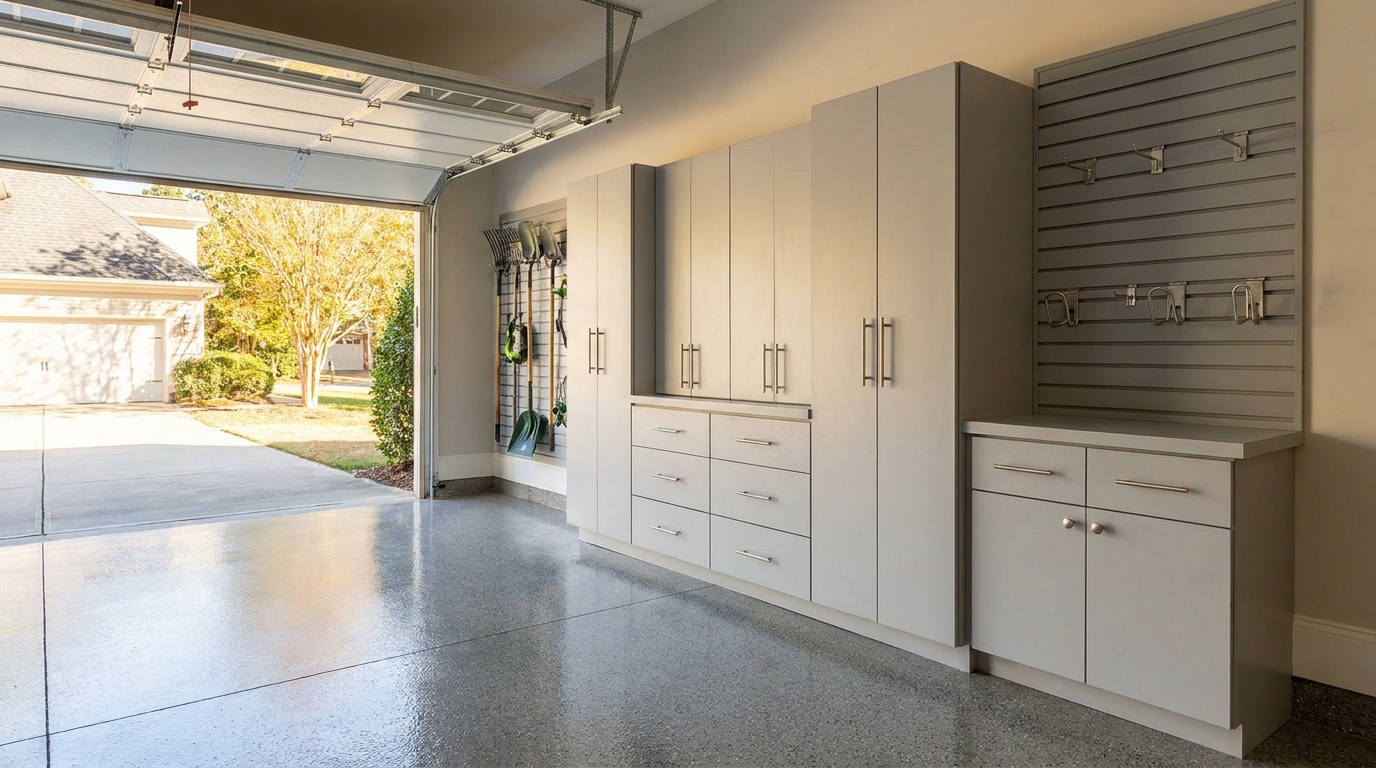
A finished garage in Charlotte, Waxhaw, or Monroe looks settled when the metal agrees from one wall to the next. A matching garage cabinet hardware finish is the decision to name one metal, one sheen, and one color, then use that same finish on the cabinet pulls, the knobs, and the hooks on the slatwall or wall rail. The Builders Hardware Manufacturers Association assigns a code to an architectural finish together with its base material, so a specifier can call for that combination instead of a loose nickname [1]. We treat the garage the same way. One finish is written down, then carried across every piece of metal a person actually sees.
One finish across the finished garage
When our team lays out a garage, the cabinets, the slatwall, and the overhead storage are planned as one room. The face of the cabinet is a finish of its own. Our custom garage cabinets use heat-fused laminated melamine. Signature Series uses that material for the tops, bottoms, shelves, doors, and drawer fronts. The face library runs from metal patterns and wood patterns to solid colors, London Gray, Black, and White among them. The hardware on those doors is a second specification. It is not a side effect of the door color.
On that cabinet work, the hardware finishes we install are brushed chrome, black powder coat, or oil-rubbed bronze. Those three are not shades of one another. Brushed chrome is a cool silver with a dulled, directional surface. Black powder coat is a coated black. Oil-rubbed bronze is a dark, warm metal. Pick one. The pulls, the knobs, and the hooks should all be that one.
A door in Black, White, London Gray, or any other face color does not choose the hardware for you. A black door can take a black powder coat pull, or it can take brushed chrome, and either pairing can look deliberate. What does not look deliberate is a brushed chrome pull on the tall cabinet, an oil-rubbed bronze knob on the drawer beside it, and a bright silver hook on the slatwall a step away. The eye lands on the disagreement before it lands on the storage.
This article is about that seen metal. How a door or drawer closes is a different specification. We have written elsewhere about soft-close hardware specified once for a whole cabinet run. Closing action is not the finish, and a soft hinge does not answer the color of the pull.
What the finish code is actually naming
Homeowners often say chrome, or black, or bronze, and mean a color family. A finish standard asks for more than the family. ANSI/BHMA A156.18, the American National Standard for Materials and Finishes, is written so that a combination of architectural finish and substrate can be called by a code number. The public highlights use 605 as the example: clear coated bright brass, formerly US3 [1]. The same page prints a short table: bright brass, clear coated, is 605 (nearest former US equivalent US3); satin bronze, clear coated, is 612 (formerly US10); bright nickel plated, clear coated, is 618 (formerly US14); bright chromium plated over nickel is 625 (formerly US26); and satin nickel plated, blackened, satin relieved, and clear coated is 620 (formerly US15A) [1].
Two lessons sit in that table, and neither one requires a homeowner to memorize the numbers. First, bronze is not one finish. Satin bronze, clear coated, has its own line, and that line is not the same as a nickel finish that has been blackened and relieved. Second, brightness is part of the specification. Code 625 is bright chromium, not a dull or brushed chromium. If the only word on the order is chrome, the bright piece and the brushed piece can both be defended as chrome, and they will not agree on the wall.
Our cabinet page does not publish a BHMA code beside brushed chrome, black powder coat, or oil-rubbed bronze, and we do not invent one. We reorder from the words we actually install. A memory of something silver is not a specification.
For finishes certified to A156.18, the highlights describe a salt spray evaluation, with failure called out as corrosion, staining, or blistering, plus wear and chemical checks that include pencil hardness, abrasion, and perspiration resistance [1]. Ultraviolet exposure is on the list because light changes coatings, and the highlights name chipping, flaking, cracking, color loss, and a shift from clear toward white, yellow, or brownish as visual failure modes [1]. A garage in Mecklenburg County or Union County is not a test lab. Two pieces that match on day one can still age on different schedules if the coating and the metal under it are not the same. Naming one finish is how we keep that schedule shared.
In the November 2020 revision, BHMA's public update notes say the finishes standard added language and a code for custom finishes, moved visual finish matching into an appendix, clarified humidity language, and updated referenced standards, including ASTM B117-18 [5]. The notes do not print the custom-finish number on that page, so we do not guess it. We borrow the habit instead. Name the finish, and check every seen piece against that name.
Brushed, satin, and bright are not the same note
The same highlights define two words that show up whenever someone describes garage hardware. Satin is a smooth dull finish, with or without a directional pattern. Relieved means set off by contrast through the partial removal of finish, creating a brushed, satin, or antique effect [1]. Brushed and satin are related. Neither word means bright. A polished edge beside a brushed center is a relieved look. An antique effect lives in that family of contrast. It does not live in the family of mirror chrome.
Brushed chrome and a bright chrome hook can both read as silver at noon and split apart under the garage lights at night. Oil-rubbed bronze and a black powder coat hook can both read as dark until the bronze catches a warm highlight and the powder coat stays flat. The difference is the specification, not the hour you approved the sample.
BHMA's numbering explanation says building hardware should be specified by the product number so brand names, performance standards, and grade do not get mixed up [3]. In that numbering, the first numeral designates the base material [3]. The published example works out to a Grade 1, back-mounted stainless steel cabinet knob [3]. The color you see still has to be named. The type number was never a substitute for the finish.
A Department of Veterans Affairs door hardware section, written for National Cemetery Administration projects, makes the same split concrete. The submittal schedule includes a field for the ANSI/BHMA finish designation [6]. Exposed surfaces of hardware are required to have ANSI A156.18 finishes as specified in the section, with a default of 626 or 630 on exterior and interior surfaces except where another finish is specified [6]. The base-metal table under those codes pairs 626 with brass or bronze, 630 with stainless steel, and 652 with steel [6].
We are not installing cemetery door hardware, and we are not telling a Waxhaw or Monroe household to adopt code 626. Brushed chrome on our cabinets is the plain-language finish on our cabinet page. It is not a claim that the piece carries number 626, and oil-rubbed bronze on that page is not a claim that it carries a bronze code from the highlights table. The method is what transfers. One finish is written for the exposed metal, and any exception is written on purpose.
Pulls, knobs, and the hooks that have to follow
Pulls and knobs are cabinet hardware in ordinary speech, and they are cabinet hardware in the standard. The 2026 highlights for ANSI/BHMA A156.9 say the cabinet hardware standard covers nearly one hundred types, including hinges, knobs, pulls, catches, shelf rests, standards and brackets, rotating shelves, and track with guides for sliding panels [2]. The tests described in those highlights are operational, cyclical, and strength tests. The highlights give one example of strength: pulls shall support a 75 lbf test load without chipping, disassembly, or breakage of the part or the screws [2]. A pull can meet that load and still be the wrong color beside its neighbor. We do not let the strength conversation stand in for the finish conversation.
On the cabinets we install, the seen hardware choice is brushed chrome, black powder coat, or oil-rubbed bronze. A hinge that disappears when the door is closed is not part of the picture. A hinge or latch that stays visible joins the same finish note as the pull. A bar pull and a smaller knob can differ in length and still be one finish. Length is not color. If the tall cabinets take brushed chrome, the drawer knobs are brushed chrome too.
The worktop is a separate material. Maple butcher block, stainless steel, graphite black, and faux butcher block laminate are worktop choices on our cabinet work. A stainless top is not a brushed chrome pull. If the metal in the room is meant to agree, we look at the worktop in the same pass as the pulls and the hooks, and we write the exception when a material cannot take the same coating. A third metal on the hooks, one nobody discussed, is the result we avoid.
Slatwall is where that note usually gets dropped. Our garage slatwall is extruded PVC, with hooks that lock into the slat. The panel has its own color, pigmented through the PVC, chosen so the wall can coordinate with the cabinets. That panel color is not the hook's metal. A Graphite panel does not make a hook graphite, and color-coordinated screws and trim are about installing the panel, not about the hook you hang a ladder from.
A wall rail follows the same rule. It is a line of metal near eye level, and a different sheen from the cabinet pulls is what you notice when you pull the car in. We specify the hook finish with the pull finish before anything is ordered. If a hook shape is not made in the finish already chosen, we pick a shape that is, or we change the finish for the whole set. We do not switch the metal on the hook alone.
Air Force corporate facility standards for doors and windows say to provide a hardware style and color consistently throughout a facility [4]. The preferred examples on that page are neutral colors with a brushed finish, such as satin chrome, nickel, or stainless steel, with brass or bronze reserved for certain facility groups and historical work [4]. The same page says hardware finishes should stay durable and should not show excessive wear over their lifespan [4]. That page is about facility doors, not a Union County garage, and it is not a rule we paste onto a house. The decision is still the same one we make with you. One style. One color. Brushed if brushed.
For an existing building, the Veterans Affairs section says to match the finishes of hardware in similar existing spaces, except where something else is specified [6]. When we add cabinets or slatwall beside pulls already on the wall, we start from that finish, or we replace the seen metal as a set. A close-enough hook is still a second finish, and under the garage lights it reads as a miss.
The pieces that are allowed to differ
Even a strict public specification names the pieces that are allowed to differ. In that Veterans Affairs section, door closers may take a factory paint in a dull or satin aluminum color, a dull brass color, or a bronze color, and thresholds are mill finish aluminum [6]. Those lines exist because a closer body and a threshold are different objects, not because the levers may be mixed. Fastenings in the same section are called out to suit the hardware in material and finish, and fastenings exposed to weather are required to be nonferrous metal [6]. On a residential garage we are not writing a federal fastening schedule. A seen screw still joins the finish note. A hidden fastener can be the one the piece needs for a solid mount.
Overhead storage, when the plan includes it, is structure and clearance. A floor coating is its own material. Epoxy, polyurea, and polyaspartic are different coatings, and none of them selects the cabinet pull.
Sheen also depends on the light in the room. In a Charlotte garage with hard afternoon sun, or a Monroe garage that lives mostly under its own fixtures, we look at the sample in that light. Brushed chrome can look quiet in the driveway and livelier under a cool lamp. Oil-rubbed bronze can look nearly black until a warmer lamp finds the brown in it. Black powder coat tends to stay flat, which is why it should not impersonate bronze. We write one of three names: brushed chrome, black powder coat, or oil-rubbed bronze.
If the pulls already on the wall are worn or were never a single finish, we reset the seen metal as a group when the new cabinets or the new slatwall go in. Across Mecklenburg County and Union County the garages differ in width and ceiling height. The finish decision does not. One metal, written once, on the pulls, the knobs, and the hooks.
Practical takeaways
- Choose one hardware finish for the pulls, the knobs, and the hooks, and write the name in words you can reorder later.
- On our cabinet hardware, that choice is brushed chrome, black powder coat, or oil-rubbed bronze. Do not mix them and call it coordinated.
- Keep cabinet face color separate from hardware metal. A black, white, or London Gray door does not select the pull.
- Treat sheen as part of the finish. Bright and brushed are different specifications, even when both look silver at a glance.
- If a hook shape is not made in the chosen finish, change the shape or change the finish for the whole set. Do not change only the hook.
- Match pulls that are already on the wall when you add slatwall, or reset the seen metal together. A near miss is still a second finish.
- Leave strength, soft-close action, panel color, worktop material, and floor coatings on their own lines. They do not stand in for the metal finish.
How we can help
Have more questions or want to get in touch? Our team can walk the garage with you and set one hardware finish for the cabinets and the hooks before anything is ordered. Contact Total Garage Charlotte.
Citations
- Builders Hardware Manufacturers Association, "A156.18 - 2020 Materials and Finishes" (2020)
- Builders Hardware Manufacturers Association, "A156.9 - 2026 Cabinet Hardware" (2026)
- Builders Hardware Manufacturers Association, "BHMA Product Numbering" (n.d.)
- Air Force Corporate Facilities Standards, "Air Force Corporate Facility Standards | Doors and Windows Hardware" (n.d.)
- Builders Hardware Manufacturers Association, "Standards Updates" (2020)
- U.S. Department of Veterans Affairs, "Section 08 71 00 Door Hardware" (2023-10-01)