A Trash and Recycling Cabinet That Matches the Cabinet Run
A garage trash and recycling cabinet should be a cabinet in the run, not a freestanding can standing next to one. We build that bay at the house-door end, with the same door style, finish, and hardware as the doors beside it, so the walk in from the kitchen still reads as millwork. The U.S. Environmental Protection Agency recommends keeping the trash bin and the recycling bin together, which is the pair this cabinet is sized to hold [1]. The bins sit behind the door. The wall keeps its line.
A door that belongs to the run
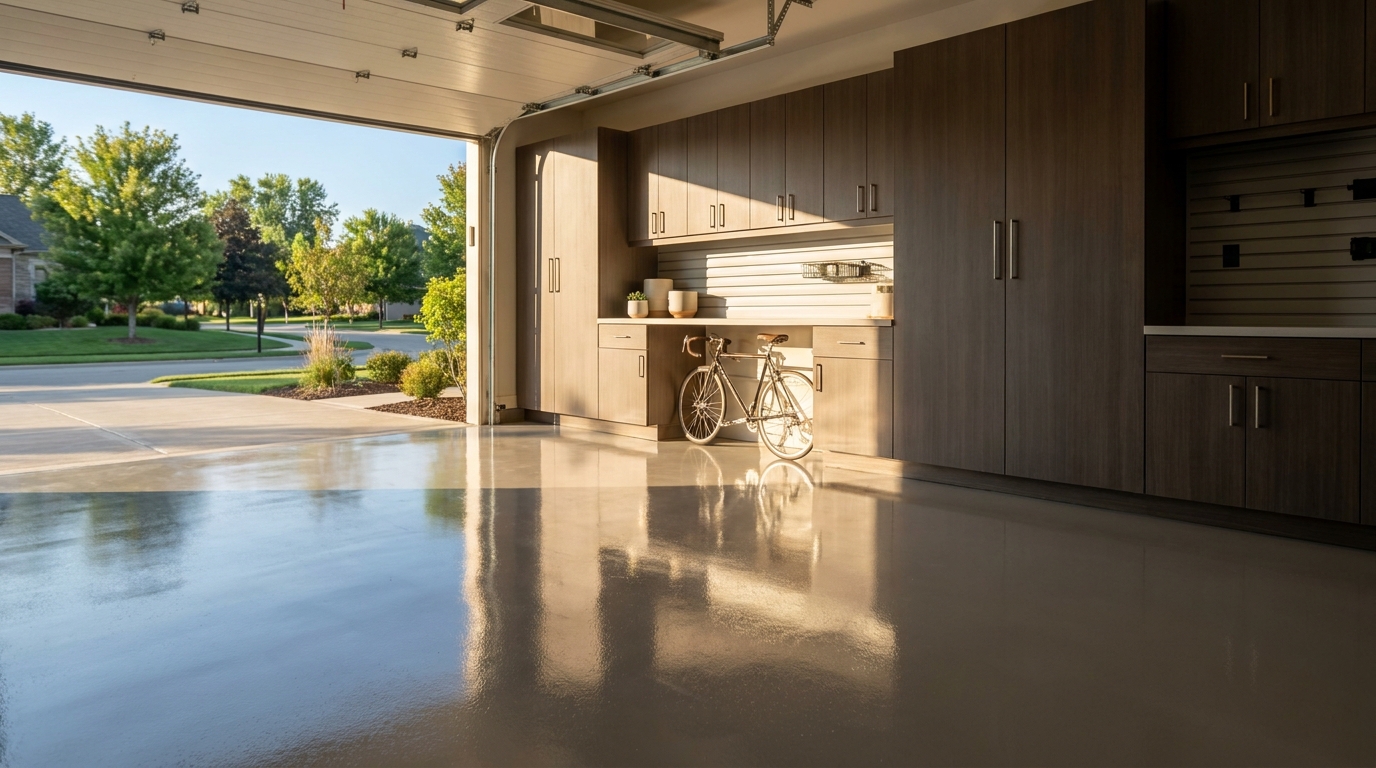
The garage we like to hand over is a room you are glad to walk into, and cabinetry is what makes that wall feel finished. A bin parked in front of it undoes the face we just built. Trash and recycling live inside a bay ordered with the rest of the run, in the same heat-fused laminated melamine, on the same soft-close hinges, with the same pull.
From the house doorway you see a continuous row of faces. Open the door and the bins are there, one for household trash and one for recycling. Close it, and the wall is quiet again. We draw this bay with the cabinets around it, and our crew installs it with them, on the same hinge the rest of the run uses.
At the house-door end
We put this cabinet at the house-door end of the run, the end you reach first coming in from the kitchen with a rinsed jar or the last of the mail. In Charlotte, and in Waxhaw and Monroe across Union and Mecklenburg counties, that door may land at the start of a wall or farther along it. We still start there. The cabinet sits at the end of the run nearest the house, even when the wall continues past it, so the first face you see belongs with the rest.
Two bins in one cabinet
The EPA's recycling guidance reads like a cabinet note. Put the recycling bin and the trash bin together so it is easy to recycle, keep recyclables clean and dry, keep food and liquids out of the recycling bin, keep plastic bags and wraps out, empty and flatten cardboard, and check the local program before anything goes in [1]. One open can cannot do that. Two bins, side by side, behind one door, can.
The recycling side stays an open bin you empty loose. Mecklenburg County says not to bag recyclables, because bagged material cannot be recycled in that program [2]. The trash side takes ordinary household waste. A rinsed container goes in the recycling bin, and anything that does not belong goes in the trash [1].
The list the cabinet is built around
Mecklenburg County does not collect curbside trash or recycling. The City of Charlotte or one of the towns does the pickup, and households in unincorporated parts of the county who want curbside service contract a hauler [3]. The county processes the recyclables at its materials recovery facility, and it asks every Mecklenburg resident to follow the same guidelines for what can be recycled at home [3]. Items that are not on the list contaminate the recyclables and can make whole loads unacceptable to the end users who take the sorted material [3].
The county's current curbside list includes plastic bottles, jugs, containers, and cups; paper cups, cartons, and juice boxes; empty aerosol cans; aluminum cans; cereal boxes; flattened cardboard; clean pizza boxes; glass bottles and jars; tin and steel cans; brown bags and high-grade paper; junk mail; and magazines and newspapers [2]. It now also accepts plastic clamshells, takeout containers, drink and yogurt cups without straws, and plastic dairy containers [2]. If an item is not on that list, it is not curbside recycling in this program [2].
Mecklenburg County does not follow the plastic numbering system, because many products are incorrectly numbered [2]. The EPA makes the same point nationally: the resin number inside a triangle identifies the plastic type, and that symbol does not necessarily mean a community will collect the item [4].
One list does not cover every address we serve. A Charlotte home on the county facility can use the county list. A home in Waxhaw or Monroe, or anywhere a different program applies, needs that program's list. The EPA's first instruction is to check locally [1]. Our team asks which list you use. The millwork stays the same. A note, if you want one, goes inside the door and can name accepted items and refusals such as plastic bags and film, which the county sends to a staffed or full-service center rather than the curbside cart [2].
The face, the hinge, and the pull
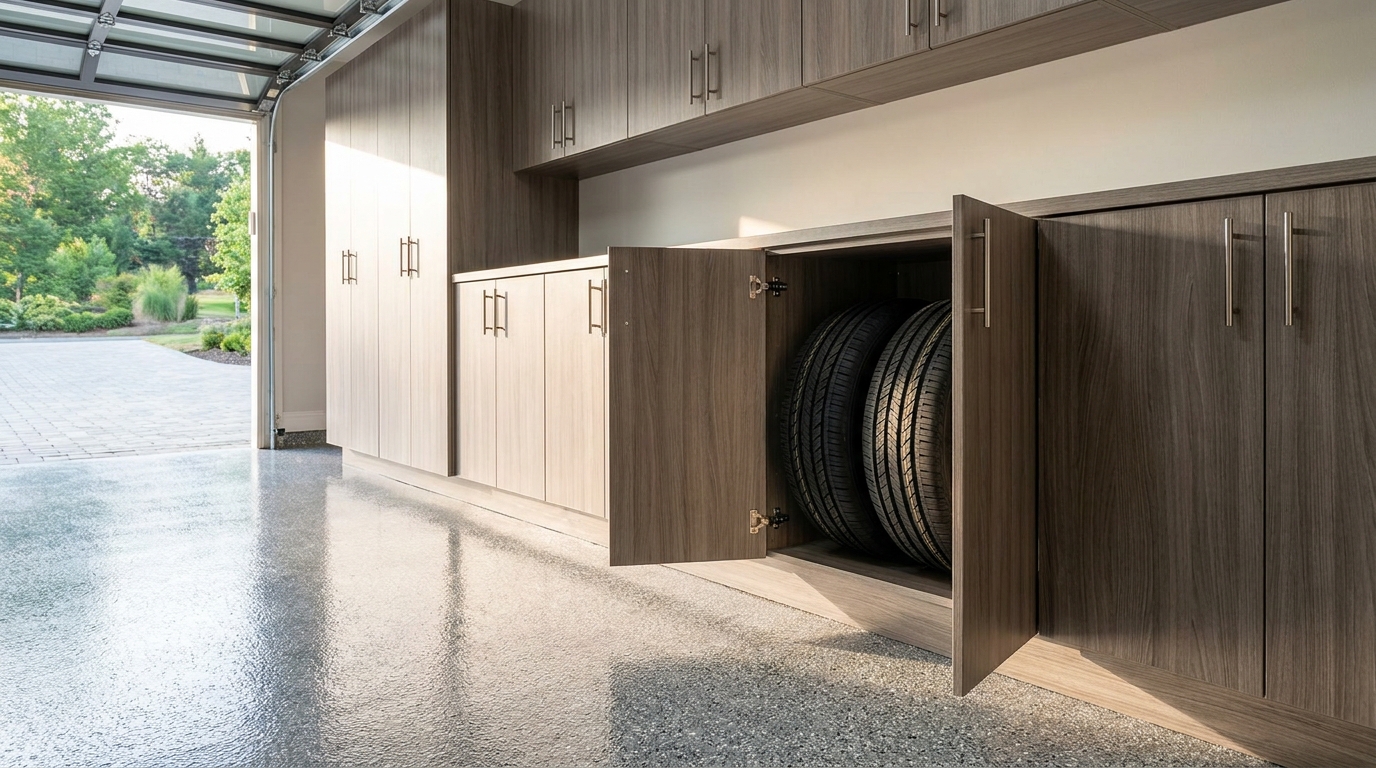
Heat-fused laminated melamine is how that door stays in the family of the run. The Composite Panel Association's voluntary Thermally Fused Laminate Panel Standard, issued May 1, 2025, describes thermally fused laminate as a hot-press process: resin-impregnated décor paper is fused directly to a substrate, and heat and pressure seal the surface without a separate glue line [5]. The surface can be a solid color or a printed décor [5]. A trash door can wear the same color and grain as the door beside it because the face is a fused sheet.
That 2025 standard is written for interior decorative panels on particleboard, medium-density fiberboard, or hardwood plywood, and it points those substrates to the EPA formaldehyde standards in 40 CFR Part 770 [5]. EPA's rule, published on December 12, 2016, covers hardwood plywood, medium-density fiberboard, and particleboard, and it has required those products, including finished goods that contain them, to be labeled TSCA Title VI compliant since March 22, 2019 [6]. We use the standard for how the face is made, not as a weather rating, because its scope is interior decorative panels [5].
ANSI/BHMA A156.9-2026 sets cycle, strength, and operational tests for cabinet hinges, knobs, and pulls [7]. In that standard, a Grade 1 hinge is tested for 100,000 cycles, and a pull is tested to support a 75 lbf load without chipping, coming apart, or breaking [7]. A concealed hinge, in the same standard, is one installed so it cannot be seen from the outside when the door is closed [7]. Those figures describe the tests. They are not a Grade 1 label on a particular hinge here. What we specify is the same hinge style, the same pull finish, and soft-close hinges, so this door closes like the doors farther down the wall.
Kitchen cabinetry has its own boundary. The Kitchen Cabinet Manufacturers Association describes ANSI/KCMA A161.1 as the performance standard for kitchen and vanity cabinets, not as a garage specification [8]. In a January 2023 account of that program, doors swing through 90 degrees for 25,000 cycles and must still operate, with no visible hinge damage and no loosened connections [8]. That same 2023 account describes finish tests using household spills, including juice, ketchup, coffee, olive oil, and mustard [8]. A house-entry cabinet sees that kind of daily swing, which is why this bay is cabinetry.
An opening sized to the bins you use
No single bin fits every household. During the on-site measure, our team sets the clear width, height, and bottom around the bins you will use. A tall bin needs a clear interior. Two slimmer bins need room to sit without rubbing, and the door still has to line up with its neighbors so the horizontal lines of the run stay continuous.
The curbside cart is a different object. It goes out on collection morning. The cabinet holds the pair you live with between pickups. Because county recycling has to go in loose, the recycling bin is one you can lift and empty, not a bag you throw [2]. Cardboard that the EPA says to empty and flatten gets folded before it goes in, and a box that will not fit can go out with the cart the same way [1][2].
If the run leaves the floor clear underneath, the bins still sit on a solid bottom at a height that lines up with neighboring doors. We set that height with the rest of the elevation, keep switches reachable, and check the cabinet door against the house door so the two swings do not fight.
What stays on a different path
The cabinet is for household trash and for the recycling stream your program accepts. Lithium-ion batteries, and devices that contain them, should not go in household garbage or recycling bins, the EPA says [9]. Take them to a battery recycling point or a household hazardous waste collection, and tape the terminals or bag each battery before the trip [9]. Mecklenburg County says the same for curbside carts: bring rechargeable and lithium-ion batteries to a staffed or full-service recycling center instead [2]. A power-tool pack waits for that trip. It does not go behind the matched door.
Plastic bags, wrap, and film stay out of the household recycling bin as well [1]. The county points those materials to a staffed or full-service center, so they are not the liner for this cabinet either [2]. Mail, a rinsed bottle, a flattened cereal box, and kitchen trash each have a bin. The door closes, and the run looks like one piece of work.
Practical takeaways
- Place the garage trash and recycling cabinet in the run, at the house-door end, so the arrival from the kitchen reads as millwork.
- Match the door style, the heat-fused face, and the pull to the cabinets beside it, and use the same soft-close hinge.
- Hold two bins in that opening: trash, and a loose recycling bin you can empty without a bag where the program requires it.
- In Mecklenburg County, follow the county list, not the number on the plastic. The county processes material that a city, a town, or a hired hauler collects [2][3].
- On a Waxhaw, Monroe, or other address with a different program, use that program's list. The cabinet stays. The inside note can change.
- Keep lithium-ion batteries and plastic bags on their own path, out of both bins [1][2][9].
How we can help
Have more questions or want to get in touch? Our team designs this bay with the rest of the cabinet run, measures the bins you will actually use, and matches the door to the wall. Visit our contact page to start the conversation, or look through our garage cabinets to see the finish and hardware family the trash door is meant to join.
Citations
- U.S. Environmental Protection Agency, "What You Can Do to Improve the Recycling Rate" (updated 2026-06-16)
- Mecklenburg County Solid Waste and Recycling, "Recycle Right Curbside Pickup" (2026)
- Mecklenburg County Solid Waste and Recycling, "Municipal Curbside Collection" (2026)
- U.S. Environmental Protection Agency, "How Do I Recycle Common Recyclables" (updated 2026-05-19)
- Composite Panel Association, "Thermally Fused Laminate (TFL) Panel Standard CPA 5-25" (2025-05-01)
- U.S. Environmental Protection Agency, "Formaldehyde Emission Standards for Composite Wood Products" (updated 2026-02-12)
- Builders Hardware Manufacturers Association, "ANSI/BHMA A156.9-2026 Cabinet Hardware" (2026)
- Kitchen Cabinet Manufacturers Association, "Cabinets Certified to Last" (2023-01-17)
- U.S. Environmental Protection Agency, "Used Lithium-Ion Batteries" (updated 2026-03-20)