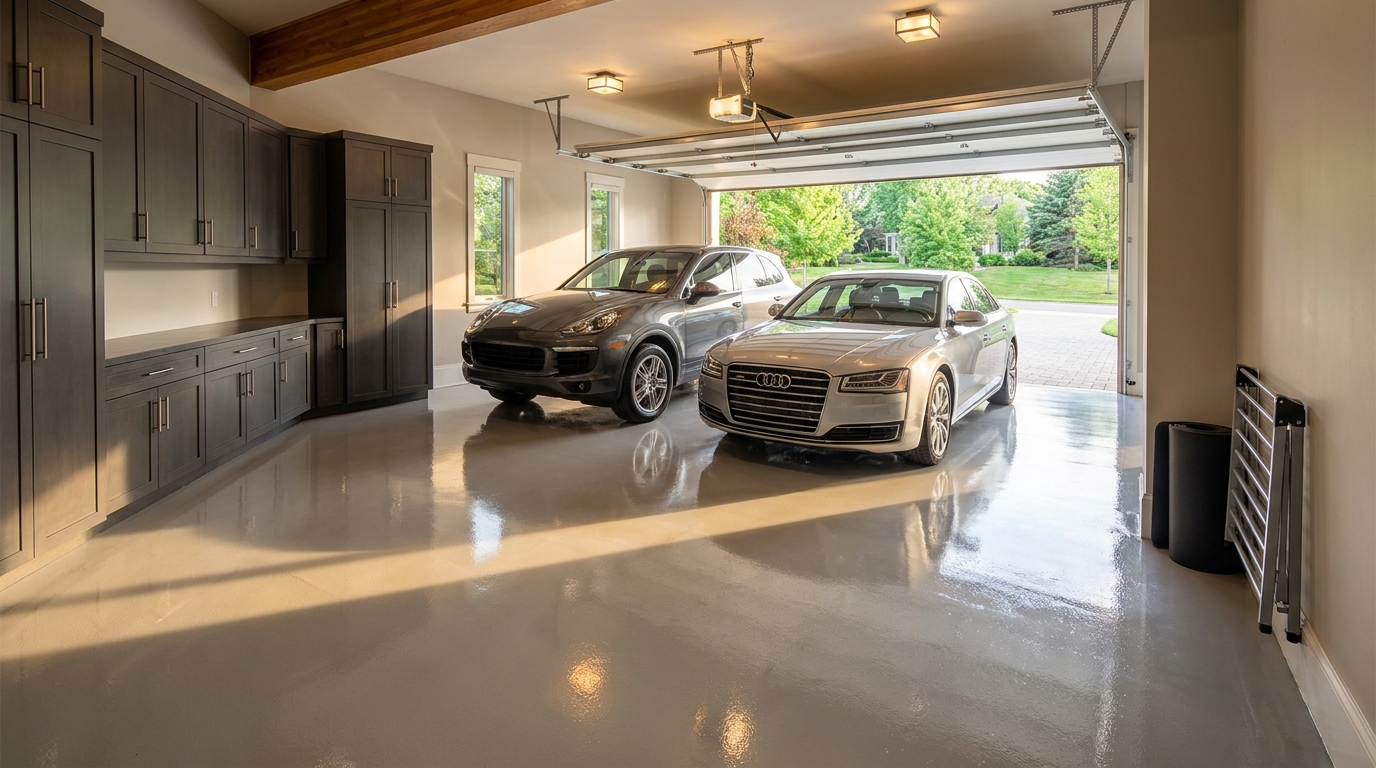
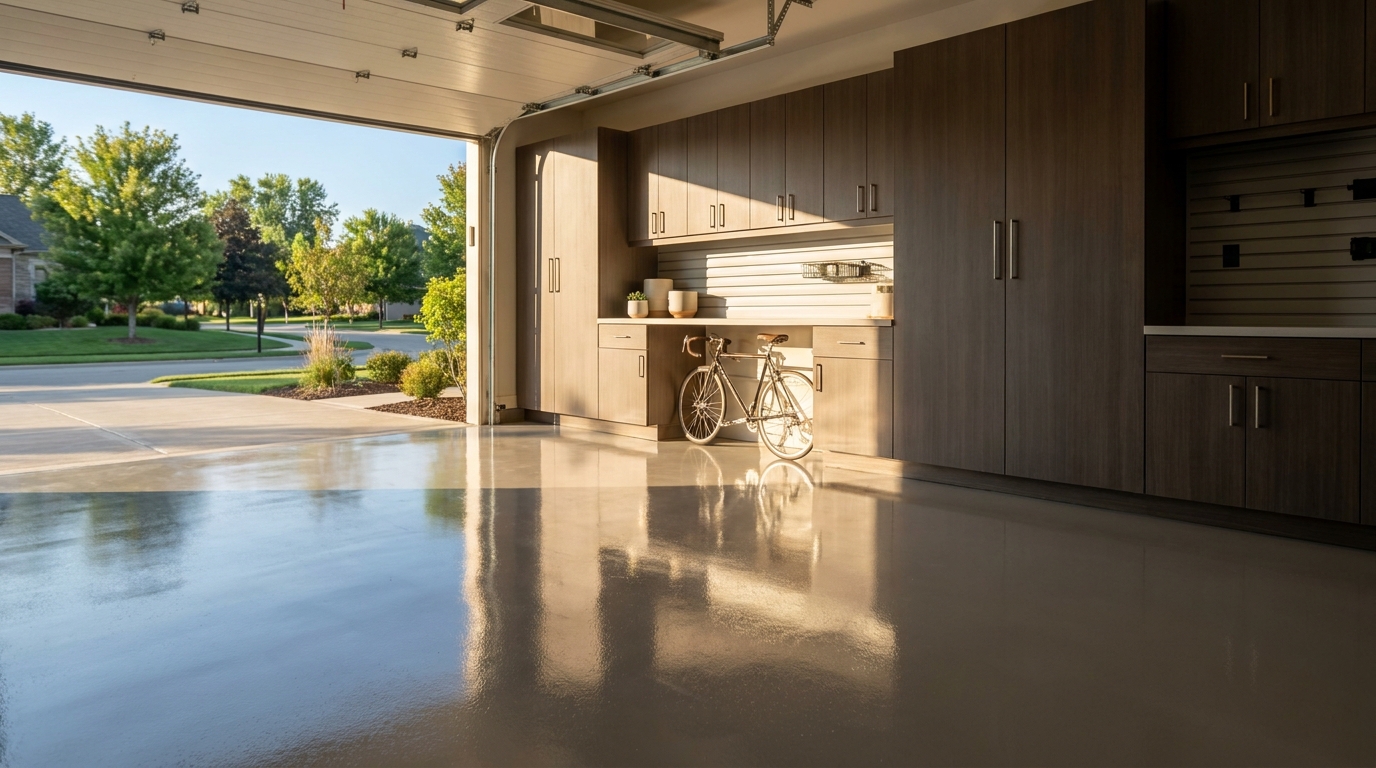
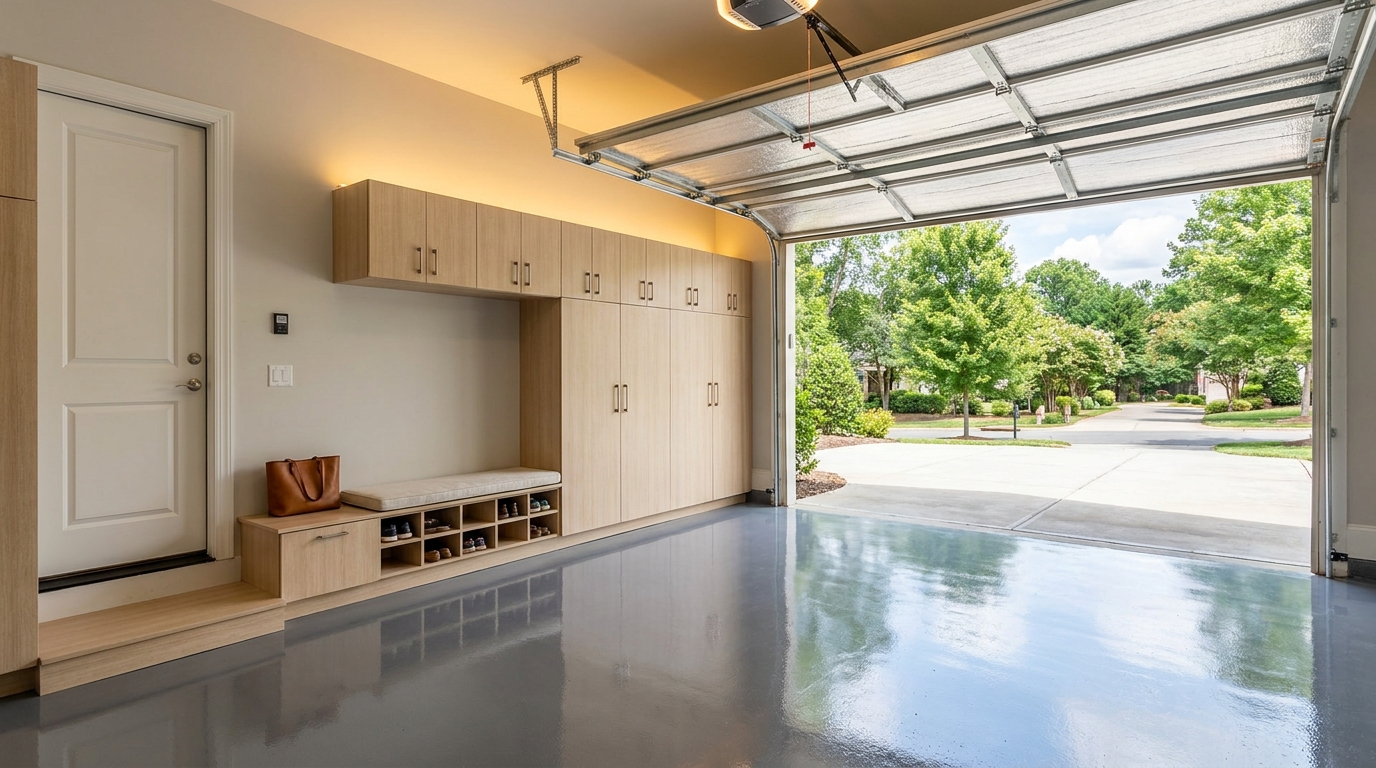
A Tire Cabinet Finished Like the Rest of the Run
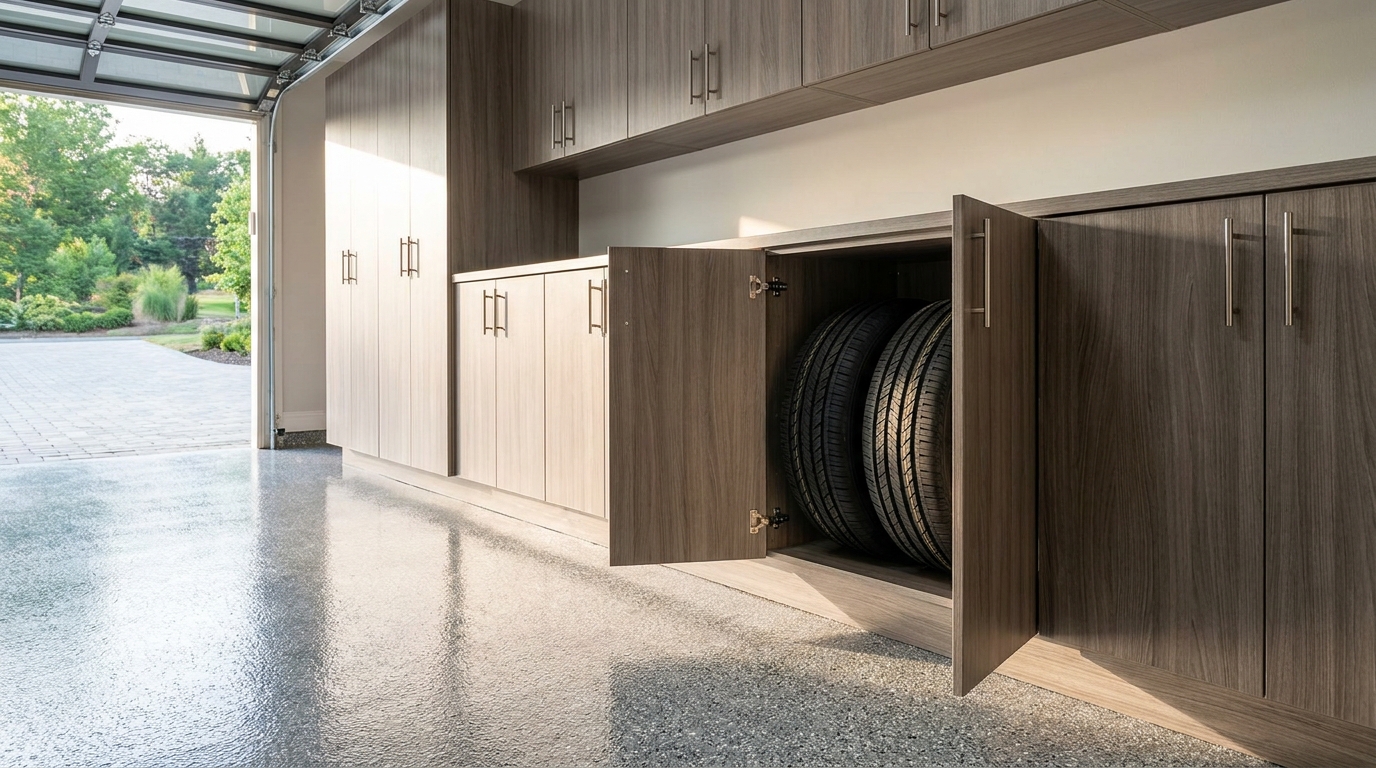
A garage tire storage cabinet, in the garages we design, is a closed bay in the cabinet run. It wears the same heat-fused laminated melamine, the same door, and the same hardware finish as the cabinets beside it, and it is drawn so the seasonal set lives in the room. We plan it that way because a tire off the vehicle belongs in a clean, dry, cool, well-ventilated place, out of direct sunlight, and away from petroleum products and from ozone sources such as electric motors, battery chargers, generators, and welding equipment.[1]
The same face as the cabinets beside it
Some homeowners in Charlotte, Waxhaw, and the surrounding Union and Mecklenburg towns keep a second set of wheels. It might be a snow set for trips toward the mountains, a summer set, or the wheels that came off at the last change and are waiting for their season. The design decision is where that set belongs once the garage is finished as a room.
We do not send it out of the house to make the wall look complete, and we do not leave it as an open stack that breaks the line of the cabinets. The tire bay is specified with the rest of the garage cabinetry. Same door style. Same soft-close hinges. Same finish, whether the run is a wood pattern or a solid color. The hardware is chosen once for the wall, so the tire doors do not introduce a second metal. When the doors are closed, the wall reads as one run. The seasonal set is simply what lives behind those doors.
That is a finish decision and a planning decision at the same time. The bay is not a leftover opening we fill after the tool cabinets are drawn. Our team measures the actual wheels, asks whether they are mounted, and gives that volume a place in the wall before anything is built. Our garage cabinetry page describes both the Signature and Classic lines as manufactured in the United States, and the tire bay is part of that same order, not a rack from a different catalog added on install day.
Shade, indoor air, and an honest limit
The U.S. Tire Manufacturers Association's November 2024 tire storage bulletin recommends indoor storage to protect tires from sunlight, ozone, and other conditions that can damage them, and it notes that poor storage can damage a tire in ways that may eventually lead to failure.[2] Indoors, the bulletin says to keep the area clean, dry, and well ventilated, with only a minimum of circulating air, and to use temperate conditions that are mild, shaded, or dark.[2] It also says to raise tires off the storage surface, on something like a pallet or a rack with a flat, smooth face, so they are not sitting in moisture.[2]
A closed cabinet answers the shade part of that list. The doors are the same melamine doors as the rest of the run, so the set is not sitting in the light that comes through an open garage door. The door does not change the temperature of the garage. Michelin's storage guidance says to keep tires in a cool, dark, dry place, and to avoid garages exposed to temperature extremes, direct sunlight, or ozone sources such as electric motors and generators.[3] BFGoodrich says an interior garage can work well when it is cool, dark, and dry, and kept away from electric motors, generators, and furnaces.[4] Both can be true in the same house. A garage that runs hot through a Charlotte summer, or that drops into a hard cold snap, is still that garage after the doors are hung, so we do not describe the cabinet as climate control.
Ventilation gets the same honesty. The bulletin wants the storage area well ventilated, and it warns against a poorly ventilated space.[2] For covers used outdoors, it says a waterproof cover needs vent openings so it does not become a heat box.[2] We do not build the tire bay as an airtight bin, and we do not wrap the set in a closed bag that traps damp air. The doors close for the finished line of the run and for shade. The air in the bay is still the air of the garage.
Michelin's storage page, updated July 30, 2026, also puts a time line on the difference. Under ideal conditions, cool, dark, dry, and away from ozone, that page says tires can be stored for several years without meaningful degradation. Tires stored in poor conditions, outdoors, in sunlight, or near heat, can crack and degrade in as little as one season.[3] A closed bay aims at the better of those two conditions. It does not stop rubber from aging.
What shares the bay, and what does not
The November 2024 bulletin is specific about neighbors. Do not expose stored tires to gasoline, oil, or other volatile solvents, and do not keep them in the same area as electric motors, battery chargers, generators, welding equipment, or other ozone sources.[2] The tire-facts page says the same about petroleum products and ozone-generating equipment.[1] BFGoodrich adds that ozone can attack rubber and show up as sidewall cracking, and that the surface under the tires should be free of grease, fuel, and solvents.[4]
So the tire cabinet is not the fluids cabinet. Paints, fuel cans, oil, and solvents get their own closed volume if they need a home in the run. A battery charger, a welder, or a motor that runs in place is a placement question. The tire bay goes on a different stretch of wall when the garage has those tools. We are not the electrician, and we do not relocate circuits as part of a cabinet drawing. We do place the cabinet so the stored set is not sitting against that equipment.
Before the set goes in, the prep is the prep the tire makers describe, and it takes one calm pass rather than a project. Note which corner of the car each wheel came from, so next season's rotation is not a guess.[3][4] Wash with water, not a harsh solvent, pick stones out of the tread, and dry the wheels so moisture is not closed in with the rubber.[3] If the tires have white sidewalls or raised white letters, those faces go toward each other, because black rubber can stain them.[3] A card on the inside of the door can hold the corner map with the set.
The deck matters too. Michelin says bare concrete can draw moisture, and it points to a pallet or a storage bag rather than the slab itself.[3] The bulletin wants tires raised off the surface on a smooth support, not a grated one that can indent the rubber over a long sit.[2] In our runs, the seasonal set sits on the cabinet deck or a clean shelf, off the garage slab. The deck is flat. We are not asking the bottom tire to rest on a wire grid.
Mounted wheels and bare tires are not the same drawing
This is where a careful drawing beats a single diagram, because the sources do not all say the same thing.
For tires mounted on rims, Michelin says to hang them or stack them horizontally, and not to store them standing upright on the tread.[3] BFGoodrich says the same: on rims, stack horizontally or hang, because the rim supports the tire. Off the rims, stand them upright side by side and rotate them occasionally, because a stack of unmounted tires can distort the sidewalls.[4] When the homeowner keeps a second set of wheels, we plan for that mounted case. A closed cabinet suits a level stack on the deck better than a hook. We draw the bay for that stack, and we do not treat "stack them" as permission to pile every loose wheel in the house onto the bottom tire.
For bare tires, with no rims, the tire makers and the association diverge, and we will not pretend otherwise. Michelin says not to stack or hang unmounted tires, and to store them standing up.[3] BFGoodrich agrees, and adds an occasional turn so one patch does not carry the whole season.[4] The November 2024 association bulletin, which covers both unmounted and mounted tires, tells storage practice to keep unmounted tires sidewall to sidewall, either stacked horizontally without overstacking, or racked sidewall to sidewall.[2] Too much weight, it says, can damage the tires at the bottom of a stack.[2] Some specialty tires, including certain racing tires, may need still other conditions, and the bulletin sends that question to the tire maker's own note.[2]
Bare casings follow that tire maker's note, plus the shared rules on shade, dryness, fuel, and ozone. A mounted set follows the mounted guidance: a horizontal stack or a proper hang, not a season standing on one patch of tread. Either way, we draw the interior after we see the wheels. We do not publish a stack height from a catalog.
Overhead racks stay a different system
Overhead storage is the ceiling system in the same garage. On that page it is the place for holiday decorations, camping gear, sports equipment, and other items a household needs only a few times a year. We use that volume when the garage calls for it. It is not the tire cabinet.
A bin and a set of wheels ask for different treatment. The wheels want shade, a smooth dry deck, a matching door, and a way out at floor level when the season changes. Overhead racks stay overhead. The tire set stays in the cabinet. Holiday bins can live above the bay door. The wheels live behind a door that matches the doors beside it.
The date on the sidewall, then the placard
The cabinet makes the set easy to live with. It does not inspect the tires. Before stored tires go back into service, the association's bulletin says a tire service professional should look at them, visually and by hand, to confirm they are clean, dry, free of foreign objects, and not showing damage.[2] If the vehicle maker or the tire maker has a service-life recommendation, the bulletin says to ask that manufacturer how storage interacts with it.[2] The last four digits of the DOT tire identification number are the week and year the tire was made, which is the figure that conversation starts from.[2]
Federal tire identification rules say the same thing with more precision. Under 49 CFR 574.5, as displayed in the eCFR with Title 49 current as of October 8, 2026, the date code is the final group of four numerical symbols on the tire identification number. It must identify the week and year of manufacture. The first two symbols are the week, and the third and fourth are the last two digits of the year.[5] We are not a tire shop, and we do not read that code as a substitute for a tire professional. We do leave the set where a homeowner can pull one wheel out, find the code, and take the set to someone whose work is tires.
Michelin's storage page adds its own numbers, and they should stay attached to Michelin. That page says tires older than 6 years should be professionally inspected before use, and those over 10 years should be replaced.[3] That is one manufacturer's guidance, not a statute, and other makers publish their own intervals. The association's tire-facts page says calendar age alone cannot predict the service life of a specific tire, because service and storage conditions vary so widely. The next step it describes is the tire maker's own guideline plus a real inspection. Age matters more, on that page, for full-size spares and for vehicles that are driven very little.[1] A labeled bay makes that check ordinary instead of a search through the garage.
When the set does go back on the car, inflation belongs to the vehicle, not to the number molded on the sidewall. The storage bulletin says to inflate to the pressure on the vehicle's tire placard.[2] Michelin says to check cold, using the placard or the owner's manual, not the maximum printed on the tire.[3] A fueleconomy.gov maintenance page, in estimates revised on June 27, 2016, says that keeping tires at the proper pressure can improve gas mileage by 0.6 percent on average, and by up to 3 percent in some cases.[6] We keep the year on that figure because it is an older estimate. The practical step is simpler than the percentage: the set comes out of the cabinet, and cold pressure is set from the placard. The sidewall number stays a maximum, not the target.
How the bay sits in the room
We draw the tire cabinet in the same pass as the rest of the wall. On site we measure the wall, the ceiling, the door clearances, and the gear that already belongs in the room, and the bay takes its place from that wall and from the wheels themselves.
Our cabinetry is a wall-mounted system, with optional legs, so the run can hold one line along the floor and leave the slab reachable for cleaning. The tire doors sit on that line. If the garage is also getting a floor coating, that coating stays its own system, and the cabinet run, including the tire bay, is planned to sit cleanly above it.
Practical takeaways
- Give the seasonal set its own closed bay in the cabinet run, with the same melamine, doors, hardware, and soft-close hinges as the cabinets beside it.
- Keep the bay shaded and indoors, on a smooth deck off the bare slab, and do not store gasoline, oil, solvents, chargers, or welders in it.[1][2]
- A cabinet door does not cool or heat the garage. If the room runs to temperature extremes, that limit is still real.[3][4]
- Mounted wheels stack horizontally or hang, and they should not stand on the tread for the off-season. Bare tires are a different case, and the tire maker's note wins where it disagrees with a general stack diagram.[2][3][4]
- Before the set returns to the car, read the date code, have a tire professional inspect the tires, and set cold pressure from the vehicle placard, not the sidewall.[2][3][5][6]
How we can help
Have more questions or want to get in touch? Our team will look at the off-season set with you, measure the wall, and plan the tire bay in the same run as the rest of the garage. Reach us through our contact page.
Citations
- U.S. Tire Manufacturers Association, "Tire Facts" (2026)
- U.S. Tire Manufacturers Association, "TISB Vol. 23 No. 6, Tire Storage Recommendations" (2024-11)
- Michelin Canada, "Tire Care | How do I store my tires?" (2026-07-30)
- BFGoodrich, "Tire Storage Guide - How to Properly Store Tires" (2026-09-01)
- eCFR, National Archives, "49 CFR 574.5 Tire identification requirements" (2026-10-08)
- fueleconomy.gov, "Gas Mileage Tips - Keeping Your Vehicle in Shape" (2016-06-27)