A Pet Station Cabinet That Matches the Rest of the Garage
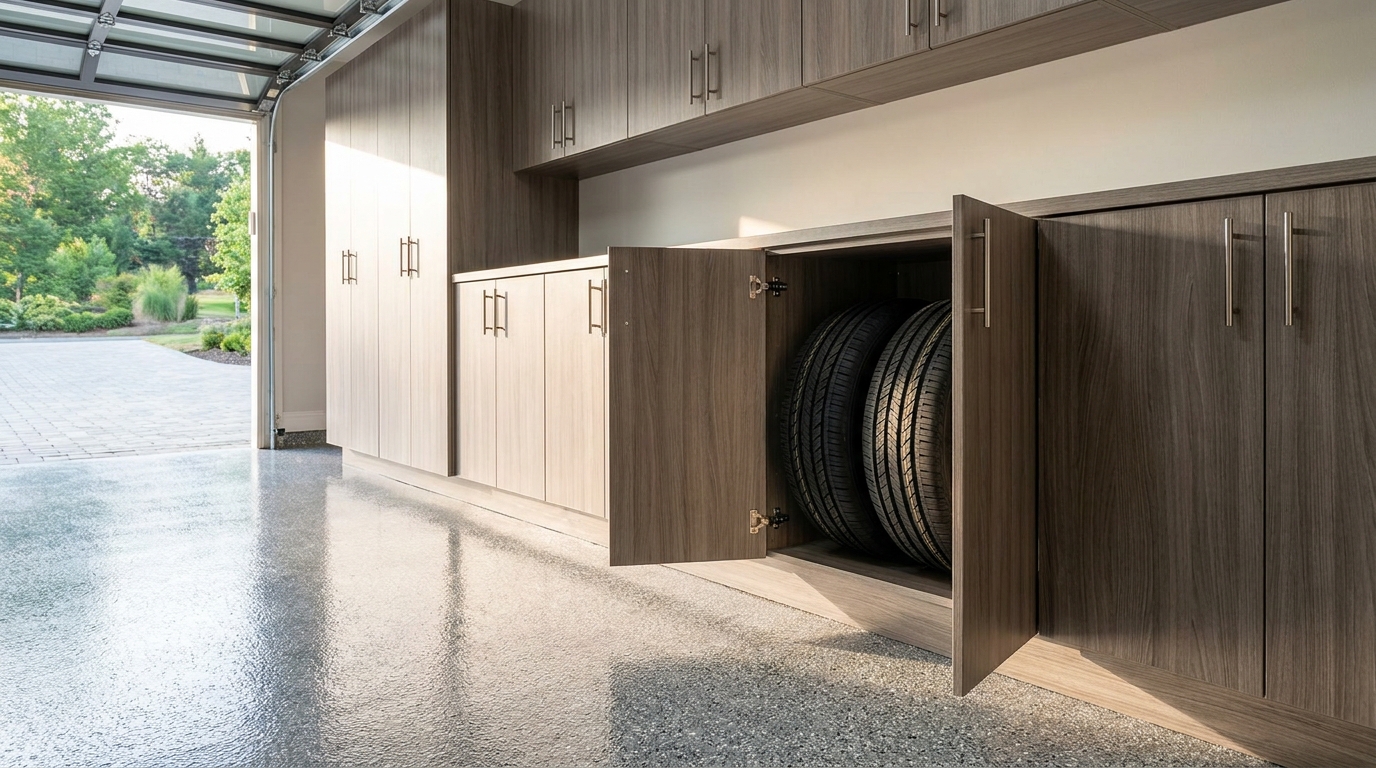
A garage pet storage cabinet is a closed cabinet in the same run as the rest of the garage. It wears the same heat-fused laminated melamine, the same door style, and the same hardware as the boxes beside it. We usually place it at the house-door end of that run. Food, leashes, towels, and bowls live behind the door, so when the overhead door is open the station looks planned. It reads as millwork, not as a bin left on the floor.
What you see when the overhead door is open
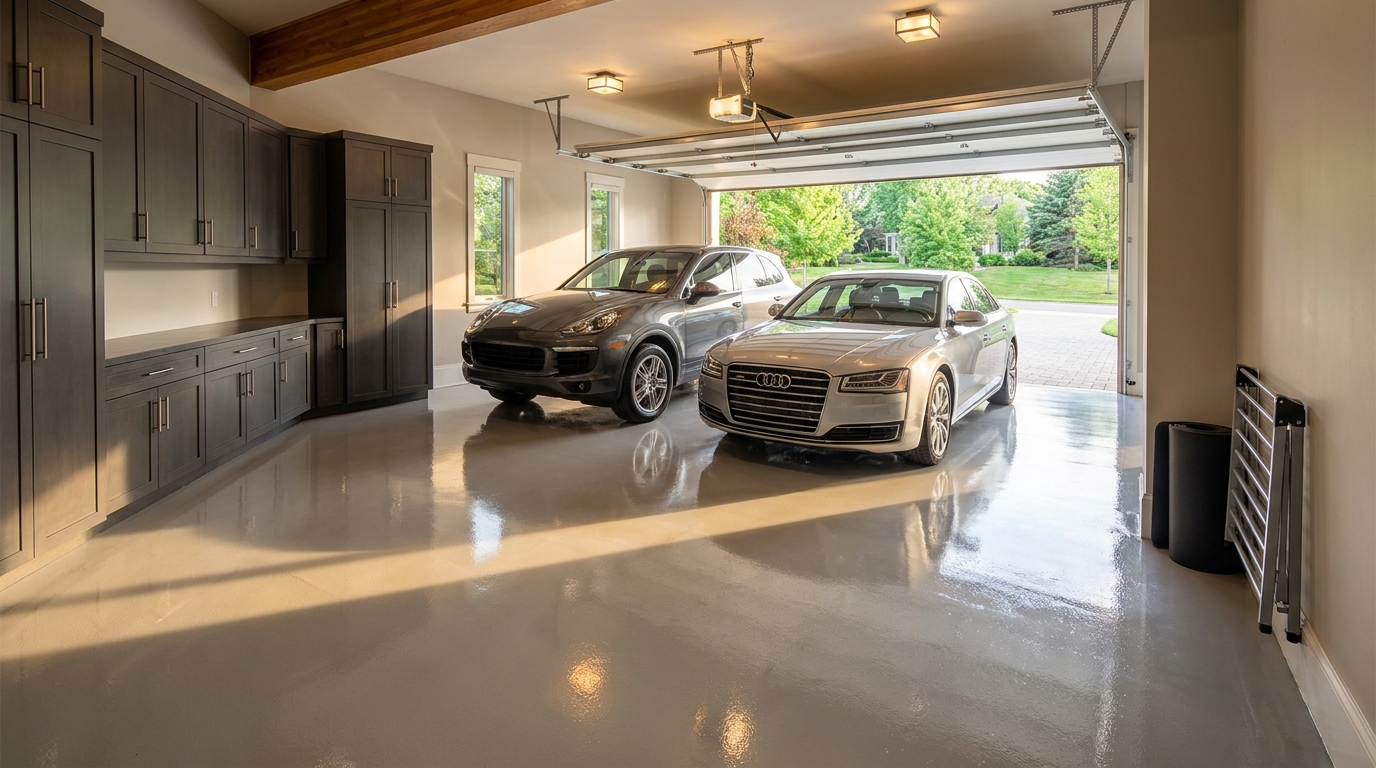
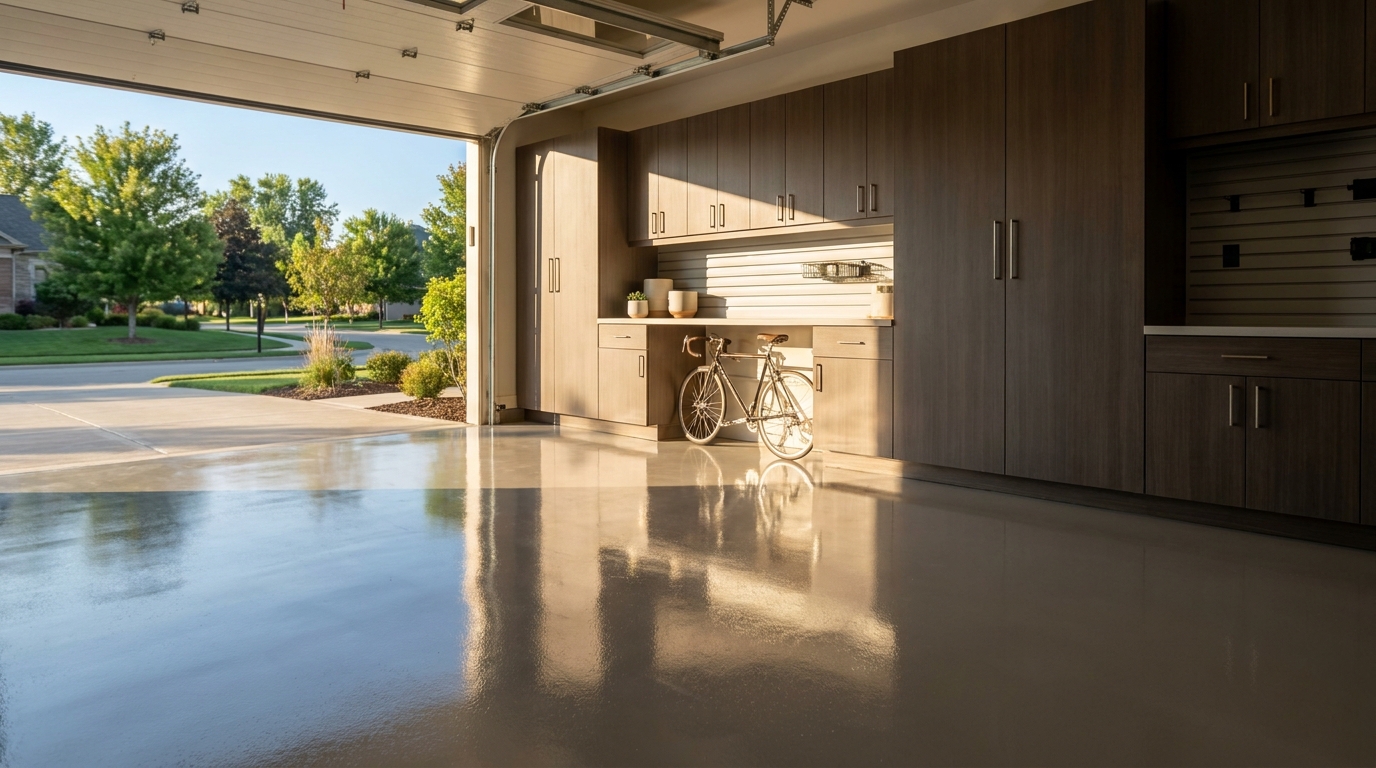
The test is the view from the driveway. The overhead door is up, daylight is on the floor, and the wall reads as one run. The pet station does not announce itself with a different color or a row of hooks on the face. The door is shut. The pull matches the cabinet next to it.
We build the station into the run instead of setting a freestanding bin at the house door. Daily gear still has a home. It lives in a cabinet drawn with the rest of the wall. Our team designs garage cabinets as one composition: door style, finish, and hardware decided together for the wall in front of us. The pet cabinet is one box in that composition, not a separate product with its own look. In Charlotte, Waxhaw, Monroe, and the rest of Union and Mecklenburg counties, the request is usually the same. People want the leash where the trip outside starts, and they want the garage to look finished when the door is open.
Where we place it
The usual spot is the house-door end of the run. That door is already the path between the car, the house, and the yard, so a leash, a towel, and a spare bowl are one stop on a walk you already take. We do not drop the cabinet in the middle of a parking bay just because a stud is open.
The door still has to work. The U.S. Access Board's guide to the ADA Standards says required door maneuvering clearances must be free of protrusions for the full height of the clearance, which the guide describes as 80 inches minimum [1]. The same guide says those clearances can be offset up to 8 inches from the face of the door to make room for casework and shelves beside the doorway, and that the clearance must be measured from the leading edge of that casework so the full clearance stays free of obstructions [1]. It also says doors on cabinets and other storage that do not provide user passage do not have to comply with the door provisions, though those storage elements still fall under the standards' storage requirements, including clear floor space and operable parts [1].
A private garage is not an ADA facility, and we do not treat the guide as a code mandate for a Charlotte house. We still draw the house-door path first. The pet cabinet can come close to the door. Its box stays out of the swing, and an open cabinet door should not cross the walk. If the two doors conflict, we flip the cabinet hinge or slide the box down the run. We decide that on site, with the house door open.
We often wall-mount this cabinet, as we can with the rest of the run, so the coated floor continues underneath. That floor is part of the room, epoxy or polyaspartic, specified with the cabinets. You can see how those pieces sit together on our services page. Legs remain an option when the wall wants them. Either way, the station belongs to the run.
What the closed door is hiding
The face matches the run. The interior is organized for the animals in that house, on adjustable shelves so the heights can change when a bag size changes or a second pet arrives.
The everyday shelf holds leashes, waste bags, and a towel, near the front so you are not hunting while someone waits at the door. The food shelf holds dry food in a lidded container, with room for the lid to open inside the cabinet. The lower shelf holds spare bowls, a mat if you use one, and extra towels. A shallow drawer can hold the scoop when the run already uses drawers. We do not force a drawer into a run that is all doors.
This cabinet does not include a sink, a faucet, or a water line. Washing a bowl, or your hands, still happens at a real sink. The towel here is for paws and a quick wipe.
The food shelf, planned as part of the interior
The food shelf turns a storage rule into a container, a label, and a shelf height. The cabinet is not a refrigerator.
The FDA's pet-food storage page, current as of May 23, 2024, says to store dry pet food and unopened canned food in a cool and dry place at less than 80 F, because excess heat or moisture may cause the nutrients to break down [2]. A closed door does not lower the garage air temperature. We ask which wall near the house door stays out of the afternoon sun, and we put the food shelf on the cooler wall. If that wall still runs hot, dry food may belong in the house. The cabinet can still hold leashes, towels, and bowls.
That page says the better way to use another container is to put the entire bag inside it, rather than pour the kibble out [2]. If you do pour, the container should be clean and dry, with a lid that "fits snuggly," and you should tape the UPC code, lot number, product name, manufacturer, and "best by" date to the outside, then replace that note when you open the next bag [2]. Lauren Carey, a veterinarian and pet food expert at FDA, says on that page: "When you file a complaint about a pet food, the lot number and 'best by' date, along with the full product name, are important for you to provide" [2]. The page states that less than half of the pet food complaints FDA receives include the lot number [2]. We size the shelf for the bag inside a lidded container, and we leave a spot for that label.
The same page says to wash and dry the container between bags, and to keep food where a persistent pet cannot reach the whole supply [2]. Treats need a secure spot so a pet cannot eat the whole supply at once [2]. The closed door is the ordinary answer. On most of our configurations we can add a key lock. Many households never need it. We mention it when a dog has already learned to open an unlatched door.
Opened canned or pouched food does not live here. The FDA storage page says to refrigerate leftovers promptly or throw them out, with the refrigerator at 40 F or below [2]. The FDA safe-handling page, also current as of May 23, 2024, says to keep dry food in its original bag with the top tightly folded, in a secure cool and dry place at less than 80 F, and to refrigerate leftover wet food promptly at 40 F or below [3]. It also says to wash your hands for at least 20 seconds with soap and hot water before and after handling pet food, to wash bowls and scoops with soap and hot water after each use, and not to use the bowl as a scoop [3]. Use a clean scoop, spoon, or cup, and use it only for pet food [3]. The scoop gets its own spot. A spare bowl lives on the lower shelf. The sink is elsewhere.
CDC's pet food safety page, dated January 30, 2025, says to follow the storage instructions on the label and to clean bowls, scoops, treat toys, feeding mats, and placemats frequently [4]. It also says fresh pet foods, which use fewer preservatives or none, need to be refrigerated and do not keep as long as kibble or canned food [4]. If that is what you feed, this cabinet is not the refrigerator. It can still hold the leash, the towels, the bowls, and any dry food whose label allows ordinary dry storage.
AAFCO's product-handling page, published January 17, 2023 and modified June 11, 2024, tells consumers to keep dry pet food in a cool, dry place at less than 80 degrees F and, if possible, to store the original container inside a clean, dedicated plastic container with a lid [5]. You choose that container. We make the shelf and the door agree with it.
Lawn products get a different cabinet
Pet food and lawn chemicals do not share a box. The EPA page on storing pesticides, last updated October 9, 2025, says never to store pesticides in cabinets with or near food, animal feed, or medical supplies, to store them out of reach of children and pets, and, if possible, to keep them in a locked cabinet in a well-ventilated utility area or garden shed [6]. Virginia Cooperative Extension at Virginia Tech, in a guide first published in June 2020 and revised in March 2026, says never to store pesticides in cabinets where food or animal feed is stored, and it prefers a well-ventilated locked cabinet out of the reach of children and pets [7].
Neither page gives a distance in inches for the word "near." We do not invent one. The pet cabinet holds food, leashes, towels, and bowls. Any pesticides you keep in the garage get a separate cabinet in the same finish, with a lock when you want one. At the visit we decide whether that second cabinet sits farther down the run or on another wall. Matching doors keep one project. Separate interiors keep the jobs apart.
Pulls, reach, and a door that closes quietly
Daily use is a height decision as much as a finish decision. The U.S. Access Board's guide to operable parts states that an unobstructed forward reach and an unobstructed side reach both run from 15 inches to 48 inches above the floor, and that this range applies only to operable parts [8]. The guide says non-operable portions can sit outside that range, and it describes standard U-shaped pulls as acceptable hardware where those rules apply [8]. Round door knobs that require a full hand grip and turning do not comply, the guide says, because they require twisting of the wrist [8].
A house garage is not required to meet that guide. We still set this pull in that band of 15 inches to 48 inches, in the same pull and finish as the rest of the run: brushed chrome, black powder coat, or oil-rubbed bronze, chosen once for the wall. A twist knob used only on the pet door would mark the station from the driveway. A matching pull does not. The leash and the scoop sit near the front of a shelf around that height. The heavy food container can sit lower. Soft-close hinges, the same hinges we use across the run, matter because this door moves every day, a few feet from the house door, and it should finish its swing without a bang.
One finish, decided with the run
The pet cabinet is ordered with the rest of the run, not after it. If the wall is Slate, Timber Gray, White, or another finish from the set we are using, this door wears it too, including the gaps between doors. When the overhead door is open, the eye should travel along the run and not stop on a mismatched box by the house.
We look at the wall, the house-door swing, the sun through the overhead door, and the container you plan to use. Then we draw the cabinet at the height and width that wall can take. Our team builds it with the cabinet project and lines the doors up before we leave. If you later add a second pet or a larger bag, the shelves move. The face of the garage does not have to.
Practical takeaways
- Build the pet station as a closed cabinet in the run, in the same melamine, door style, and hardware, usually at the house-door end.
- Keep the box and the open cabinet door out of the house-door walk. The Access Board's guide says maneuvering clearances stay free of protrusions and can be offset up to 8 inches for casework beside a door [1]. A private garage is not an ADA project.
- Store dry food in a clean lidded container, preferably with the original bag inside, and keep the lot number with it. The FDA storage page, current as of May 23, 2024, says that place should be cool and dry, at less than 80 F [2]. The cabinet does not cool the garage.
- Do not keep opened wet food, or fresh pet food the label says to refrigerate, in this cabinet. Refrigerate those at 40 F or below, or follow the label [2] [4].
- Give the scoop its own spot. Do not use the food bowl as the scoop, and wash bowls at a sink [3].
- Keep pesticides out of the pet food cabinet. If they stay in the garage, give them a separate cabinet [6] [7].
- Set the pull between 15 inches and 48 inches above the floor, matching the rest of the run, and put the leash and scoop near the front of the shelf [8].
How we can help
Have more questions or want to get in touch? Tell us how you use the house door, what the pet station needs to hold, and which finish the rest of the garage should wear. Our team will measure the wall and design the cabinet into the run. Start with our contact page.
Citations
- U.S. Access Board, "Chapter 4: Entrances, Doors, and Gates" (guide to the ADA Standards)
- U.S. Food and Drug Administration, "Proper Storage of Pet Food & Treats" (2024-05-23)
- U.S. Food and Drug Administration, "Tips for Safe Handling of Pet Food and Treats" (2024-05-23)
- Centers for Disease Control and Prevention, "About Pet Food Safety" (2025-01-30)
- Association of American Feed Control Officials, "Product Handling Safety" (published 2023-01-17, modified 2024-06-11)
- U.S. Environmental Protection Agency, "Storing Pesticides Safely" (2025-10-09)
- Virginia Cooperative Extension, "Pesticide Storage and Disposal: A Quick Guide for Home Use" (revised 2026-03-10, first published 2020-06)
- U.S. Access Board, "Chapter 3: Operable Parts" (guide to the ADA Standards)