A Patio Gear Cabinet at the Side Door, Matched to the Parking Bays
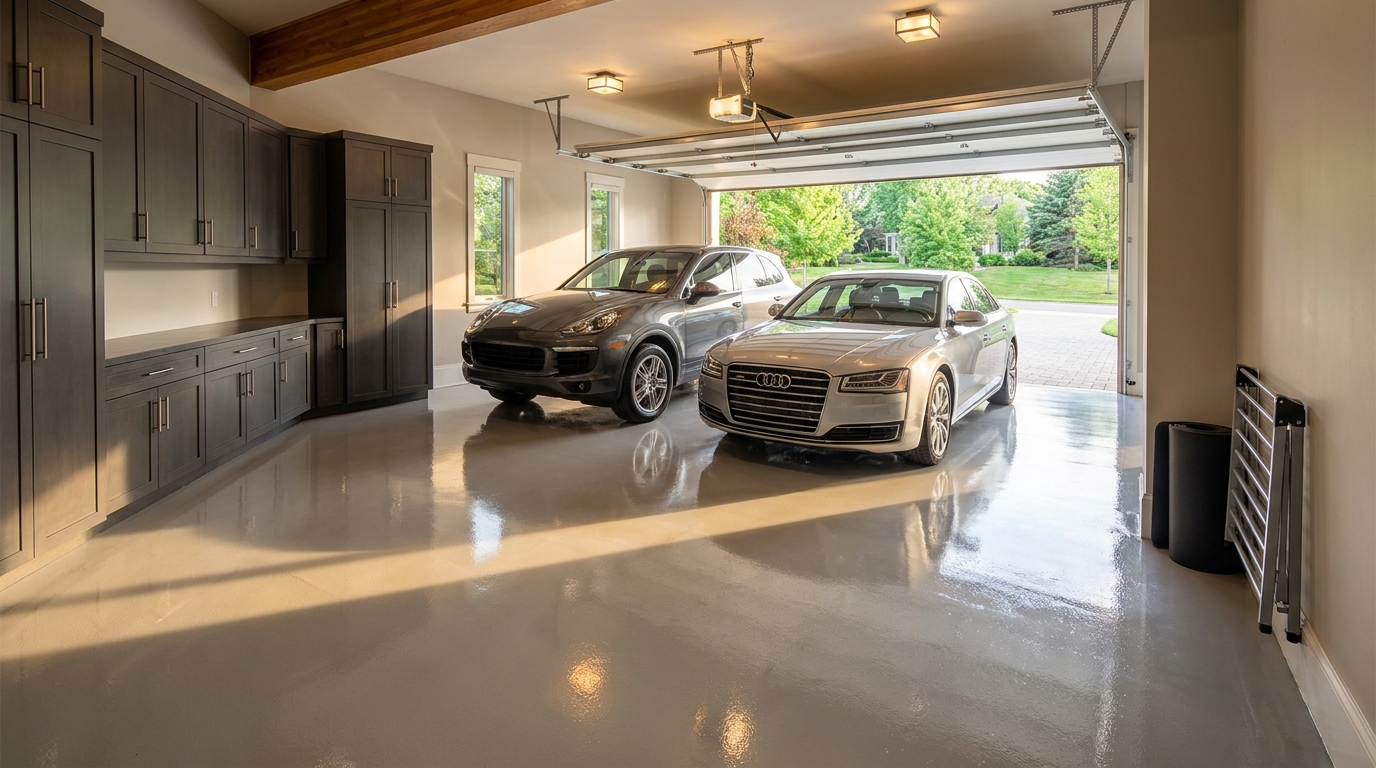
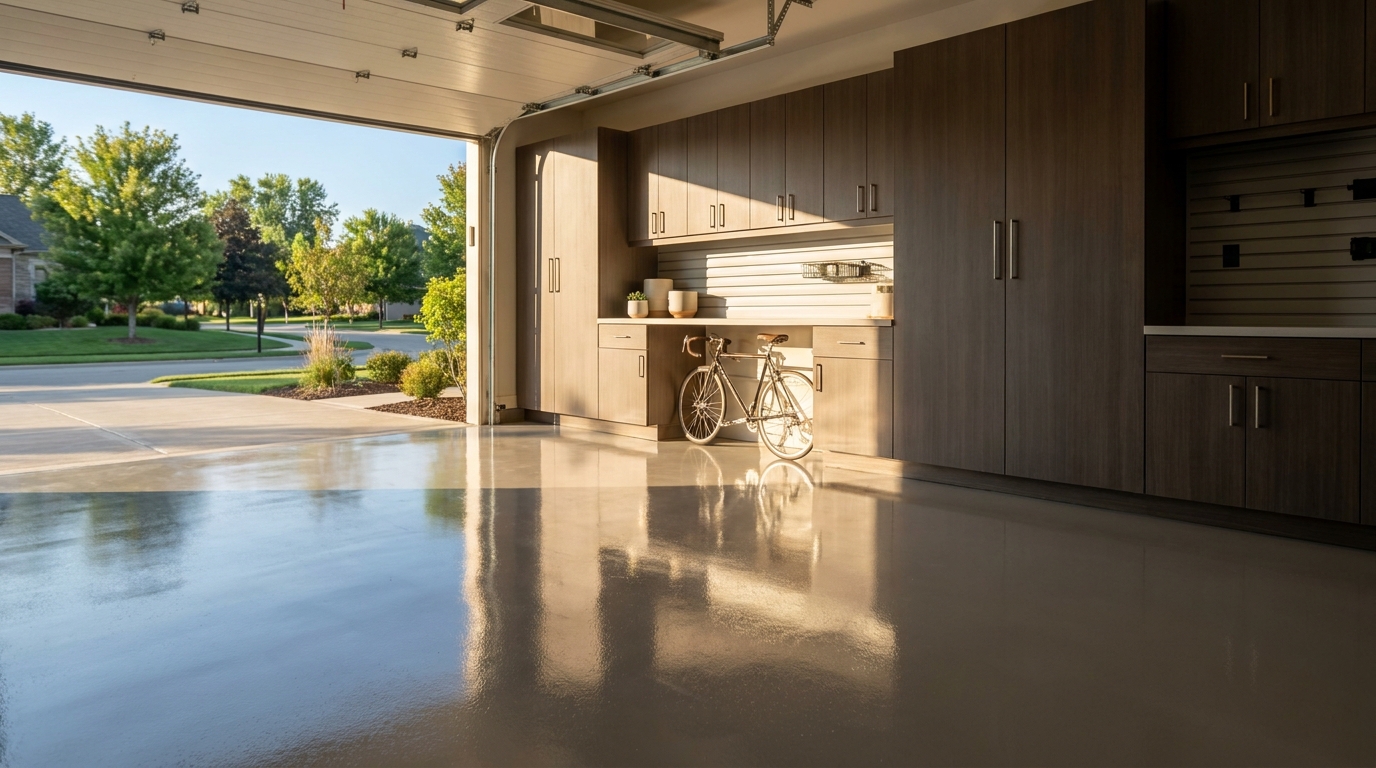
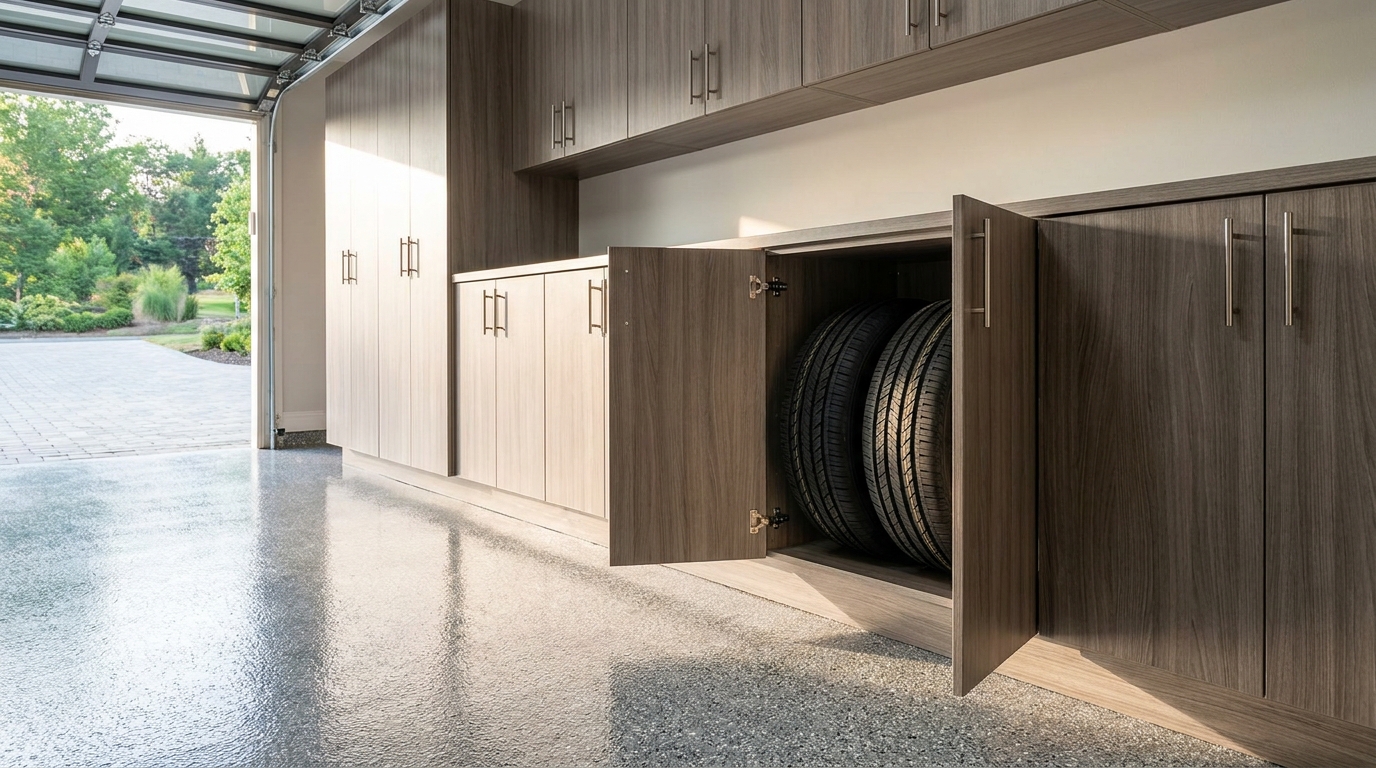
A garage patio storage cabinet is one closed cabinet beside the side door to the patio, in the same heat-fused laminated melamine, the same door style, and the same hardware as the cabinets along the parking bays. Trays, grill tools, a cooler, and folding chairs live behind that door. Lawn equipment stays on its own wall. When the overhead door is open, the side of the room still reads as one run.
One cabinet, decided with the bays
We start with the finished garage. The parking bays already have a cabinet run, or they are about to. The side door is the door people use with a tray in one hand and chairs in the other. Our team puts one cabinet on that path, in the finish already chosen for the bays, so the entertaining kit does not show up later as a different box.
We design garage cabinets as one composition: door style, finish, and hardware decided together. This box is part of that composition, not a deck chest rolled inside. In Charlotte, Waxhaw, Monroe, and across Union and Mecklenburg counties, the serving pieces should sit where the trip to the patio starts, and the garage should still look planned with the overhead door up.
This is not the stop for mail at the house door, and it is not the mower wall. Chairs can stand here because they leave through this door. The drawing is still this one cabinet, not a narrow slot elsewhere in the run.
The floor beside the side door stays a floor
The 2018 North Carolina Residential Code, quoted in an October 18, 2023 interpretation from the N.C. Office of State Fire Marshal, says there shall be a landing or floor on each side of each exterior door, not less wide than the door served, and not less than 36 inches (914 mm) in the direction of travel [1]. The analysis says that floor is required on both sides [1]. The interior side is the garage floor, so the cabinet stays beside those 36 inches [1]. The same letter says egress reaches the required exterior door without travel through a garage, and that one exterior egress door is enough, so other exterior doors need not meet that door's minimum clear width and height [1]. This patio door is not the house's required exit. We do not narrow it to fit a cabinet.
For other exterior doors, the quoted code says a landing is not required where a stairway is on the exterior side, if the door does not swing over the stairway [1]. The analysis keeps a floor on both sides as the ordinary rule, and it limits the exception to an exterior stairway the door does not swing over [1]. The cabinet still stays out of the swing.
A private garage is not an ADA facility. The U.S. Access Board's door guide is still a useful layout: maneuvering clearances must be free of protrusions the full height, described as 80 inches minimum, and may be offset up to 8 inches from the face of the door for casework [2]. The clearance is measured from the leading edge of that casework [2]. Cabinet doors that do not provide user passage do not have to meet the door provisions, but the storage still falls under clear floor space and operable parts [2]. We hinge the cabinet door clear of the side-door swing. Epoxy or polyaspartic can run under a wall-mounted box, and legs remain an option. The floor and the cabinets together are on our services page.
What the closed door is holding
The face matches the bays. Inside, adjustable shelves are sized to the pieces this house already owns. We measure the largest tray, the folded chairs, and the cooler before we lock the opening.
Grill tools that touch food sit near the front of a shelf you can reach without a step stool: tongs, a spatula, a grate brush, and the tray they ride on. The FDA's safe food handling page, content current as of March 5, 2024, says to wash cutting boards, dishes, utensils, and countertops with hot soapy water after preparing each food item [3]. This cabinet is where those tools come back after that wash. Trays stack flat or stand on edge. We do not add a faucet, a drain, or a built-in grill.
Folding chairs belong here when they leave through this door, at the height and depth the set needs, in the bay finish. If the wall is short, we change the width. We do not move them to the mower wall.
The cooler sits on the cabinet floor or the lowest shelf, empty between gatherings. The same FDA page says to refrigerate or freeze meat, poultry, eggs, seafood, and other perishables within 2 hours of cooking or purchasing, and within 1 hour if the temperature outside is above 90 F [3]. This cabinet does not get cold, and a stored cooler is not a refrigerator. We size the opening for the cooler you own.
Heat-fused panels, kept indoors
The finish is heat-fused laminated melamine, the same family as the parking-bay cabinets. The Composite Panel Association's voluntary standard CPA 5-25, issued May 1, 2025, covers decorative thermally fused laminate panels for interior use on particleboard, medium density fiberboard, or hardwood plywood [4]. It defines the surface as a hot press that permanently fuses resin-impregnated decor paper to the substrate, and it says heat and pressure make that bond "without the use of an intermediate adhesive" [4]. The substrates are those in ANSI A208.1-2022 and ANSI A208.2-2022, or hardwood plywood in ANSI/HPVA HP-1-2024, and the standard says they shall comply with EPA's formaldehyde rule under TSCA Title VI, 40 CFR Part 770 [4].
EPA's page on that rule, last updated February 12, 2026, says that after March 22, 2019, composite wood products must be labeled TSCA Title VI compliant [5]. The products named are hardwood plywood, medium-density fiberboard, and particleboard, "as well as household and other finished goods containing these products" [5]. The CPA scope is interior use, so the chairs go outside and the box stays in the garage, ordered in the same face as the bays [4].
Hardware is chosen once: brushed chrome, black powder coat, or oil-rubbed bronze, the same on this door as on the bay doors, with the soft-close hinges we use across the run. We do not invent a certification the panel maker did not mark.
A Charlotte afternoon, and gear that comes in dry
National Weather Service daily normals for Charlotte, 1991 through 2020, put July's normal high at 90.3 F, the low at 69.9 F, the average at 80.1 F, and July rain at 3.74 inches [6]. The December sheet shows a running precipitation total of 43.6 inches by December 31, and it notes that monthly normals do not always equal the summed daily normals because extra digits are rounded in the daily figures [7].
A July normal high of 90.3 F meets the line on the FDA page, content current as of March 5, 2024, which shortens refrigeration from 2 hours to 1 hour above 90 F outside [6] [3]. This cabinet is not cold storage.
EPA's mold and moisture guide, last updated February 18, 2026, says the key to mold control is moisture control, and that mold will not grow without water or moisture [8]. If wet or damp materials are dried within 24 to 48 hours after a leak or spill, in most cases mold will not grow, and spores will not grow if moisture is not present [8]. A wet cooler or chair pad dries with the lid open, then the matched door closes. The guide also says, if possible, to keep indoor humidity below 60 percent, ideally between 30 and 50 percent [8]. This door does not set that number. It keeps dry trays, clean tools, and chairs together.
The pull you use on the way out
The U.S. Access Board's guide to operable parts says an unobstructed forward reach and an unobstructed side reach both run from 15 inches to 48 inches above the floor, and that this range applies only to operable portions [9]. Non-operable portions can sit outside it [9]. Standard U-shaped pulls are acceptable, and knobs that need a full hand grip and a turn, including round door knobs, do not comply where those rules apply, because they require twisting of the wrist [9]. Operable parts must work with one hand and must not require tight grasping, pinching, twisting of the wrist, or more than 5 pounds of force [9].
A house garage is not required to meet that guide. We still set this pull between 15 inches and 48 inches, in the same pull as the bay doors [9]. The tongs sit near the front of a shelf around that height, and the cooler sits low. If a forward reach crosses a deep obstruction, the guide drops the 48 inch maximum to 44 inches once the depth exceeds 20 inches, so we do not hide this pull behind a worktop [9].
Ordered with the run
The patio cabinet is ordered with the parking-bay cabinets, and the finish chosen for that run is the finish on this door. We measure the swing against the 36 inches the landing rule describes, then build this cabinet with the rest of the run [1].
Practical takeaways
- One closed cabinet at the side door, in the same melamine, door style, and hardware as the parking bays.
- Leave a floor on each side of that exterior door, at least as wide as the door and at least 36 inches in the direction of travel, as the 2018 North Carolina code states in the October 18, 2023 interpretation [1]. The patio door is not the required house exit [1].
- Wash utensils with hot soapy water before they go back in, and refrigerate perishables within 2 hours, or within 1 hour above 90 F outside, which is what the FDA page, content current as of March 5, 2024, says [3].
- Dry a wet cooler or chair pad within 24 to 48 hours, because EPA's guide, updated February 18, 2026, says mold does not grow without moisture [8].
- Set the pull between 15 inches and 48 inches, matching the run [9]. Charlotte's 1991-2020 July normal high is 90.3 F, with 3.74 inches of July rain [6].
How we can help
Have more questions or want to get in touch? Tell us which door leads to the patio, what the trays, chairs, and cooler measure, and which finish the parking bays should wear. Our team will measure the swing and draw this cabinet into the run. Start with our contact page.
Citations
- North Carolina Office of State Fire Marshal, "2018 NC Residential Code Section R311 Means of Egress" (2023-10-18)
- U.S. Access Board, "Chapter 4: Entrances, Doors, and Gates" (guide to the ADA Standards; page last modified 2026-02-04)
- U.S. Food and Drug Administration, "Safe Food Handling" (content current as of 2024-03-05)
- Composite Panel Association, "Thermally Fused Laminate (TFL) Panel Standard CPA 5-25" (2025-05-01)
- U.S. Environmental Protection Agency, "Formaldehyde Emission Standards for Composite Wood Products" (page last updated 2026-02-12)
- National Weather Service, "July, Charlotte NC, Climatological Data, Daily Normals for Years 1991-2020" (2021-12-05)
- National Weather Service, "December, Charlotte NC, Climatological Data, Daily Normals for Years 1991-2020" (2021-12-05)
- U.S. Environmental Protection Agency, "A Brief Guide to Mold, Moisture and Your Home" (page last updated 2026-02-18)
- U.S. Access Board, "Chapter 3: Operable Parts" (guide to the ADA Standards; page last modified 2026-02-04)