A Bulk Pantry Cabinet Near the House Door
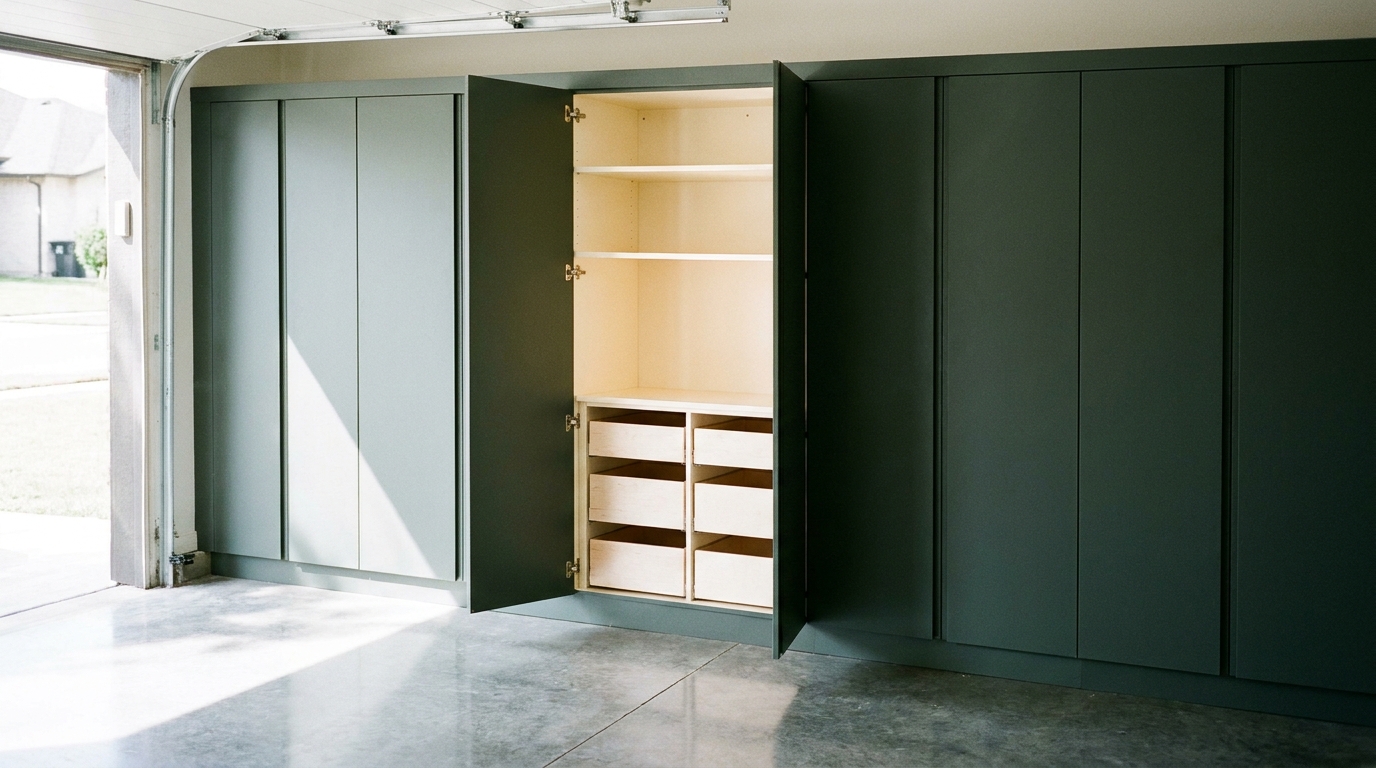
A garage pantry cabinet is the tall closed cabinet we place at the house-door end of the run. It uses the same door style as the cabinets beside it, and the shelves inside are planned for bulk paper goods, sealed bottled water, and backup household supplies. The kitchen stays the room for daily cooking. The garage holds the overflow in furniture you can close.
A tall door at the house-door end
The finished piece is easy to picture. You come through the door from the house, and the first cabinet in the run is a full-height door, closed, lined up with the doors that continue down the wall. Nothing about it asks the kitchen to stretch. The counters, the pantry shelves next to the stove, and the refrigerator stay on cooking duty. This cabinet is the furniture for the extras that a Charlotte area household buys in bulk and does not want scattered on the garage floor.
We put it at the house-door end for a simple reason of walking. Paper towels, toilet paper, tissues, and a sealed case of water are things someone grabs on the way back inside. A tall cabinet in that spot makes the grab one step, then a closed door. The rest of the run can hold tools, sports gear, or a worktop. This one door has a narrower job, and the door style matches the run so the wall still reads as one piece of cabinetry.
Closed matters as much as tall. Open shelves at the house door collect dust from the bay and make every pack part of the view. A door keeps the bulk out of sight and gives the paper goods a calmer spot than a stack beside the car. We still treat the door as a cabinet door, not as a climate wall. It blocks a splash and a glance. It does not turn the garage into a conditioned room.
What this cabinet is for
The shelves are for three kinds of overflow.
Bulk paper goods come first, because they do not ask the room for a temperature. Wrapped paper towels, toilet paper, facial tissue, and napkins live here in the packaging they came in. A household that buys the large packs needs a vertical space, not another corner of the kitchen floor.
Sealed bottled water comes second, with a condition we will spell out below. Cases stay closed, in the original bottles, and only while the garage is a reasonable place for them. When the room runs hot or toward freezing, those cases belong in the house, and the cabinet goes back to paper goods and the other sealed supplies.
Backup household supplies come third. Think of the sealed items a family wants in one known spot: soap, toothpaste, spare toothbrushes, and other personal hygiene packs, plus a small first-aid kit if you want it near the door instead of buried in a bathroom closet. ReadyNC, the state emergency management site, tells households to keep a kit in one place that every family member knows, with water at 1 gallon per person per day for 3 to 7 days, and with sanitation items such as soap and toothpaste on the list [1]. The American Red Cross uses the same rate of 1 gallon per person per day, and it splits the amount into a 3-day supply if you have to leave and a 2-week supply if you are staying home [2]. We use those lists as a packing guide for this cabinet, not as a reason to move the kitchen pantry outside.
Food that needs a steady cold shelf stays in the house. An FDA page current as of March 5, 2024, tells households to keep the refrigerator at or below 40 degrees Fahrenheit and the freezer at or below 0 degrees Fahrenheit [3]. Opened food, produce, leftovers, and anything else that belongs in that cold range stay in the kitchen appliances. We do not plan this cabinet as a pantry for them. Canned goods and other shelf foods that want a cool, steady cupboard stay in the house as well. A garage in the Charlotte area is not that cupboard just because a door is closed.
Bottled water, and where the cases actually live
Bottled water is the item people most want to park in a garage, and it is the item we plan with the most care. The Red Cross and ReadyNC figures above are about how much water a household may want on hand [1] [2]. They are not a claim that every garage is the right room for it.
The same FDA page, current as of March 5, 2024, says to keep a supply of bottled water stored where it will be as safe as possible from flooding, and it says not to drink or use bottled water that has an odor [3]. A cabinet raised off the floor, with a door, is a better spot than a case sitting in the low corner by the bay door. It is not a flood wall. If water has stood around the bottles, or if a case smells off when you open it, that water is done [3]. We say that plainly during the design visit so the cabinet is not asked to do a job it cannot do.
Heat and cold are the other half of the decision. The National Weather Service July climate normals for Charlotte, covering 1991 through 2020, put the monthly normal high at 90.3 degrees Fahrenheit, the normal low at 69.9, and the normal average at 80.1 [4]. Those numbers are outdoor air for the Charlotte station, not a thermometer we hung in your garage. They still tell the story of a Charlotte area summer. A closed cabinet in an unconditioned garage is shade. It is not air conditioning. When the garage runs hot, the cases move into a cooler part of the house, and the tall door keeps its paper goods.
Winter has its own line. The January climate normals for the same 1991 through 2020 period put Charlotte's monthly normal low at 31.8 degrees Fahrenheit, with a normal high of 52.3 and a normal average of 42.1 [5]. Again, that is outdoor air, not a promise about a particular garage. Nights in that record sit near freezing. Bottles that freeze can split, and a split case is a mess on the shelf and water you should not assume is still good. If a cold snap can reach the cabinet, the cases belong indoors until the room moderates.
So the design is a cabinet that can hold water, not a cabinet that must hold water all year. On the visit we talk through where the cases live in July and where they live in January. Some households keep a modest sealed supply in the cabinet through the milder months and shift it inside for the extremes. Some keep all of the drinking water in the house and use this cabinet only for paper goods and sealed supplies. Both are honest versions of the same piece of furniture. What we will not do is tell you a Charlotte area garage is a safe stand-in for a cool indoor shelf.
Paper goods stay dry and visible
Paper goods are the cabinet's steady job, and moisture is the thing that spoils them. EPA's mold course, updated December 1, 2025, says mold can grow on paper, along with wood, carpet, food, and insulation, as long as moisture and oxygen are present [6]. The same chapter says wet materials need to dry within 24 to 48 hours if you want to avoid mold growth, and it says indoor relative humidity should be kept below 60 percent, ideally between 30 and 50 percent, if possible [6].
We do not pretend a garage cabinet creates that humidity. Many garages in the Charlotte area are open to the weather every time the bay door cycles, and a cabinet door does not dehumidify the bay. What the cabinet does is get the packs up on a shelf, inside a door, instead of on the concrete where a wet tire, a blown-in leaf pile, or a spill at the house door can soak the cardboard. If a pack does get wet, it comes out. We would rather replace a wrap of paper towels than leave a damp bundle in a closed box.
Original packaging stays closed until you need it. A torn or damp wrap comes out of the cabinet rather than staying shut in with the dry packs [6]. Soap, toothpaste, and similar sealed items from a home kit stay in their containers, on a shelf you can reach without moving the paper goods [1]. We do not mix them with open food, and we do not set them on the floor. The cabinet is the place, so the floor can stay clear.
Height, depth, and the house door
Tall is a starting idea, not a single number we drop in every garage. The 2022 ANSI/KCMA A161.1 glossary describes a utility cabinet as a cabinet installed on or near the floor for appliances or accessories, with a typical depth of 12 inches or 24 inches and a typical height of 84 inches or taller [7]. We use that 2022 description as a size reference when we talk about a floor-standing tall cabinet. It is a kitchen and vanity standard. It is not a certification of our garage cabinets, and we do not present it as one.
From there, the room decides. An 84-inch box under a low ceiling, or hard against a garage door track, is the wrong height even if a glossary calls it typical [7]. We measure the ceiling, the track, the lights, and the slope of the floor. We also open the house door and the future cabinet door in the same visit. The cabinet has to clear the swing of the door you use every day, and the cabinet door has to open without blocking the walk from the house to the car. A deep 24-inch box is generous for paper goods. A shallower box is sometimes the right call when the house door, a freezer, or the parking line leaves less room. The glossary allows both a 12-inch and a 24-inch typical depth for that utility type [7]. We pick the one that fits the wall you actually have.
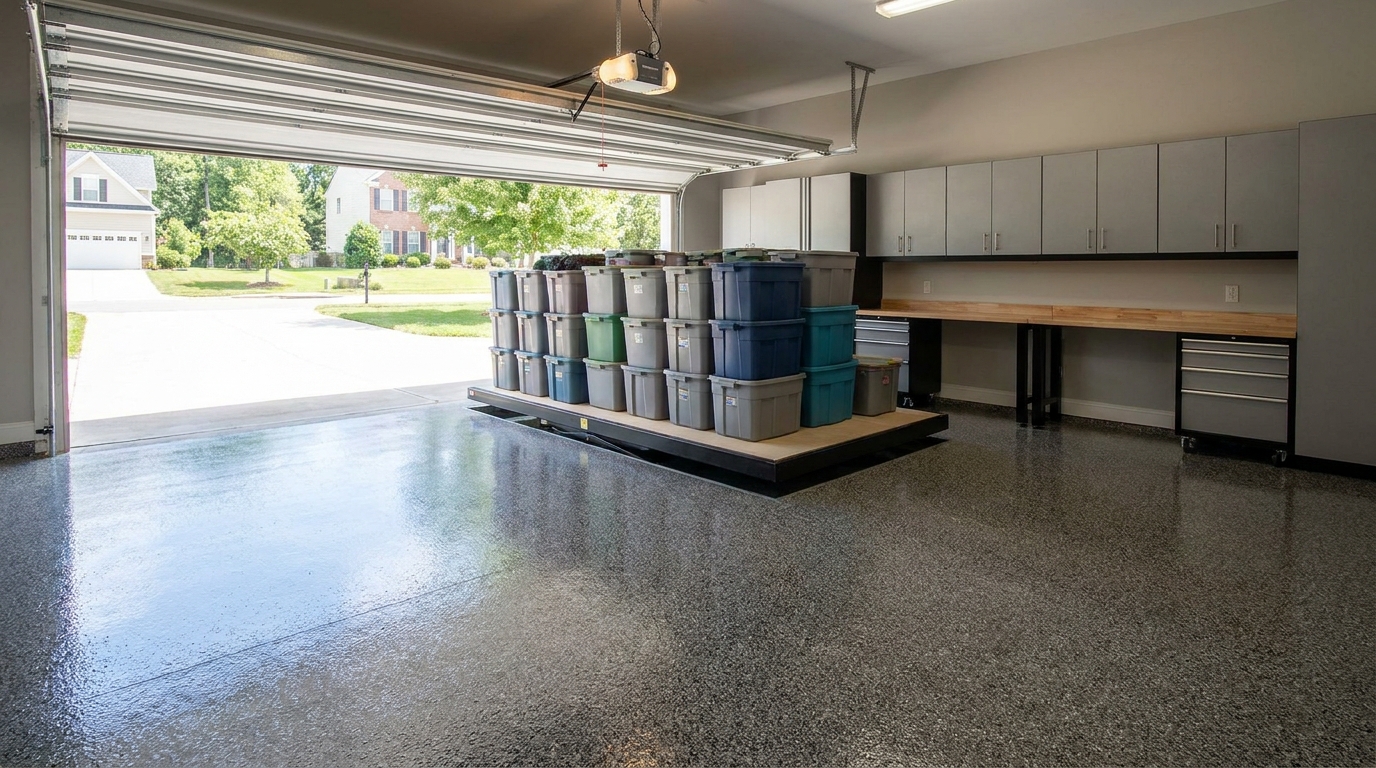
The material is the same language as the rest of our cabinet work. Heat-fused laminated melamine, soft-close hinges, and full-extension drawers are how these runs are built, including a tall cabinet at the house door. Shelf positions adjust, doors close on soft-close hinges, and any drawers in the cabinet ride on full-extension glides so the item at the back is not a guess. The construction is spelled out on our garage cabinets page. On site, our team confirms hinge adjustment and that the tall door lines up with the doors beside it. Same style, same hardware finish, one run.
Wall mounting, with legs only if you want them, is worth deciding at this cabinet in particular. A box that sits tight to a damp floor is a poor home for paper goods. Lifting the cabinet keeps the bottom shelf out of a shallow puddle and leaves the floor open to sweep. We look at the slab, the house-door threshold, and how water behaves in a hard rain before we choose feet or a wall mount.
Shelves, drawers, and a separate place for chemicals
Heavy paper multipacks go low, where you are not lifting a large pack down from above your shoulder. The packs you open often sit between about waist and eye level. Light, slow items go high: extra tissue, a spare wrap of napkins, a sealed pack you will not touch until the one below it is gone. If the cabinet includes drawers, those drawers hold the small sealed things, such as a first-aid kit, spare batteries for a flashlight, or a box of soap. Full-extension glides mean you see the whole drawer, not only the front row.
We keep fuel, pesticides, solvents, paint, and automotive chemicals out of this cabinet. They do not belong next to bottled water or next to paper goods you will carry into the kitchen. If those products need a home in the same run, they get their own cabinet, and a lock is available when you want them out of a child's reach. The pantry cabinet at the house door stays a paper, water, and sealed-supply cabinet. One job, one door, no mixed chemistry.
A short label habit keeps the cabinet readable. Write the month on a case of water if you keep any here, and move older paper packs forward when you add new ones. ReadyNC's point about one known place only works if the place stays understandable [1]. We design the interior so the categories stay obvious: paper on the shelves, small sealed goods in a drawer if you want one, water only on the shelf you chose for it, and nothing that belongs in the refrigerator.
We measure, draw the run so you can see the tall door at the house end before anything is built, and our local crew installs it. If the house door, a water heater, or a stepped ceiling changes the height, we change the cabinet on the drawing.
Practical takeaways
- Place the tall closed cabinet at the house-door end, in the same door style as the rest of the run, and keep daily cooking in the kitchen.
- Use the shelves for wrapped paper goods and sealed household supplies. Leave opened food, produce, and refrigerator items in the house.
- Store sealed bottled water here only when the garage is a reasonable place for it. Charlotte's 1991 through 2020 July normals are already a warm outdoor summer, and the January normal low sits near freezing, so hot weeks and cold snaps are a reason to move cases indoors [4] [5].
- Keep paper goods up on adjustable shelves, in closed packaging, and replace anything that gets wet. A cabinet door does not set garage humidity [6].
- Size the height and depth to the ceiling and the house-door swing, using 12 or 24 inches of depth and 84 inches or taller only as a 2022 planning reference, not as a fixed order [7].
- Keep fuel, paint, and pesticides in a different cabinet. A lock belongs on that cabinet, not as an excuse to mix them with water and paper goods.
- Tell everyone in the house which door holds the supplies, so the cabinet stays the one known place rather than a second junk shelf [1].
How we can help
Have more questions or want to get in touch? Our team will measure the house-door wall, the ceiling, and the door swing, then plan the tall cabinet with the rest of the run. Reach us on our contact page.
Citations
- ReadyNC, North Carolina Emergency Management, "Get a Kit" (accessed 2026)
- American Red Cross, "What Do You Need In a Survival Kit" (2026)
- U.S. Food and Drug Administration, "Food and Water Safety During Power Outages and Floods" (2024-03-05)
- National Weather Service, "July, Charlotte NC, Daily Normals for Years 1991-2020" (1991-2020)
- National Weather Service, "January, Charlotte NC, Daily Normals for Years 1991-2020" (1991-2020)
- U.S. Environmental Protection Agency, "Mold Course Chapter 2: Why and Where Mold Grows" (2025-12-01)
- Kitchen Cabinet Manufacturers Association, "ANSI/KCMA A161.1-2022 Performance and Construction Standard for Kitchen and Vanity Cabinets" (2022)