A Lawn and Garden Wall That Matches the Parking Bays
A lawn wall that belongs with the cars
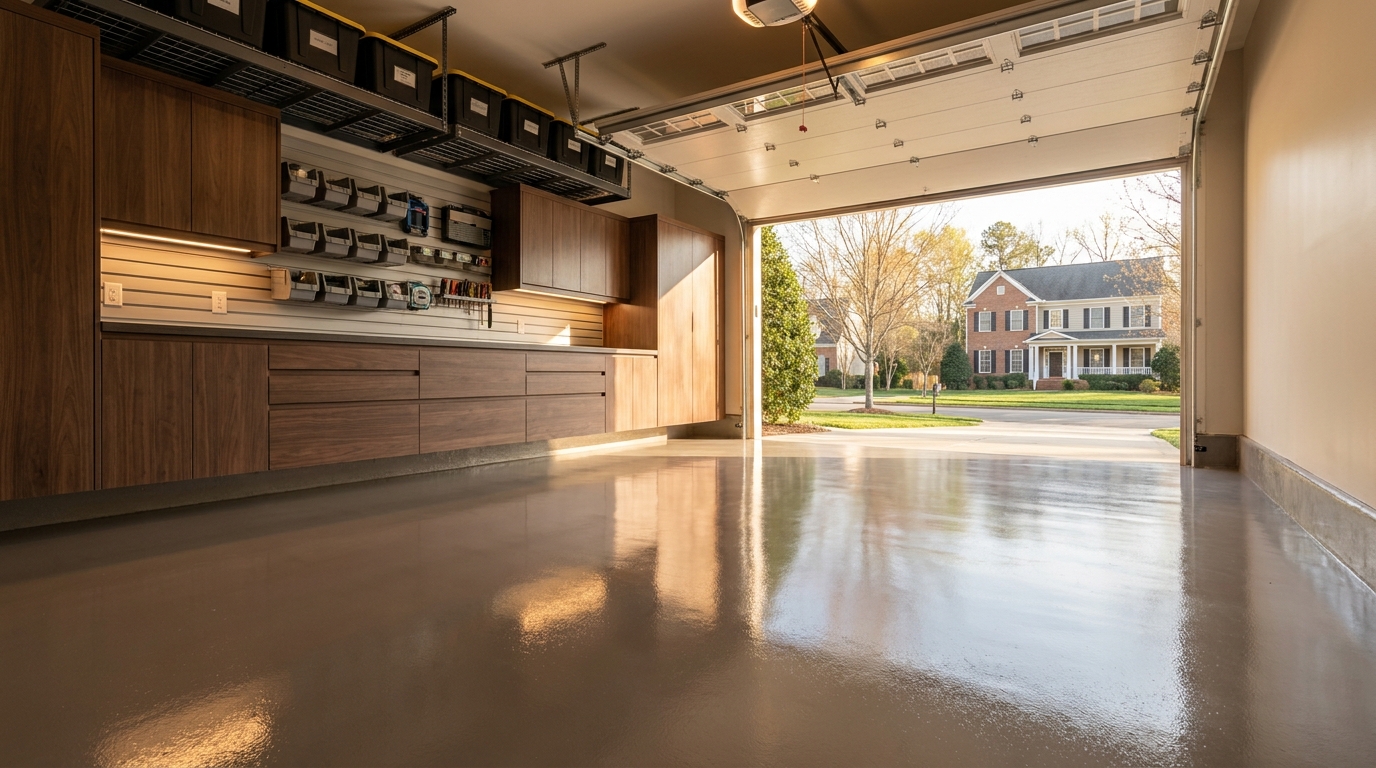
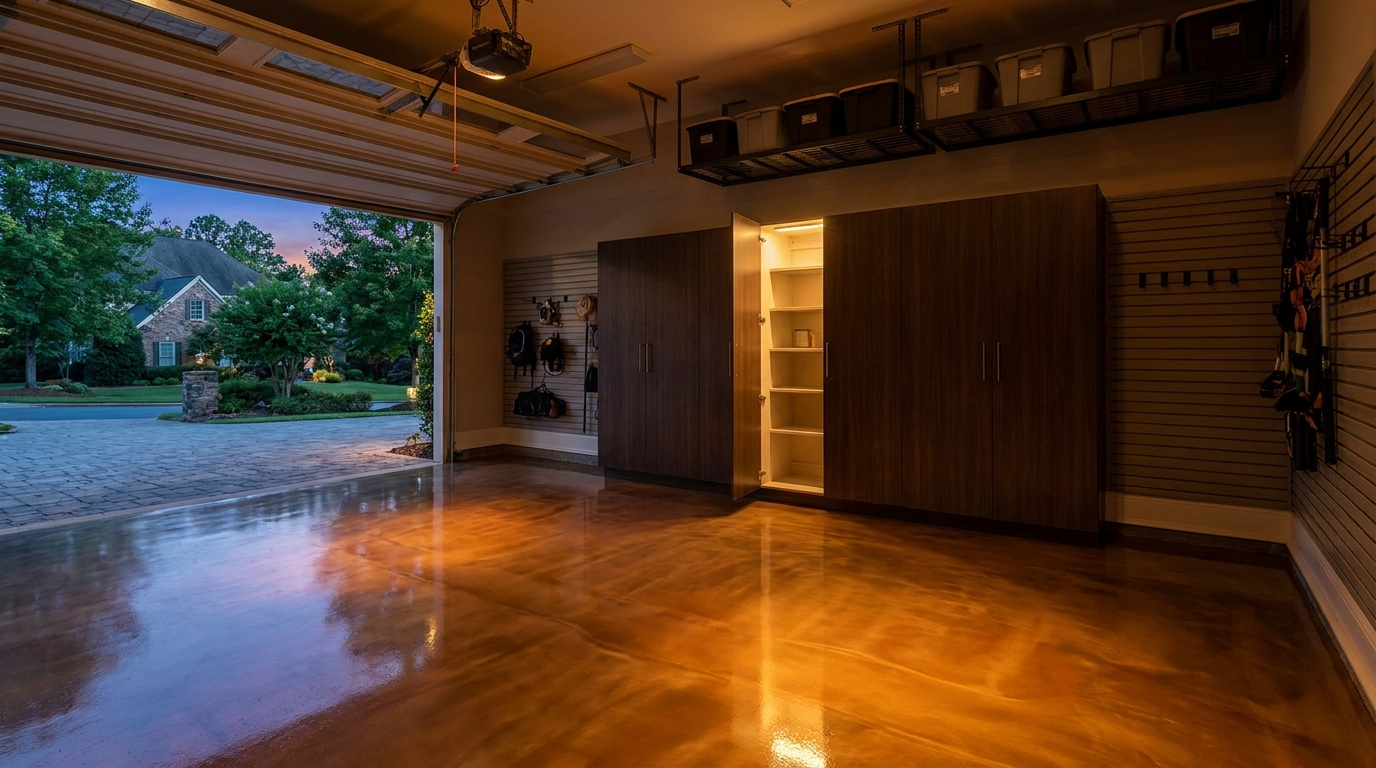
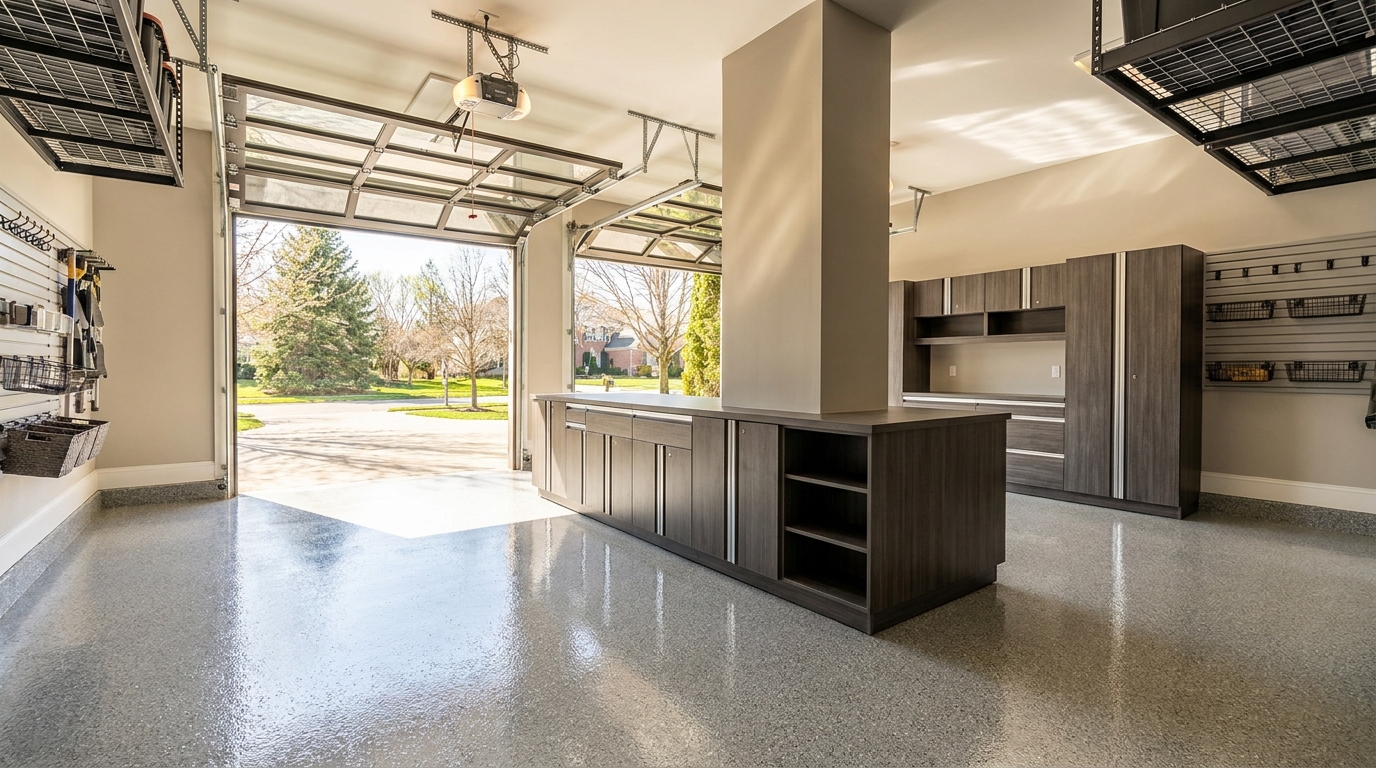
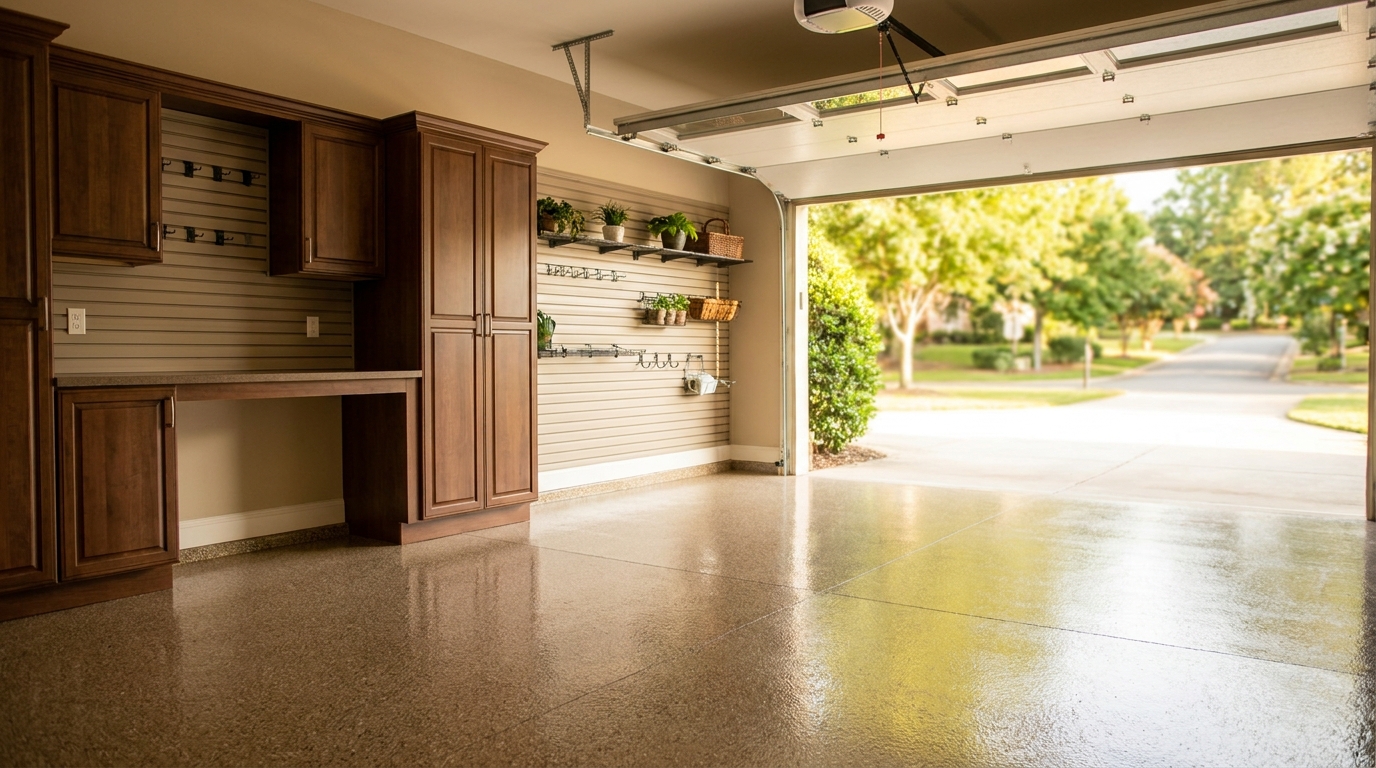
The picture we design toward is a garage lawn equipment storage wall that reads like the rest of the room. Cabinets share the finish of the parking-bay run. Trimmers, blowers, and rakes hang on locking hooks. The mower has a floor pocket of its own, and both cars still park in full stalls. Garden chemicals sit behind a lock, in original bottles, on a wall that was drawn with the bays instead of after them.
That is a layout, not a leftover corner. Our team measures the cars, the door travel, and the tools you actually own, then builds one elevation so the lawn gear looks like it was always part of the garage.
Draw the parking bays first
A two-car garage is a floor plan before it is a storage project. Door openings, tracks, the walking lane to the house, and the stall for each vehicle all claim space before a single hook goes on the wall. We start there on purpose. The lawn-and-garden wall takes the leftover elevation: usually a side wall, a back wall beside the mudroom door, or a short return that does not pinch a bumper.
That sequence is the whole difference between a designed room and a row of tools parked wherever they fit. If the mower, the trimmer, and a stack of bags claim the stall, the cars live in the driveway. If we reserve the stalls first, the lawn wall has to earn its width. It usually can. Long-handled tools hang. Bags and bottles go behind doors. The mower sits in a marked pocket that is deep enough for the deck and the handle, and still short of the car's door swing.
We treat that pocket like a third stall, only smaller. Tape on the floor during design. A painted or coated lane edge after install. Enough clearance that you can roll the mower out without shuffling a car. The garage organization plan for this wall is the same method we use on the rest of the room: daily tools at hand height, bulky items on the floor or overhead, and a walking lane that still feels like a room.
Charlotte and Waxhaw garages vary in stall count, but the rule does not. Cars keep their envelopes. The lawn wall keeps its own, in the same finish, so the room does not split into a show bay and a yard closet.
Cabinets for what you store, slatwall for what you hang
The wall is two jobs stacked on one elevation. Closed storage holds bottles, granules, extra line, oil, and the small parts that look messy on an open shelf. Open wall holds the long tools you want to grab and put back in one motion.
Our garage cabinets are the closed half. We size the run to the wall, not to a catalog module that almost fits. Doors and drawers finish to match the rest of the garage. Lock-and-key options belong on the cabinets that hold fertilizer, weed killers, and other products you want available but out of reach. Interior shelves are rated for the kind of weight a working garage actually generates, so a case of product does not sag a board. Wall-mounted boxes keep the floor clear under the run, which matters when you rinse a deck or sweep after Saturday.
The open half is garage slatwall. Extruded PVC panels take locking hooks for long-handled yard equipment, plus baskets for gloves, extra spools, and the small blower that does not want a floor spot. Hooks that lock into the slat stay put when a car door glances the wall. Standard hooks can still slide when you want to rearrange a season later. Color is pigmented through the panel, so the lawn wall can match London Gray, Graphite, Desert Stone, or whichever finish we already chose for the cabinet doors.
We do not treat the two as competing products. A typical Charlotte elevation is cabinets from the floor (or on legs) to a consistent head height, slatwall in the field above or beside them, and a worktop only if you actually mix or repair on this wall. Outlets stay notched and usable. The hose bib, if it lives on this wall, stays reachable. The whole elevation is one piece of millwork in the drawing, even when it is two materials in the room.
What hangs versus what hides is a conversation on the site visit. String trimmers, hedge trimmers, rakes, shovels, and a backpack blower belong on hooks. Extra bottles, grass seed, and the spare spark plugs belong behind doors. If a tool is too heavy or too odd for a hook, it gets a floor pad in the mower pocket or a short run of open shelving that still matches the cabinet color. The goal is a wall you can photograph with the cars in place.
A mower pocket that still leaves two parking bays
Walk-behind mowers are not wall décor. They need a floor home with a path in and out. We measure the deck, the handle height, and the turning radius you actually use, then reserve that rectangle on the lawn wall so it never borrows from a car stall.
Federal safety rules for walk-behind rotary mowers, on the books since 1979 and still in force, shape how that pocket should feel. The blade is not supposed to run unless you actuate a control, and it is supposed to need continuous contact to keep turning. After you let go, the blade has to come to a complete stop within three seconds.[5] Rotary mowers also need a second, deliberate action before a stopped blade can start again.[5] We read that as a layout note. The handle and the blade-control bar need air. They should not be jammed under a shelf, hooked on a cabinet pull, or folded so tight against the wall that the next person to grab the mower has to fight the storage to find the controls.
The pocket itself is simple. Floor coating (the same as the bays) runs under the mower. A bumper or a low stop keeps the deck from kissing the cabinet toe. The handle parks in a clear zone, not in the walking lane and not in the swing of a car door. If you own a battery mower, the pack comes off and lives in a drawer on this wall, not on the floor under a tire. If you own a gas mower, the machine still sits in the pocket. The can does not.
Riding mowers and zero-turns are a different drawing. They often want a third bay or an exterior shed. When the machine is a walk-behind, the lawn wall can take it. When it is a rider, we say so on the first visit and redraw the room instead of squeezing.
Fuel in approved cans, in a designed place
Gasoline is part of many Charlotte lawn walls, and it gets its own decision, not a leftover square on the floor. Federal rules treat a consumer portable fuel container as a vessel of five gallons or less, intended for flammable liquid fuels (gasoline, kerosene, diesel, and similar), and used to transport, store, and dispense those fuels.[6] Empty consumer cans sold for that job have to include a flame-mitigation device that meets ASTM F3326-21, unless the can is a safety can built to the flame-mitigation section of UL 30:2022.[7] Closures on portable gasoline containers manufactured on or after December 22, 2022, have to meet the child-resistance tests in ASTM F2517-22e1.[8]
We plan the wall around those cans, not around a jug that happened to be in the room. Caps stay on. The can sits in a dedicated floor niche or a ventilated cabinet zone that is still part of the same elevation. It is not a milk jug, not a soda bottle, and not an open pan under the mower.
Fire-code quantity is the other half of the drawing. Under the 2021 International Fire Code, flammable and combustible liquids used for maintenance and for running equipment, in amounts over 10 gallons, belong in listed liquid storage cabinets. Amounts of 10 gallons or less may sit outside a cabinet, in approved containers, in a private garage or another approved location.[4] That 10-gallon line is a design budget. Two or three consumer cans, kept closed, in a marked pocket, will usually land inside it. A cluster of five-gallon jugs plus leftover mix will not. We count what you actually keep before we assign the niche.
Where that niche sits matters as much as how big it is. EPA consumer guidance is to store flammable liquids outside the living area and far from an ignition source such as a furnace, a car, a grill, or a lawn mower.[1] On our drawings, that means the fuel pocket is on the lawn wall, not against the water heater, not under the opener motor, and not in the same cabinet as the weed killer. It also means the pocket is out of the car's door swing, so a bumper does not find the can.
It is a place on a designed wall for the fuel you already buy, in the kind of can the rules describe, at a quantity the fire code already contemplated for a private garage.
A locked cabinet for lawn and garden chemicals
Weed killers, insect sprays, fertilizer, and the other products that live with a lawn wall are pesticides in the federal sense. EPA's consumer storage page is blunt about how they should sit in a house: out of reach of children and pets, and if possible in a locked cabinet in a well-ventilated utility area or garden shed. Never in a cabinet with food, animal feed, or medical supplies. Always in the original container, with the label, which carries directions, ingredients, and first-aid steps.[1] Do not pour them into a soft-drink bottle or any other food container. Child-resistant packaging is not child-proof. Close it tightly anyway.[1]
Oregon State's National Pesticide Information Center, which EPA funds as a public information center, adds the spatial rules we use on the drawing. Designate a place used only for pesticide storage. Pick a well-ventilated location that children and pets cannot reach, preferably with a latch or lock. Keep products away from food, feed, and flames. As a general rule, store them between 40 and 90 °F, and always follow the label if it is stricter. Buy only what you need this season. Consider setting bottles inside a larger tray that would catch a leak.[2]
Virginia Tech's homeowner guide, revised in March 2026, matches that picture: a well-ventilated locked cabinet or area, original containers with labels, no food cabinets, flammable products away from living areas and ignition sources, and no stockpiling for a year you may not use.[3] EPA's child-protection page repeats the lock, the original container, and a second, practical instruction: post the national Poison Help number, 1-800-222-1222, and program it into a phone.[9] Weed killers sit on that same list of household pesticides to keep out of a child's reach, alongside roach sprays, pool chemicals, and pet flea products.[9]
Our cabinet run is how those instructions become furniture. A lockable section, keyed alike with any other chemical cabinet in the garage, holds the lawn products at adult height. Labels face out. Liquids sit on a lipped shelf or in a tray, with dry goods above them so a drip does not soak a bag. This cabinet is not the snack shelf, not the dog food, and not the fuel niche. It is also not a junk drawer with a padlock. It is the same door style, the same pull, and the same reveal as the rest of the run, so the safety hardware does not announce itself as a different piece of the room.
We will not oversell the lock as a complete plan. The EPA still tells you to buy only what you will use soon, and to close the container every time, including when a phone call interrupts an application.[1][9] The cabinet makes that easy because the home for the bottle is on the way back in from the yard, on the same wall as the trimmer you just hung up.
One elevation, one finish, one Saturday path
The test of garage lawn equipment storage is not whether every tool has a hook. It is whether Saturday still looks like a finished garage when both cars are in. You open the door. The stalls are clear. You take the trimmer off a locking hook, roll the mower out of its pocket, and the cabinet that holds the extra line is the same cabinet run you already used for the rest of the house gear. When you are done, the path reverses. Hooks accept the long tools. The mower returns to its rectangle. The bottle goes back on its tray, behind the same door, with the same key.
That path is why we refuse to treat this wall as a shed bolted onto a pretty bay. The parking bays set the geometry. The cabinet and slatwall set the look. The mower pocket, the fuel niche, and the locked chemical section set the use. All of it is one elevation on the drawing we walk with you before anything is built.
Practical takeaways
- Draw the car stalls first. The lawn wall gets the leftover elevation, in the same finish, so garage lawn equipment storage never borrows a parking bay.
- Put long tools on locking slatwall hooks and put bottles, bags, and spare parts behind cabinet doors on the same wall.
- Give the walk-behind mower a floor pocket with a clear handle zone. Federal walk-behind rotary rules expect the blade control to need your hand, and the blade to stop within three seconds after you let go.[5]
- Keep consumer fuel in closed, child-resistant cans of five gallons or less, with the flame-mitigation hardware the federal rule requires on empty cans, and keep the household total inside the fire code's 10-gallon garage allowance unless you are using a listed liquid storage cabinet.[4][6][7][8]
- Give lawn chemicals their own locked cabinet, in original labeled containers, away from food, pet food, and the fuel niche, and keep the Poison Help number (1-800-222-1222) on a phone.[1][2][3][9]
- Count the tools on the site visit. A rider, a second mower, or a wall of bagged soil may need a different wall, a third bay, or less product on hand, not a deeper pile in the same stall.
How we can help
Our team measures your stalls, your mower, and the garden tools you actually use, then draws a cabinet-and-hook wall that matches the parking bays and still leaves you a Saturday path in and out. Have more questions or want to get in touch? Contact us
Citations
- U.S. Environmental Protection Agency, "Storing Pesticides Safely" (2025-10-09)
- National Pesticide Information Center, Oregon State University, "Storage of Pesticides" (2026-01-06)
- Virginia Cooperative Extension, Virginia Tech, "Pesticide Storage & Disposal – A Quick Guide for Home Use" (2026-03)
- International Code Council, 2021 International Fire Code via UpCodes (Austin Fire Code 2021), "Section 5704.3.4.4 Liquids for Maintenance and Operation of Equipment" (2021)
- Cornell Law School, Legal Information Institute, "16 CFR § 1205.5, Walk-behind rotary power mower controls" (1979, current)
- Cornell Law School, Legal Information Institute, "16 CFR § 1461.2, Definition" (portable fuel container) (2023)
- Cornell Law School, Legal Information Institute, "16 CFR § 1461.3, Requirements for flame mitigation devices on portable fuel containers" (2024-04-30)
- Cornell Law School, Legal Information Institute, "16 CFR § 1460.3, Requirements for child-resistance for closures on portable gasoline containers" (2022-12-22)
- U.S. Environmental Protection Agency, "Reduce Your Child's Chances of Pesticide Poisoning" (2026)