Garage Floor Salt Damage on Untreated Concrete
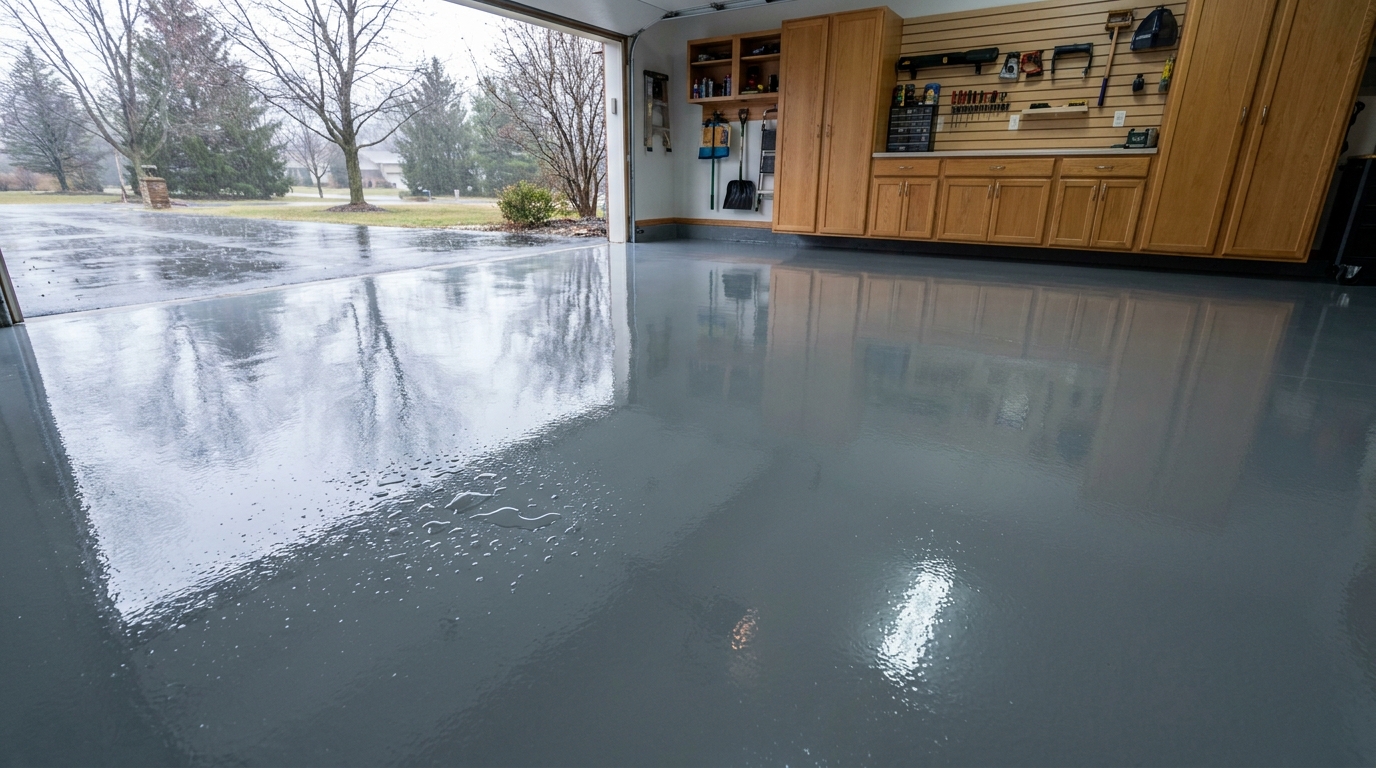
Untreated garage concrete looks solid. It is not. A typical slab is a network of capillary pores that pull in water and whatever is dissolved or riding in that water. In a working Charlotte garage that load includes road-salt brine from winter tires, fertilizer salts from lawn bags and hopper spills, and petroleum from leaks and oil changes. Those materials do not sit on top. They soak in. The result is garage floor salt damage (white crust, pitting, and surface scaling), rust-colored fertilizer stains, and dark oil shadows that soap will not lift. A sealed or coated slab is easier to clean because the pores are no longer open to the next puddle.
Untreated concrete is open to liquids
Concrete is a hardened mixture of cement paste and aggregate. The paste is never a closed, glass-smooth mass. As the mix hydrates, leftover water leaves a connected pore system. The more water that was in the mix relative to cement, the more open that system stays. A 2018 Federal Highway Administration tech brief on chemical deicers notes that paste porosity drops as the water-to-cementitious materials ratio drops, which lowers permeability. ACI guidance cited there recommends a maximum water-to-cementitious materials ratio of 0.45 for plain concrete that will see freeze-thaw, and it treats chemical deicers as the most severe freeze-thaw exposure.[1]
That is a mix-design rule, not a homeowner product spec. The garage point is simpler. A builder-grade slab that was never sealed still has capillaries. Dry concrete will pull liquid into those capillaries by sorption. The same FHWA brief states that concentrated calcium chloride and magnesium chloride solutions used in anti-icing can be drawn into a dry surface and joints at full strength, before rain or meltwater dilutes them.[1]
We see that physics every winter. A car rolls in with slush. The slush melts. A film of salt water sits on the slab. By morning the puddle is gone, but the chlorides are not. They have moved into the surface paste.
Air-entrained concrete is built to handle some freeze-thaw stress. Entrained bubbles (typically specified in the 5 to 8 percent range for severe exposure) give expanding water a place to go.[1] Many garage slabs were not mixed or finished for that exposure. Even a well-air-entrained slab still absorbs liquids. Air voids help with ice pressure. They do not stop chloride, fertilizer salts, or oil from entering the paste.
Road salt and garage floor salt damage
Road salt is not one chemical. USGS water scientists describe sodium chloride as the most common deicing compound, with calcium chloride and magnesium chloride salts also in regular use. Those deicers work by dissolving into water and adding charged particles (ions) that lower the freezing point.[3] The chloride ion is not held by soil particles and is not lost to evaporation, so it moves freely with water.[3]
That mobility is why a brine puddle under a parked car is more than a mess. As water evaporates, the remaining solution gets stronger. The next drip redissolves the residue and pushes it deeper. You do not need a plow in a Charlotte driveway for this to happen. Crews still salt when ice is forecast, and the car brings that brine inside.
Nationally, USGS reported in 2022 that about 25 percent of the salt used each year is applied to pavement as deicing salt, and that U.S. deicing-salt application has tripled since the 1970s.[3] A 2019 USGS chloride page makes the same point and adds that other salt uses have stayed flat or fallen.[4] A 2014 USGS study of 19 urban streams found substantial chloride increases in 84 percent of the streams analyzed, including rising summer levels at 13 of them, a sign that chloride stored in groundwater keeps leaking out after the snow is gone.[5] Those figures are about watersheds, not garage floors. They still tell you what is on the tires that park in your bay.
Once that brine is on untreated concrete, two kinds of damage show up.
Physical damage. The National Ready Mixed Concrete Association's Concrete in Practice sheet on scaling (last revised in 2014) defines scaling as local flaking or peeling of a finished surface after freeze-thaw cycles. Deicing chemicals make it worse by increasing saturation at the surface and the number of freeze-thaw cycles the surface sees.[2] Light scaling does not expose coarse aggregate. Moderate scaling can take off 1/8 to 3/8 inch of surface mortar. Severe scaling leaves the aggregate standing out.[2] Usual causes include non-air-entrained concrete, weak mixes, over-finishing, poor curing, and heavy deicer use, especially on new, still-saturated concrete.[2]
The 2018 FHWA brief adds a saturation threshold. Partially dry concrete can survive freeze-thaw because larger pores still have empty space. The same concrete, frozen above about 86 percent saturation, can be damaged in a single freeze-thaw cycle, even with a decent air-void system.[1] A low spot under a dripping wheel well can sit at that saturation through a cold night.
Chemical damage. Calcium chloride and magnesium chloride do more than amplify freeze-thaw. They react with calcium hydroxide in ordinary cement paste and form calcium oxychloride, an expansive phase. FHWA describes that change as highly expansive, with damage likely from crystallization pressure. In laboratory work summarized in the brief, mortar cylinders soaked in those chlorides at 40°F expanded and cracked even though they were never frozen.[1] Depending on salt concentration, the phase change can occur between 32°F and 122°F, so it is not only a midwinter problem.[1]
A 2015 National Concrete Pavement Technology Center MAP Brief (FHWA-sponsored) puts the same chemistry in plain terms. Sodium chloride tends to react with sulfo-aluminate phases. Calcium chloride and magnesium chloride form calcium oxychloride when calcium hydroxide in the concrete meets calcium chloride in water.[10] Cores treated with a sealer limited that contact, and no appreciable calcium oxychloride formed in those sealed samples.[10]
NRMCA is blunt about what should not be used as a deicer on concrete. Calcium chloride and sodium chloride (rock salt) are treated as the more acceptable options when a deicer is necessary. Ammonium sulfate, ammonium nitrate, and magnesium-based salts are described as chemically aggressive and destructive to concrete. Magnesium-based salts are used for pre-snow deicing of roads and can be tracked in by cars. Poor drainage, which lets salt solutions pond, makes the exposure worse.[2] The homeowner advice we repeat is NRMCA's: when conditions allow, hose off the salt that cars deposit on driveways and garage slabs.[2]
In a house we visit, garage floor salt damage is quieter than a failed highway joint. You see a white crust in the parking tracks, a sandy film that used to be surface paste, small pits where mortar has popped, and sometimes a darker shadow along a control joint where brine sat. The slab is still carrying the car. The surface is no longer a tight skin.
Fertilizer is a salt load, not just plant food
Lawn chemicals get less attention than road salt, and they belong in the same conversation. University of Maryland Extension, in a page updated in March 2026, states it directly: the mineral nutrients in a fertilizer formulation are "salts," and they cause problems when they are too abundant. Ice-melting products from pavement runoff create similar salt stress on turf.[7] If a fertilizer is a salt on the lawn, it is a salt on the garage slab.
Colorado State University Extension's fertilizer guide (reviewed in July 2022) warns against unneeded phosphate and potash because those nutrients add to soil salts. The same guide is specific about hard surfaces. After yard waste, over-spreading fertilizers onto sidewalks, driveways, and streets is a major landscape source of phosphate pollution. Fertilizer that lands on those surfaces moves with runoff.[8]
The garage version is ordinary. A torn bag weeps on the slab. A spreader is filled inside. Pellets hide in tire treads after you drive across a treated lawn. A sprinkler washes leftover product under the overhead door. Wet granules become a salt solution, and that solution soaks into the pores.
Iron is the stain people notice first. Colorado State University Extension's Ask Extension service answered a 2018 driveway question by calling iron stains from iron-containing fertilizer a common issue. The practical fix was not a mystery product: sweep the pellets off the concrete after you apply them. The homeowner later noted that even after sweeping, irrigation washed granules back onto the walk.[9] That is capillary concrete plus water, not a special acid eating the slab overnight.
Potassium chloride shows up in both worlds. CSU lists it as a 0-0-60 potash fertilizer.[8] The same salt is sold as a deicer. Wet it on a porous garage floor and you have a chloride solution sitting on open paste. Fertilizer stains are often orange-brown, sometimes with a white halo. Dye and iron move into the same pores that take road salt. Scrubbing helps the film. It does not pull every ion back out.
Oil does not rinse. It hides.
Petroleum is the third regular load on a working garage slab. Used motor oil is not just dirty. EPA consumer guidance on managing used oil (updated June 25, 2026) says used motor oil is insoluble and persistent, can contain toxic chemicals and heavy metals, is slow to degrade, and sticks to everything from beach sand to bird feathers. EPA's homeowner line is stark: used oil from one oil change can contaminate one million gallons of fresh water, described there as a year's supply for 50 people.[6]
That is a water-resource fact, not a stain-removal tip. It still explains why a drip on untreated concrete is a poor plan. Oil does not evaporate the way salt water does. It wets the paste, fills pores, and darkens the surface from inside. A degreaser can lift what is still sitting on top. The shadow that remains is oil that already moved below the surface. We see that pattern under engines and parked mowers.
EPA's household hazardous waste page (updated June 1, 2026) lists oils among leftover household products that need special care. Improper disposal includes pouring them on the ground, down the drain, or into storm sewers.[11] EPA tells do-it-yourself oil changers to collect used oil in a leak-proof container, take it to a recycling drop-off, and not spill it while collecting it. Recycled oil can be re-refined. One gallon of used motor oil provides the same 2.5 quarts of lubricating oil as 42 gallons of crude oil.[6]
Catch drips. Recycle the used oil. Do not use the slab as a drain field.
Why a sealed or coated slab is easier to clean
None of this means concrete is a bad material. An open pore system plus a working garage is a filter. The filter keeps chlorides, fertilizer salts, and petroleum. Cleaning an untreated floor is a fight with whatever is already inside the paste.
A barrier changes the job. NRMCA's scaling sheet recommends a commercially available silane or siloxane breathable sealer on winter-exposed slabs, applied when the concrete is reasonably dry, with late summer called an ideal window.[2] The 2015 CP Tech Center brief reports that sealed cores limited salt-solution contact with calcium hydroxide and did not form appreciable calcium oxychloride.[10] FHWA's 2018 brief likewise lists penetrating sealants (certain silanes, siloxanes, and others) as one way to reduce salt-solution ingress. Field research on that strategy was still underway when the brief was written.[1]
A film-forming garage floor coating is a different kind of barrier. It is not a penetrating sealer. It is a bonded layer that keeps the next brine, fertilizer solution, or oil drip on the surface so it can be wiped instead of absorbed. That is the maintenance point, not a product pitch. Spills still happen. They just stop disappearing into the slab.
A coating does not reverse scaling that has already eaten the paste. Loose mortar has to be ground or removed before anything will stick. That is why we start with the condition of the concrete, not with a color chip.
If you want the floor to stay untreated, the same physics still gives you a punch list. Hose off winter salt when the weather allows, as NRMCA advises for garage slabs.[2] Sweep fertilizer granules the day you apply them, and keep irrigation from washing them back on.[9] Keep bags and hoppers off the bare slab. Catch oil. Recycle used oil instead of storing open pans on the floor.[6]
Practical takeaways
- Treat untreated garage concrete as a sponge. Chlorides, fertilizer salts, and petroleum move into the pores.
- Garage floor salt damage is both physical (freeze-thaw scaling of a saturated surface) and chemical (calcium oxychloride from calcium chloride and magnesium chloride, including above freezing).[1][2][10]
- Cars are the salt spreader inside the garage. Hose off brine when you can, and do not let salt solutions pond.[2]
- Avoid magnesium-based, ammonium sulfate, and ammonium nitrate deicers on concrete. NRMCA calls those chemically aggressive.[2]
- Lawn fertilizer is a salt. Sweep granules off the slab and do not store torn bags on bare concrete.[7][8][9]
- Iron in some fertilizers leaves rust-colored stains in the pores. Same-day sweeping is the prevention extension staff recommend.[9]
- Used motor oil is persistent. Collect it and recycle it. One household oil change can contaminate a million gallons of fresh water if it is dumped.[6][11]
- A penetrating sealer or a bonded floor coating makes the next spill a wipe-up, because it limits how much liquid the paste can drink.[1][2][10]
- Scaling that has already exposed aggregate is not a soap problem. Any new finish has to start with a sound surface.
How we can help
Our team walks the slab the way a materials problem deserves. We look for white salt crust in the parking tracks, sandy paste that is starting to scale, rust-colored fertilizer marks near the overhead door, and the dark oil shadows that never quite clean up. We talk through what the concrete has already absorbed and whether a sealer, a garage floor coating, or another garage flooring system fits how you use the room. We do not pretend a coating erases a slab that has already lost its surface. We do make the next winter's brine and the next oil drip easier to clean.
Have more questions or want to get in touch? Visit our contact page to book a free in-home consultation.
Citations
- Federal Highway Administration / ROSA P, "Chemical Deicers and Concrete Pavement: Impacts and Mitigation" (FHWA Tech Brief, March 2018, FHWA-HIF-17-008 / FHWA-HIF-18-008)
- National Ready Mixed Concrete Association, "CIP 2: Scaling Concrete Surfaces" (last revised 2014)
- U.S. Geological Survey, New England Water Science Center, "Deicing New England's Roads, Parking Areas, and Walkways is Changing the Region's Water Quality" (2022-12-30)
- U.S. Geological Survey, "Chloride, Salinity, and Dissolved Solids" (2019-03-01)
- U.S. Geological Survey, "Urban Stream Contamination Increasing Rapidly Due to Road Salt" (2014-12-15)
- U.S. Environmental Protection Agency, "Managing, Reusing, and Recycling Used Oil" (updated 2026-06-25)
- University of Maryland Extension, "Lawn Problems Not Caused by Pests or Diseases" (updated 2026-03-16)
- Colorado State University Extension, "Understanding Fertilizers" (published 2015, reviewed 2022-07)
- Ask Extension / Colorado State University Extension, "Iron stains from fertilizer in concrete" (2018-05-26 / reply 2018-05-30)
- National Concrete Pavement Technology Center (FHWA CP Road Map), "Concrete Pavement Joint Deterioration: Recent Findings to Reduce the Potential for Damage" (June 2015)
- U.S. Environmental Protection Agency, "Household Hazardous Waste (HHW)" (updated 2026-06-01)