Interior Lights in Garage Cabinets So the Boxes Open Like a Kitchen
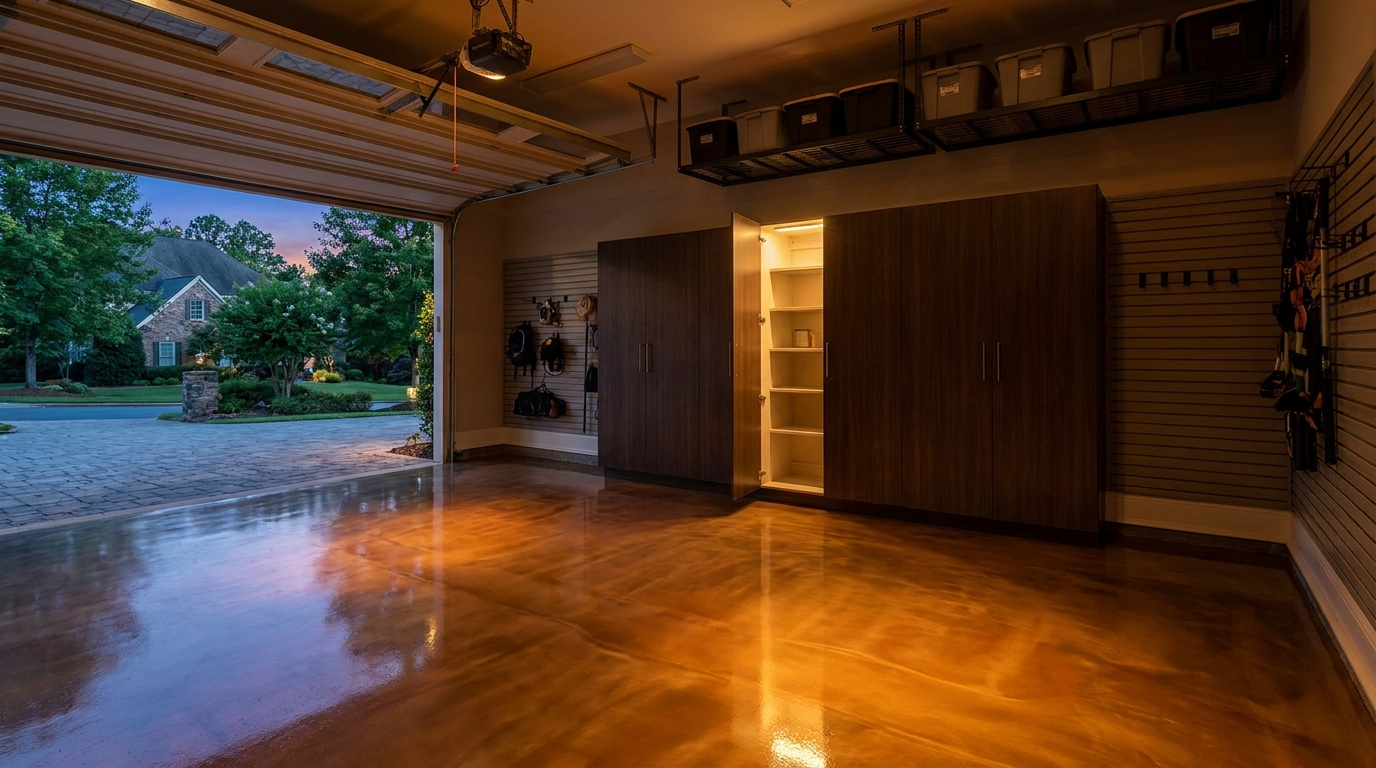
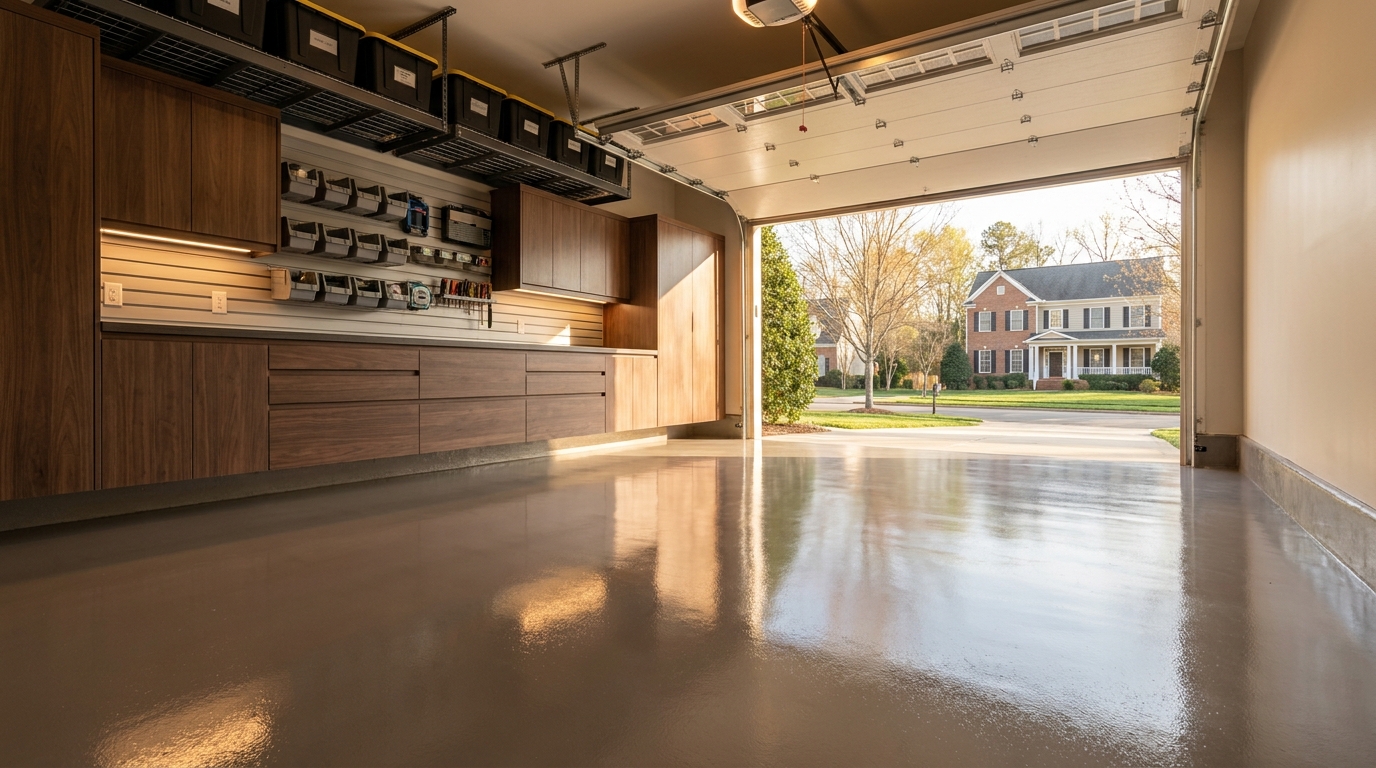
Garage cabinet interior lighting is the light we put inside the boxes so a door or a drawer opens onto a lit interior, the same way a kitchen cabinet does. Ceiling lights, lights along the cabinet run, and bounce off a glossy floor are a different conversation. They make the room read as one after dark. This is the light that lives in the box itself, so the second shelf and the back of a drawer are already visible when the door swings. The National Kitchen and Bath Association's 2024 lighting report names lighting inside cabinets and drawers as the layer that makes it easier to see their contents.[1]
The light inside the boxes, not the light in the room
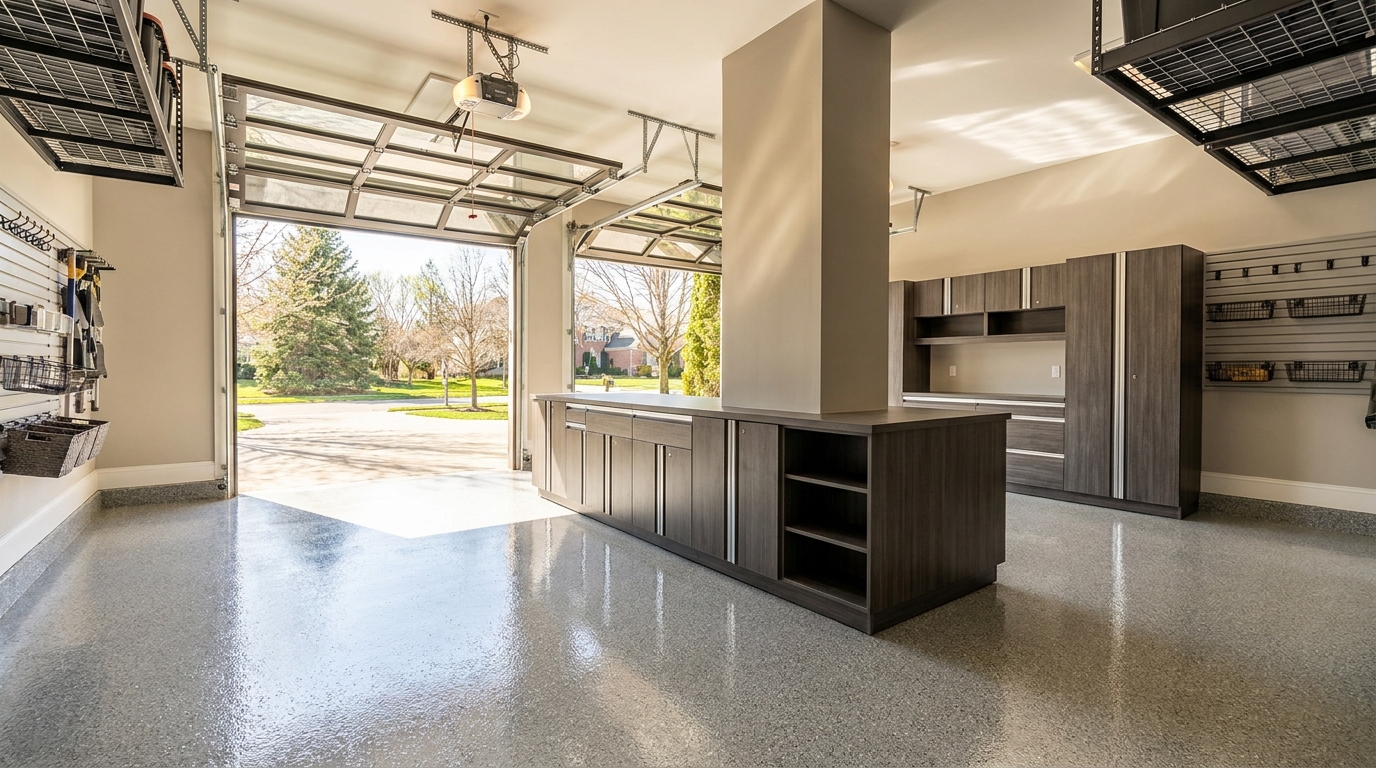
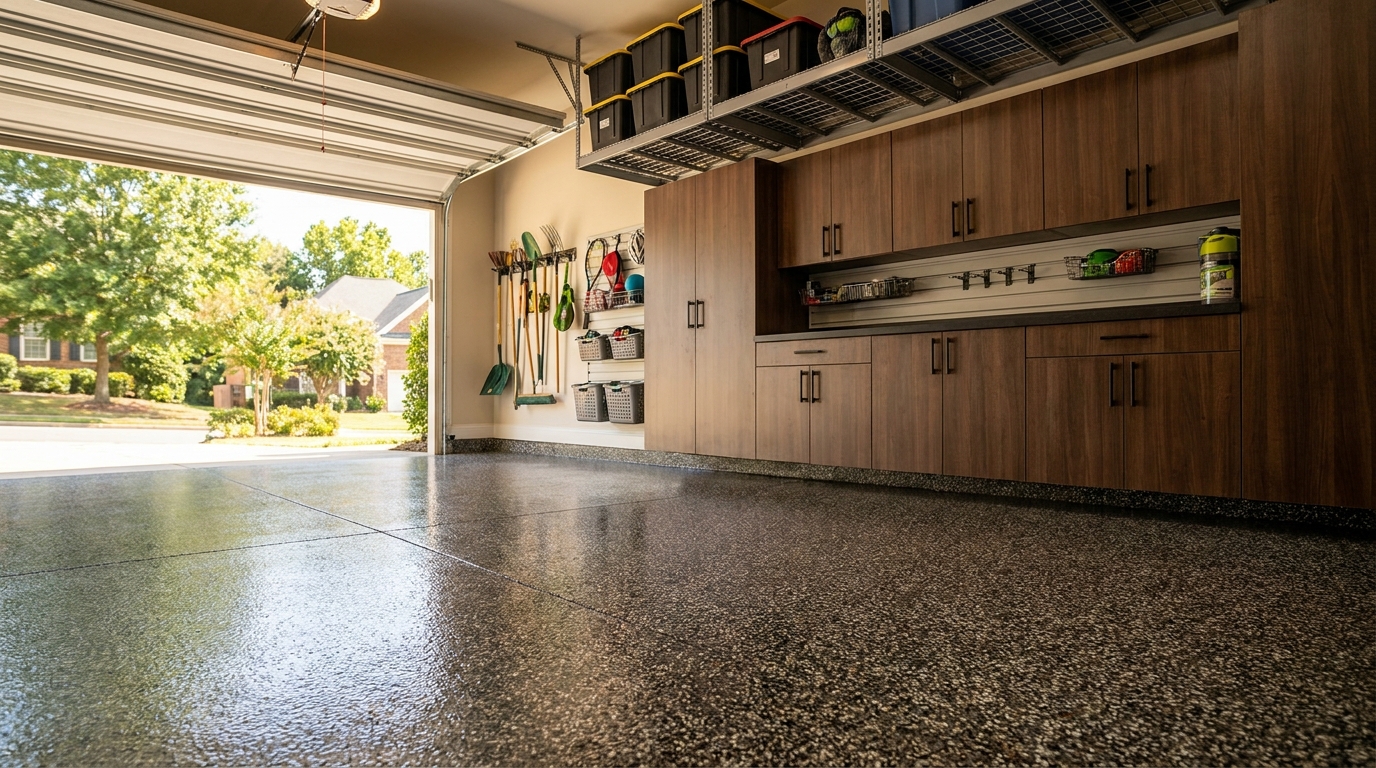
Step into a garage we have finished in Charlotte, Waxhaw, or Monroe, and the room already feels like part of the house. Heat-fused laminated melamine cabinets sit on the wall. Soft-close doors line up. Full-extension drawers pull toward you. The coated floor continues under the boxes. After dark, the ceiling lights and the bounce off that floor can make the whole bay read as one finished room. That is a different design decision.
Interior lighting is what happens when you open a door. Without it, a well-built cabinet is still a dark volume. Your body stands in the ceiling light, and the interior of the box sits in shadow. Kitchen cabinets solved this a long time ago. A door opens, and the interior is already on.
We specify garage cabinet interior lighting as part of the cabinet plan, not as a strip added later. The boxes are heat-fused laminated melamine, Signature or Classic, manufactured in the United States, wall-mounted with optional legs. Interior shelves are rated to 100 lb. Soft-close hinges and full-extension drawer glides are standard. The light belongs to that same spec: low-voltage LED that turns on with the door or the drawer and stays off when the box is closed.
The Illuminating Engineering Society's recommended practice for residential environments, RP-11, treats lighting as a set of visual tasks across rooms and age groups, and it asks designers to personalize illuminance recommendations rather than apply one number to every surface.[2] Finding a labeled bin on a 100 lb shelf is not the same visual job as walking across a coated floor. The room lights handle the walk. The interior lights handle the search.
Why kitchen cabinets already open this way
Kitchen design has a language for this. NKBA's Kitchen and Bath Planning Guidelines, Fourth Edition, ask for several layers of light in an occupiable space, zoned by activity, with a mix of general, task, and decorative lighting.[3] Task illumination at activity centers should provide a minimum of 50 footcandles, general illumination a minimum of 20 footcandles, and all illumination in the room a minimum of 90 CRI so color reads accurately.[3] Under-cabinet lighting, in that same guideline, is planned near the front edge of the cabinet or shelf so the work surface is lit rather than the backsplash.[3] Lighting inside the box is the next step of that same thinking: light aimed at the contents, not at a counter.
The 2024 NKBA lighting report puts that interior layer on a kitchen diagram as its own numbered item: lighting inside cabinets and drawers makes it easier to see their contents.[1] Designers in that study treat layered light as the way a kitchen actually works, with a minimum of three to four layers, sometimes as many as seven.[1] A garage we finish for a Charlotte homeowner is not a kitchen. It is a finished room with the same kind of millwork. Closed doors, full-extension drawers, and a worktop deserve the same courtesy: when the door opens, the interior is on.
That is the finished dream. You park, you walk to the cabinet run, you open a door, and the box greets you like furniture. A full-extension glide already brings drawer contents toward you. Interior light makes that extension useful in the evening, not only at noon.
How we place the light in the box
The hardware is small on purpose. The U.S. Department of Energy notes that one defining feature of LEDs is compact size and bright output, which enable good optical control and reduce the light that gets lost inside a fixture.[4] In a cabinet, that control is the whole point. We want the contents lit, not a hot spot on the back panel and a dark front edge.
Linear LED in a shallow channel is our usual spec for a door cabinet. It runs along the top of the box, or along the hinge-side stile, so the light washes the shelves rather than staring you in the face when the door opens. On a tall cabinet with several adjustable shelves, a second strip under an intermediate shelf keeps the lower volume from falling off. Puck lights have a place in a glass-front display. In a working garage cabinet, a linear run is more even. It does not scallop the shelf the way a single puck can.
Drawers get a short linear piece at the back of the drawer box, or a slim bar under the drawer above, that comes on as the drawer extends.
Controls belong to the box. A door-activated switch or a small occupancy sensor turns the light on when the door opens and off when it closes. NKBA's planning guidelines say lighting fixtures should be controlled by a dimming device or occupancy sensor, and that fixtures should be zoned to the activity they serve.[3] DOE's federal purchasing guidance for luminaires makes the same energy point: occupancy sensors provide savings for task lighting, and task lights should be used with lower ambient levels rather than leaving the whole room bright for one search.[5] Inside a garage cabinet, that is the natural control.
We keep the driver, the small power supply that steps house voltage down to the LED, accessible. It lives in a chase, an adjacent filler, or a high unused corner of a tall box, never buried behind a loaded 100 lb shelf.
How bright, and how it should feel
We do not light the interior of a cabinet the way we light a kitchen prep counter, and we do not light it the way we light the garage floor. A 2012 DOE Building America lighting guide, drawing on Table 33.2 of the Illuminating Engineering Society's Lighting Handbook, Tenth Edition, lists 5 footcandles as a general garage recommendation, 5 vertical footcandles on kitchen cabinet fronts, 10 horizontal footcandles for a non-walk-in closet, and 50 footcandles on a kitchen prep counter. It also notes that a kitchen counter with under-cabinet lights often lands in a 20-to-90 footcandle range.[6] Those numbers are more than a decade old, and they describe surfaces in a room, not the inside of a closed garage box. They are still a useful map. Room ambient in a garage is a low number. Searching for contents is closer to a closet or a work surface. Interior cabinet light should make labels and small parts readable without turning the open door into a floodlight on the parking bay.
NKBA's 50-footcandle minimum is for activity-center work surfaces, not for the back of a garage upper.[3] We treat it as a ceiling for a worktop and a reference for a deep drawer of small parts, not as a target for every shelf. The same 2024 NKBA report notes that as people age they need more light and less glare, and that if a 25-year-old needs 50 footcandles to see kitchen work, a 65-year-old needs 100 footcandles or more.[1] That is why we like dimmable interior LED and a sensor that only runs while the door is open.
Color rendering matters more than a dramatic color temperature. DOE's LED basics page recommends a minimum CRI of 80 for interior lighting and notes that a CRI of 90 or higher indicates excellent color fidelity, a threshold LED products can meet.[4] NKBA's planning guidelines ask for a minimum of 90 CRI in the room so color reads accurately, and they place color temperature in a 2700K to 5000K range set by user preference and the materials in the space, with sources kept consistent within the room.[3] Matching the room's after-dark color is a different conversation. For the interior of the box, we keep the LED in the same family as the rest of the garage so an open door does not look like a different lamp. A diffused channel at the top of the box or on the hinge side lights the contents and stays out of the sightline. Darker finishes in our library (Charcoal, Navy, Black) absorb more light than White or Antique White, so those interiors often want a second strip.
Listed low-voltage light in a working cabinet
The electrical path is as much a design decision as the strip. NFPA 70, the National Electrical Code, is the benchmark for safe electrical design and installation and is used in all 50 states. The 2023 edition is the current version as of NFPA's own overview.[7] In the 2017 NEC, Article 411 covers lighting systems operating at no more than 30 volts AC or 60 volts DC, and it requires the system to be listed either as a complete identified system or as an assembly of listed parts: luminaires, power supply, fittings, and suitably rated secondary wiring.[8] The 2014 cycle of the same article already named low-voltage LED such as under-cabinet lighting as part of that family, and required Class 2 power sources and lighting equipment connected to them to be listed.[8]
NFPA describes a listed product as one evaluated by a third-party organization the inspector trusts, and NEC 110.3(B) requires listed equipment to be installed and used in accordance with the instructions that come with that listing.[9] We specify listed LED, a listed driver, and a wiring method that matches the listing.
Some cabinets hold fertilizer, automotive fluids, paints, and sharp tools, and we offer lock-and-key options on those boxes. Interior light in a lockable cabinet is still a good idea. You open the door with the key, the interior comes on, and you can see what you are reaching for.
Receptacles inside a cabinet or drawer can be subject to extra rules in a given jurisdiction, which NKBA flags in its electrical planning notes.[3] We plan power for the lighting with the electrician as part of the cabinet layout, and we keep room outlets accessible.
Why LED belongs in a Charlotte garage cabinet
LED is the light source this job wants. DOE describes LED lighting as already the most energy-efficient lighting technology, with compact size, long life, resistance to breakage and vibration, good performance in cold temperatures, a lack of infrared or ultraviolet emissions, and instant-on performance.[4] A garage in Union or Mecklenburg County sees all of that. Doors open and close. Boxes sit through a cooler January morning. Instant-on matters when a sensor fires for ten seconds while you grab a bin.
Useful life is measured to L70, the hours until output has fallen to 70 percent of the initial level. DOE's LED basics page puts good-quality white LED products in a 30,000-to-50,000-hour band, against about 1,000 hours for a typical incandescent and 8,000 to 10,000 hours for a comparable CFL.[4] A 2020 DOE study of LM-80 data across 223 LED package data sets found that 96 percent of the luminous flux values had an L70 of nearly 60,000 hours or longer.[10] That 2020 package-level figure is not a promise about every cabinet strip we install, and drivers still fail before LEDs do, which DOE also notes.[4] It is why we keep the driver accessible.
EPA's ENERGY STAR specifications for lamps and luminaires, which had covered shelf-mounted display and task lights mounted under overhead storage cabinets, sunset on December 31, 2024.[5] We still care about efficiency and listing. We do not treat an ENERGY STAR mark on a new cabinet luminaire as a current certification.
Heat-fused laminated melamine is the surface that light meets. Signature Series uses 1-inch tops, bottoms, and adjustable shelves with 3/4-inch doors, drawer fronts, and side panels. The heat-fused laminate resists scratches, oil, and impact better than painted MDF or stained wood. Interior light shows that finish, and it shows the contents clearly against Pewter, Timber Gray, Navy, or White.
How we draw interior light with the cabinet plan
We start with the wall, not with a roll of tape. On-site measurement captures cabinet widths, shelf counts, drawer banks, lockable boxes, and the outlets that have to stay accessible. The 3D rendering we produce for a Charlotte garage already shows the finished run. Interior lighting is an accessory on that same drawing: which doors get a top strip, which tall boxes get a second run, which drawers get a sensor, where the driver lives.
Installation is the same local crew and the same one-to-two-day window as the cabinetry. Wiring is planned with the electrician before the boxes go on the wall. Wall-mounted cabinets with optional legs keep the coated floor running under the run, and they leave a clean chase for low-voltage cable.
A typical two-car garage across Mecklenburg, Cabarrus, Iredell, Union, Gaston, and York counties might take interior light in the lockable chemical cabinet, the drawer bank by the worktop, and the tall pantry. It does not have to be every door. The evening doors are the ones that should open onto light.
Practical takeaways
- Specify garage cabinet interior lighting as light inside the boxes, so doors and drawers open onto a lit interior the way kitchen cabinets do. Room lighting after dark is a different layer.[1]
- Use linear LED in a diffused channel at the top or hinge side of a door cabinet, and a short run for drawers, rather than a single puck that scallops the shelf.[4]
- Control the interior with a door or drawer sensor so the light is on while you are in the box and off when the door is closed, in line with occupancy-sensor guidance for task lighting.[3][5]
- Ask for listed low-voltage LED and a listed driver, installed per the listing, under NEC Article 411 limits of 30 volts AC or 60 volts DC.[8][9]
- Keep color rendering high (NKBA asks for 90 CRI in the room) and keep the interior LED in the same color family as the rest of the garage, without turning this into an after-dark kelvin-matching exercise.[3][4]
- Plan the driver where it can be reached later, and plan interior light on the evening doors: lockable chemical storage, the drawer bank, and the tall pantry.
How we can help
Have more questions or want to get in touch? We come to your garage in Charlotte, Waxhaw, Monroe, and the surrounding Union and Mecklenburg County area, measure the walls, and draw garage cabinets with interior LED as part of the same plan. Start on our contact page and we will schedule the visit.
Citations
- National Kitchen and Bath Association, "Lighting In Kitchen & Bath Design" (2024-06)
- Illuminating Engineering Society, "RP-11, Lighting for Interior and Exterior Residential Environments" (2018)
- National Kitchen and Bath Association, "Kitchen & Bath Planning Guidelines With Support Spaces and Accessibility, Fourth Edition" (2022)
- U.S. Department of Energy, "LED Basics" (accessed 2026-09-12)
- U.S. Department of Energy, Federal Energy Management Program, "Purchasing Energy-Efficient Light Fixtures (Luminaires)" (2023-06)
- U.S. Department of Energy, Building America, "Strategy Guideline: High Performance Residential Lighting" (2012-02)
- National Fire Protection Association, "Learn More About NFPA 70, National Electrical Code (NEC)" (accessed 2026-09-12)
- Electrical License Renewal, "Article 411. Low-Voltage Lighting" (2017 NEC text)
- National Fire Protection Association, "Understanding the what, when, and why about NEC listing requirements" (2021-02-08)
- U.S. Department of Energy, "New Study Examines Lumen and Chromaticity Maintenance of LED Packages, Based on LM-80 Data" (2020-07-01)