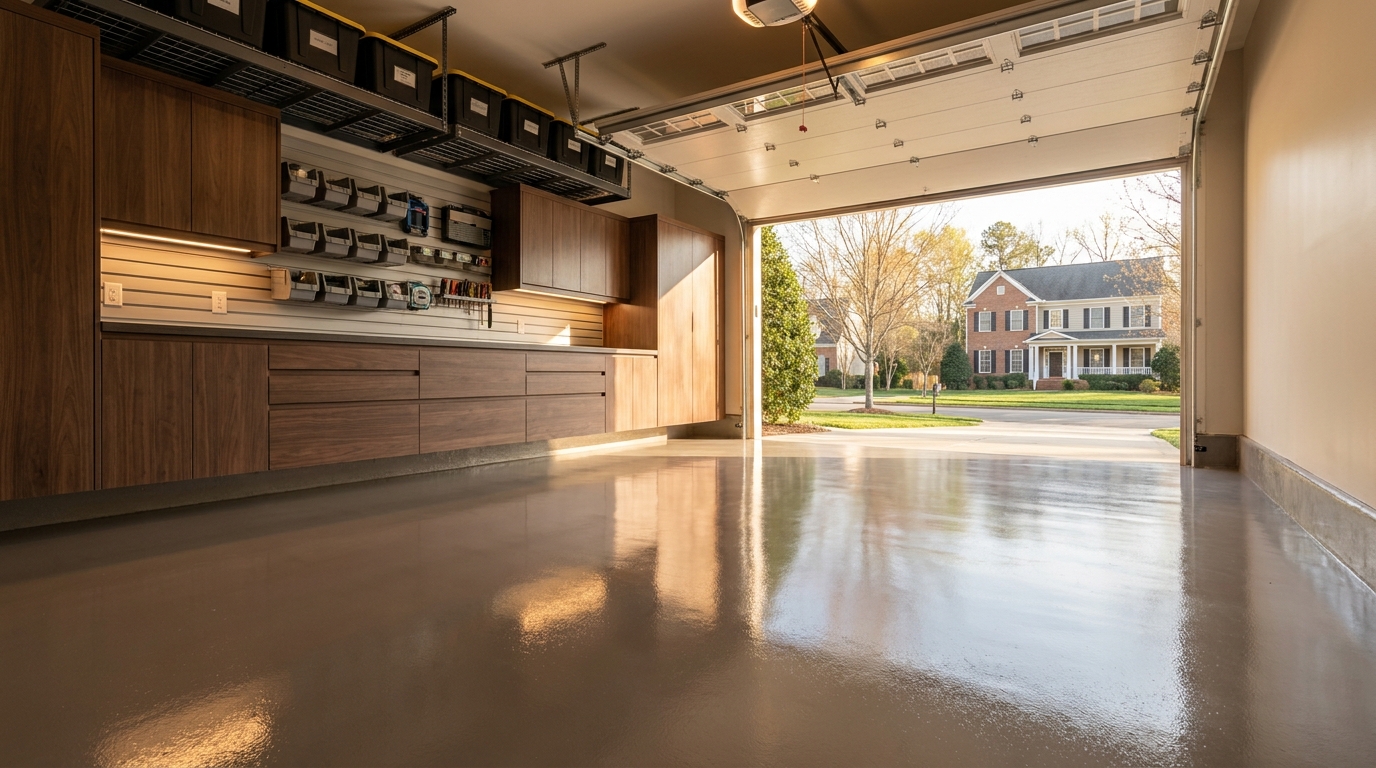
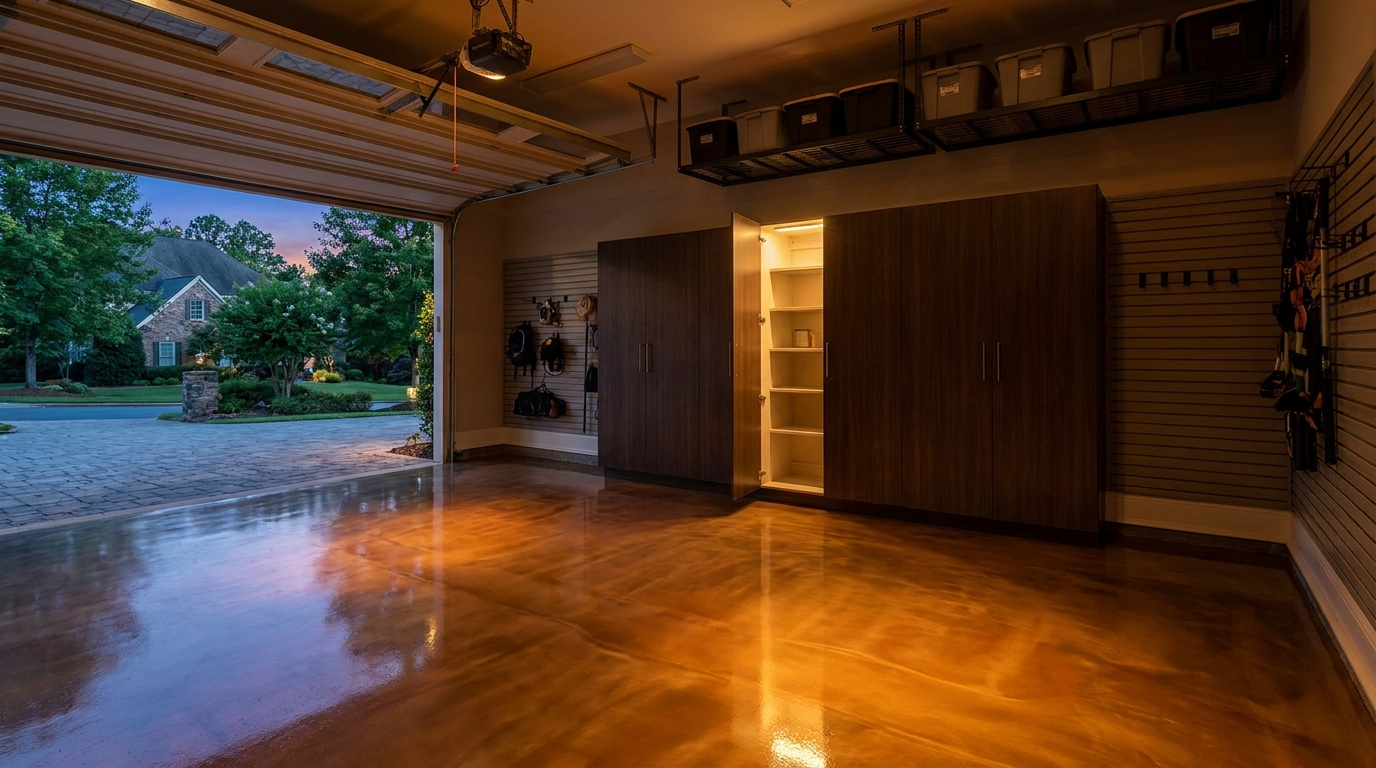
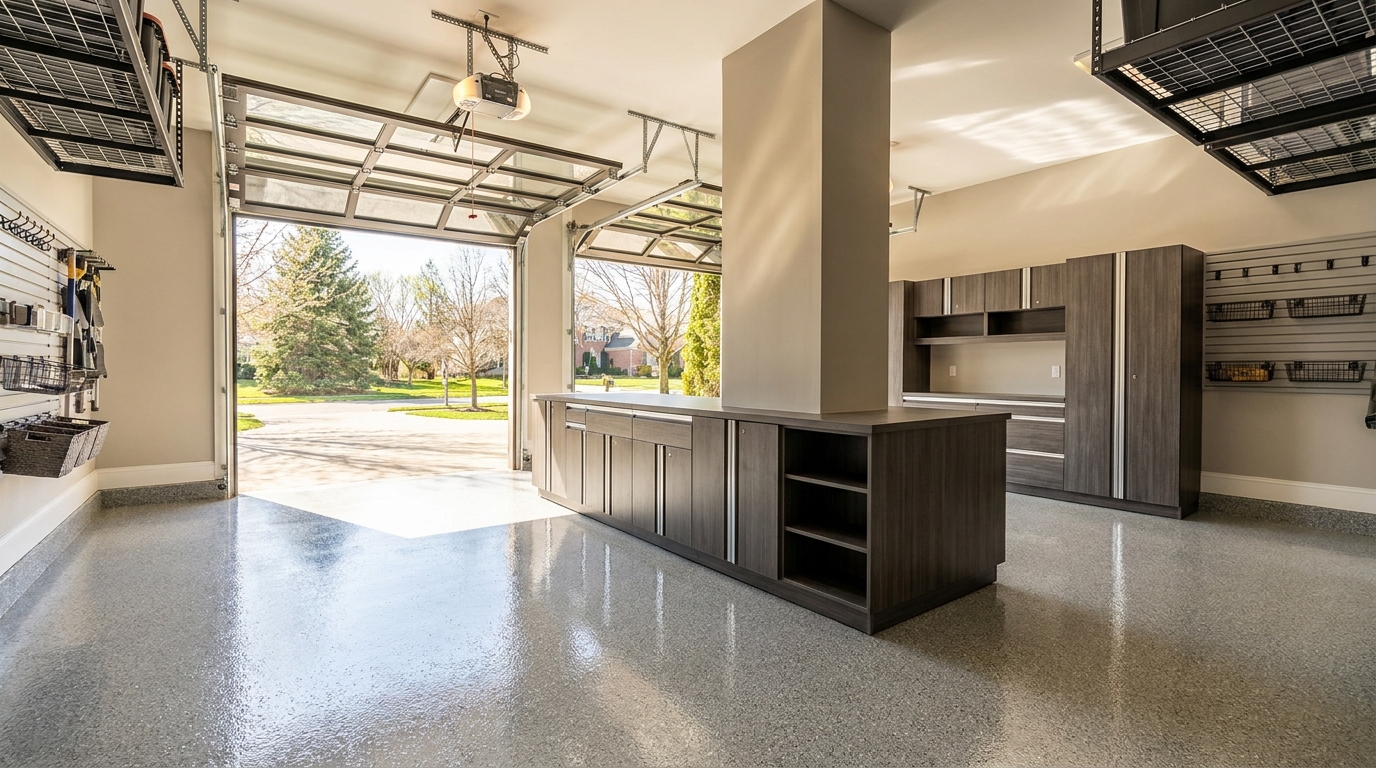
Garage Cabinets Finished to Match the Kitchen You Walk Into
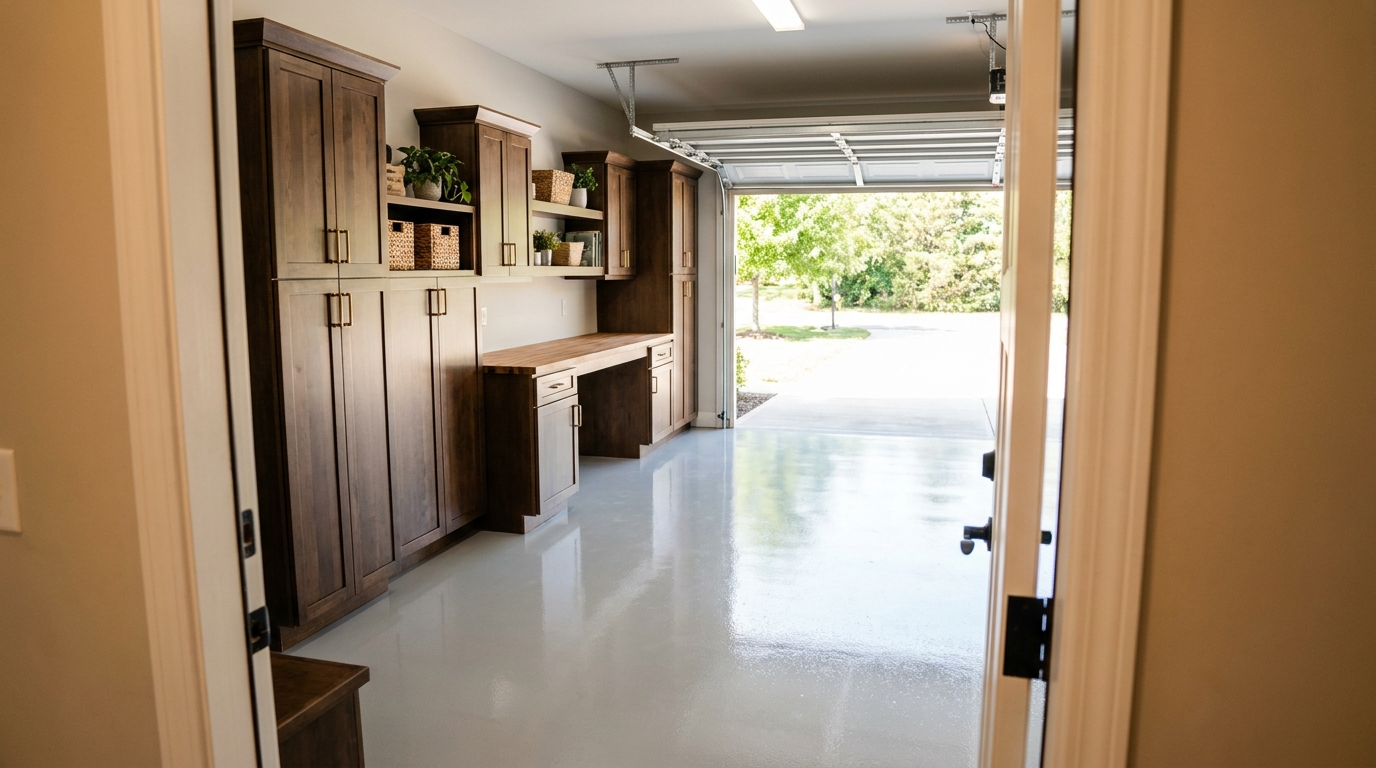
When you open the mudroom door, the garage should feel like the next room of the house, not a change of address. We specify garage cabinet finish by reading the kitchen and mudroom first (door color, wood grain, metal on the pulls) and carrying that language onto the cabinet run. In the 2025 National Kitchen & Bath Association Kitchen Trends Report, 85 percent of respondents agreed the kitchen has the strongest impact on the personality of the home as a whole [1]. The garage you walk into from that kitchen is part of the same personality, and the right garage cabinet finish is how that personality continues.
The door swing is a design moment
Picture the path you already take. Shoes off in the mudroom. Grocery bags on the island. A glance back through the doorway as you hang the keys. That glance is the test. If the cabinet doors in the garage pick up the kitchen's wood tone, painted color, or hardware family, the house holds together. If they do not, the garage reads as a separate building even when the rest of the project is beautifully built.
That is a design decision, not a storage afterthought. Our team treats the cabinet finish as the handshake between rooms. We want the finished garage to greet you the way a well-considered pantry or laundry room does: same house, same materials language, same sense that someone chose this on purpose.
Home buyers already rank garage storage among the features they most want. In the National Association of Home Builders' February 2024 "What Home Buyers Really Want" findings, garage storage sat on the same essential-or-desirable list as a laundry room, a walk-in pantry, and table space in the kitchen [2]. A March 2024 National Association of REALTORS® recap of that study noted that 80 percent or more of buyers rated those amenities, including garage storage, as essential or desirable [3]. Storage is on the wish list. Finish is what makes the storage feel like the rest of the house.
Start in the kitchen, then choose the garage
We do not pick a garage cabinet finish from a catalog in isolation. We start where you already live. On the in-home visit we photograph the kitchen and mudroom, note whether the perimeter cabinets are painted or stained, whether the island is a different color, and what metal is on the pulls, knobs, and faucet. Then we hold garage door and drawer samples in that same light.
That sequence matters because kitchens have become more personal, not more generic. The 2025 NKBA report found that 71 percent of respondents preferred colorful kitchens that showcase personality, against 29 percent who preferred a clean, classic white kitchen, and that 92 percent agreed the kitchen is a reflection of a homeowner's personality [1]. Statement colors land on backsplashes, islands, cabinets, wallpapers, and wall paints. Fifty-two percent of those surveyed agreed cabinets will be a primary place for incorporating statement colors [1]. If the kitchen is making a color statement, the garage that opens off the mudroom should know about it.
That does not mean we copy the kitchen door for door. NKBA also reported a mix-and-match mood in 2025 kitchens: blending colors and finishes, and using decorative hardware, statement lighting, and artwork as personality cues [1]. Continuation of the house can mean an echo, a related wood grain, or a hardware family that repeats. It does not have to mean every garage door is a twin of every kitchen door.
Color families that carry from kitchen to garage
The 2025 NKBA color story is light, warm, and natural more than cool gray. Green was the most popular shade for the second year, selected by 76 percent of respondents, with blue at 63 percent and brown at 56 percent [1]. White oak kitchen cabinets were the clear wood favorite, listed by 59 percent as the preferred color for 2025 [1]. Bright colors and earth tones associated with the 1970s were expected to be popular by 52 percent of respondents, and 47 percent predicted a muted mid-century modern resurgence in cabinetry, hardware, and colors [1].
Those kitchen numbers give us a useful map, because our garage cabinets already live in the same families: wood patterns such as Warm Sand, Timber Gray, and Seared Brown; solids such as Navy, Cobalt Blue, Charcoal, Antique White, and White; hardware in brushed chrome, black powder coat, or oil-rubbed bronze.
A white-oak kitchen with black pulls often wants Warm Sand or Timber Gray with black powder-coat hardware. A navy island with warmer metal often wants Navy or Seared Brown with oil-rubbed bronze so the metal repeats as you walk through. A painted white kitchen can stay quiet in Antique White, or pick up a dark island with Charcoal or Slate. Green kitchens rarely need a literal green garage door. A related wood grain or a charcoal that already sits next to the green in the mudroom usually does more. Blue kitchens have a direct path: Navy and Cobalt Blue sit comfortably next to the blues NKBA named as a top shade [1].
When the kitchen speaks wood, the garage can speak wood. When it speaks a painted door, the garage can speak that color or a quieter neighbor of it. When it mixes the two, we pick one voice for the whole garage run so the larger room stays calm.
Hardware is the handshake
Color gets the attention. Hardware is what the hand actually touches, and it is one of the fastest ways to make two rooms feel related. NKBA's 2025 report named decorative hardware, along with statement lighting and artwork, as a way to show personality through kitchen design [1]. NAHB's 2024 design-trends release made a similar point: buyers want a home that feels made for them, including through higher-quality cabinets [2].
We treat garage pulls as part of that kit. Matte black kitchens get black powder coat. Brushed nickel or chrome against stainless gets brushed chrome. Oil-rubbed bronze or warmer aged brass gets oil-rubbed bronze. A Warm Sand door next to white oak will never be a laboratory match. Repeating the black pull still tells the eye the rooms were specified together. A perfect color echo with a random chrome pull in a house full of black hardware will still feel like two projects. The cabinet hardware is the piece you see at eye level when the mudroom door is open, so it has to agree with the kitchen.
How light changes the finish you chose
A finish that looks right in a showroom, or even in your kitchen at noon, can shift in the garage. That is not a flaw in the laminate. It is how color works. Objects do not carry a single, fixed color. They reflect the light that hits them, and that reflected light is what your eye reads.
A 2022 tutorial on the Illuminating Engineering Society's ANSI/IES TM-30 method, hosted by the U.S. Department of Energy, puts it plainly: color rendition is the influence of a light source on the color appearance of objects and surfaces, and poor color rendition can make those colors look unpleasant or distorted [4]. The older Color Rendering Index relies on a limited sample set, so two lamps labeled "warm white" can still disagree about whether Seared Brown looks chocolate or gray-brown [4].
Color temperature pushes the same door in different directions. Pacific Northwest National Laboratory's Building America lighting guide, updated in 2022, groups common household lamps this way: 2700K to 3000K reads as warm and yellowish, 3500K to 4100K as a whiter light, and 5000K to 6500K as cooler white, with daylight typically identified as 4500K or higher [5]. Warm Sand looks richer under 2700K kitchen pendants and flatter under a 5000K shop lamp. Navy can look inky under warm light and more blue-gray under cool light. If the two rooms sit on different color temperatures, the match you approved on a sample board can come apart after dark.
There is a second effect when two materials are meant to look like the same color. NCS Colour describes metamerism as two surfaces that look the same under one illuminant (daylight, for example) and different under another [6]. Kitchen paint, stained wood, and a heat-fused laminated melamine garage door are not the same material. They can sit together in afternoon sun and then split under LED shop lights. NCS's advice is to check the pair in more than one light, including at least daylight and a typical indoor source [6]. That is how we use samples: kitchen at noon, kitchen at night, garage with the overheads on and with the bay door open. We do not lock a garage cabinet finish from a phone photo. Light is part of the finish.
Coordinated, not cloned
The most convincing rooms we finish in Charlotte, Waxhaw, Matthews, and Fort Mill are not photocopies of the kitchen. They are coordinated. If the kitchen mixes white oak on the perimeter with a painted island, the garage takes one of those two voices and runs it the length of the wall. Hardware repeats. A worktop can pick up a maple or stainless note that already exists at the kitchen sink.
NKBA's 2025 respondents favored personality, mix-and-match, and cabinets as a place for color, not one uniform finish on every door in the house [1]. A cloned kitchen in the garage can look less considered than a related wood grain with matching metal, because the two rooms have different jobs and different daylight. Our coordinated design work keeps that composition honest across cabinets, shelving, slatwall, and overhead racks. Cabinet color and hardware are the kitchen-facing piece. Floor color is a separate decision. Here we are talking about the doors, drawer fronts, and pulls you see when the mudroom door swings open.
How we specify garage cabinet finish in a Charlotte home
A typical project with our team follows a simple order.
First, we walk the house. We measure the garage, then stand in the kitchen and mudroom with the connecting door open. We note cabinet color, hardware, and the light you already have.
Second, we pull two or three samples that could reasonably continue the house: a wood pattern next to your oak, a navy next to your island, an antique white next to your painted perimeter.
Third, we render the garage in 3D with those finishes on the cabinet run. You can swap Warm Sand for Timber Gray, or a black pull for oil-rubbed bronze, before anything is manufactured.
Fourth, the cabinets are built in the United States to the approved spec. Signature Series uses heat-fused laminated melamine with a lifetime warranty on cabinet boxes and finishes. Classic Series carries a seven-year limited warranty. Both are wall-mounted systems with optional legs, so the finished doors sit on the wall the way kitchen wall cabinets do.
Fifth, our local crew installs. We walk the finished room with you, check hinge and drawer alignment, and look at the cabinet finish in the real light one more time. The sample visit and the rendering exist so a pull that fights the kitchen metal gets caught on paper, not after the doors are hung.
The result is simple to live with. You come in from the car, you open the mudroom door, and the garage looks like it was designed with the rest of the house. The color and the hardware are the reason it feels finished.
Practical takeaways
- Photograph your kitchen and mudroom with the connecting door open, in daylight and after dark, before you lock a garage cabinet finish. Those two rooms are the brief.
- Treat hardware as part of the finish. Repeating black, chrome, or oil-rubbed bronze from the kitchen pulls is often more convincing than chasing a perfect color clone.
- If the kitchen mixes wood and paint, pick one of those two voices for the garage run so the larger room stays calm.
- View physical samples in the kitchen and in the garage, under the lamps you actually have. Color rendition and color temperature both change how a wood grain or a navy door reads [4][5].
- Expect two different materials (painted kitchen doors and laminated garage doors) to shift relative to each other when the light changes. That is metamerism, and the fix is to check the pair under more than one source before you order [6].
- Ask to see the finish on a 3D rendering of your wall, not only on a two-inch chip. Scale changes how bold a Navy or Charcoal feels.
How we can help
Our team designs and installs garage cabinetry for Charlotte, Monroe, Waxhaw, and the surrounding Mecklenburg and Union County communities, with cabinet color and hardware specified to continue the kitchen and mudroom you already love. We measure on site, bring finish samples into the actual rooms, and render the cabinet run so you can approve the garage cabinet finish before anything is built. Have more questions or want to get in touch? Contact us
Citations
- National Kitchen & Bath Association, "NKBA | KBIS Kitchen Trends Summit Highlights 2025 Kitchen Trends Report and New Video Series" (2024-12-18)
- National Association of Home Builders, "Better, Not Bigger, Homes Among Top Design Trends for 2024" (2024-02-28)
- National Association of REALTORS®, "13 Features New-Home Buyers Say Are Essential, Desirable" (2024-03-01)
- U.S. Department of Energy / Pacific Northwest National Laboratory, "Tutorial: Background and Guidance for Using the ANSI/IES TM-30 Method for Evaluating Light Source Color Rendition" (2022)
- Pacific Northwest National Laboratory, Building America Solution Center, "High-Efficiency Lighting" (updated 2022-12-03)
- NCS Colour, "The phenomenon of metamerism" (accessed 2026-08-31)