Drawer Banks Mixed Into the Cabinet Run So Small Tools Have a Home
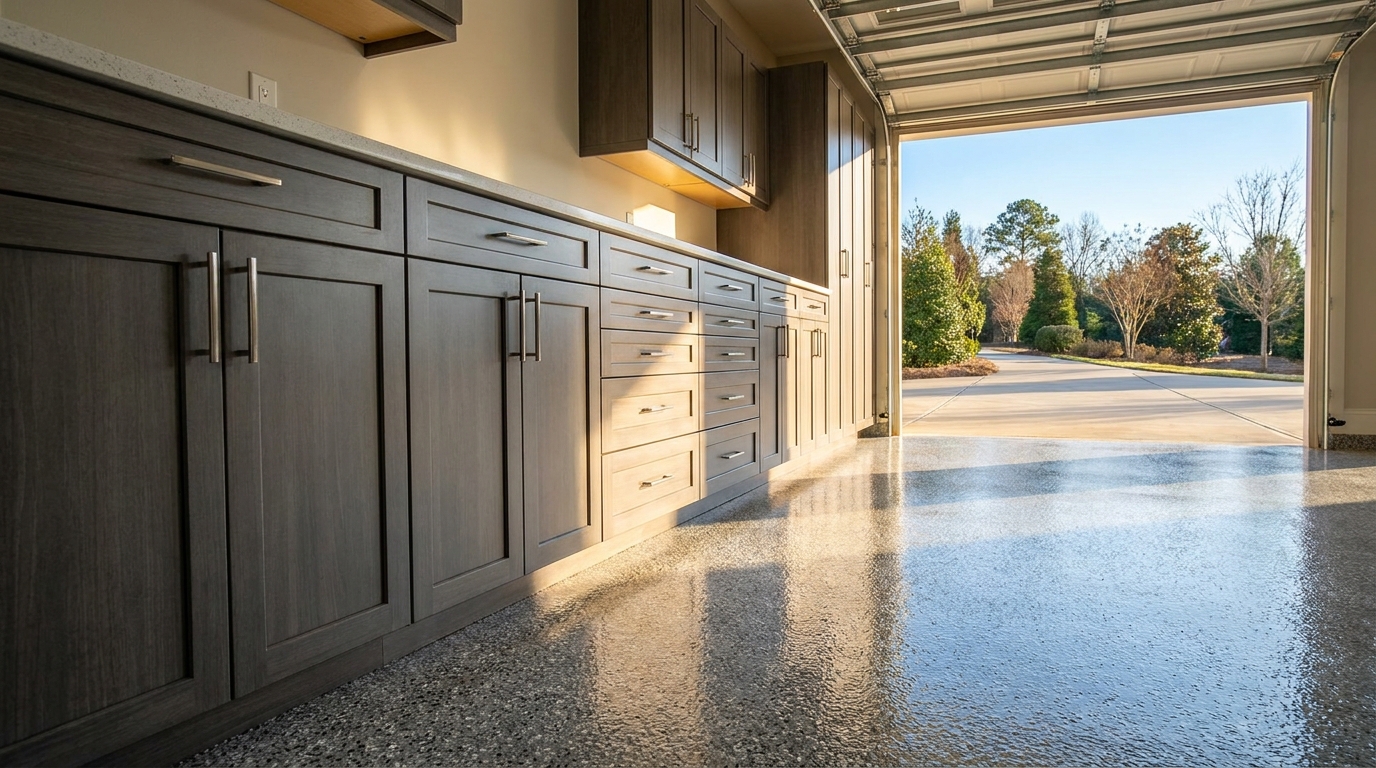
The garage we design is a finished room where the work surface stays clear because fasteners, driver bits, tape measures, and the rest of the daily kit already have a home. We mix garage cabinet drawer banks into a door-heavy cabinet run so those small tools live in labeled, full-extension drawers instead of in a pile beside the project. Doors still carry the bulky, less-often-used items that look best behind a finished face. Drawers handle the things you reach for with one hand. Industry cabinet tests cycle loaded drawers 25,000 times at 15 pounds per square foot, which is the kind of repeat use a working garage actually asks of hardware.[1]
A door-heavy run still needs a place for small tools
A long wall of closed doors is what makes a garage feel like part of the house. The elevation is calm. The floor stays open. Paint cans, bulk paper goods, and seasonal bins disappear behind a finish that matches the rest of the room. Our garage cabinets are designed that way on purpose: a furniture-like run, measured to your wall, with doors that close softly and a finish library that can follow the house.
That same wall also has to hold the small, dense inventory of a real household shop. Hex keys. Driver bits in three lengths. A roll of painter’s tape. Metric and SAE fasteners in mixed boxes. A utility knife you will look for twice in one afternoon. Those items do not belong on a work surface, and they do not belong in a deep cabinet where they migrate to the back of a shelf and vanish behind a jug of windshield fluid.
The design answer is not a rolling chest parked in front of the cabinets, and it is not a separate workbench. It is a drawer bank mixed into the cabinet run itself. One or two stacks of drawers sit in the same elevation as the doors, at the same height, in the same finish, with the same hardware family. From across the bay it still reads as one wall. From arm’s reach it is a set of labeled trays you can pull all the way out.
We place those banks during the layout, not after the doors are already ordered. The 3D rendering you see before manufacturing already shows where the drawer stack sits relative to the parking stall, the interior door, and the stretch of counter or open wall you actually use. That is a design decision about how the room will be lived in, not a hardware upgrade you add later.
Full-extension is the difference between a drawer and a cave
A drawer only earns its place if you can see the back of it. Three-quarter extension leaves the last few inches of a box buried in the cabinet, which is exactly where the 3/8-inch sockets and the spare bits go to hide. Full-extension slides bring the entire drawer clear of the face, so the last row of bins is as visible as the first.
On our cabinet runs, full-extension stainless steel roller-bearing drawer glides are the standard hardware, with optional soft-close slides if you want the same quiet close the doors already have. That is the hardware that makes a mixed elevation work. You are not fishing. You are looking down into a tray that is fully in the light.
The Kitchen Cabinet Manufacturers Association’s ANSI/KCMA A161.1 program is the performance standard most often used to prove a drawer and its hardware can take that kind of daily motion. In the drawer operation test, the drawer is loaded uniformly at 15 pounds per square foot and cycled 25,000 times. After the cycles, the drawer still has to operate, with no failure in the assembly or the slides, and the bottom cannot sag into the path of travel.[1] A second test drops a 3-pound weight against the drawer-front assembly ten times from 8 inches, then checks that the front is still tight and the drawer still works.[1]
Those numbers describe kitchen and vanity cabinets in a lab. A garage is not gentler. Fastener drawers get heavier than silverware. People close them with a hip when both hands are full. Specifying slides that are built for repeated, loaded travel is how a mixed bank still feels new after the second winter of projects.
The hardware itself has its own American standard. ANSI/BHMA A156.9, the cabinet-hardware standard in its 2026 edition, covers drawer slides along with hinges, pulls, and catches, and it grades products through operational, cyclical, and strength tests. The published highlights even assign type numbers to bottom-edge-mounted drawer slides, the kind that mount on both sides of the cabinet under the drawer box.[2] We do not ask a homeowner to recite grade tables. We do ask the hardware to be the kind of product those tests were written for, because a drawer bank in a garage is not decorative trim. It is the daily interface with the room.
What we put in drawers, and what stays behind doors
The mix works because drawers and doors are good at different jobs.
Drawers are for small, frequent, and easy-to-lose. We typically assign the shallow trays at the top of a bank to measuring and marking (tape, square, pencils, a knife), then bits and drivers, then fasteners sorted by type. A medium drawer can take pliers, hex keys, and a compact socket set. A deeper drawer at the bottom of the stack can take bulky hand tools or boxed kits that still benefit from being pulled into the light. Labels on the drawer fronts do the rest of the work. You should be able to find the right tray without opening three of them.
Doors are for volume and for things that are awkward in a tray. Tall bottles. Cases of water. Spare filters. A stack of paper towels. Holiday bins that come out twice a year. A door cabinet with adjustable shelves is still the right box for those items, and it is the box that keeps the elevation looking finished.
That split also keeps the work surface honest. If bits and screws have a labeled drawer two steps from where you stand, they stop colonizing the counter. The surface can be a place to assemble, tape, or wrap, not a parking lot for every small tool in the house. We will still plan a worktop when a garage needs one. This post is about the wall, not the top: the drawer bank is what keeps that top from becoming storage.
A useful test, during the on-site walkthrough, is to name the ten items you reached for last weekend. If most of them would fit in a tray and you used them more than once, they are drawer items. If they are bulky, heavy, or seasonal, they are door-and-shelf items, or they belong on a garage organization wall of hooks and overhead racks instead of in the cabinet run at all.
Labels, height, and putting things back
A drawer bank that is not labeled is a prettier version of a junk drawer. The EPA’s 5S guidance, written for workplaces but useful in a home shop, treats “set in order” as arranging items so they are easy to use and labeling them so they are easy to find and put away. The same page describes a typical result as tools and materials in labeled, color-coded storage locations, plus kits that hold just what a task needs.[4] That is the habit we are designing for. A drawer front that says “1/4-inch bits” or “SAE fasteners” turns putting a thing back into a one-second decision.
Height matters as much as the label. The 2010 ADA Standards for Accessible Design, which apply to public and commercial facilities rather than a private home garage, still give a clear picture of comfortable adult reach. For an unobstructed forward reach, the high point is 48 inches maximum above the floor and the low point is 15 inches minimum.[3] We are not building an ADA garage unless a client asks for that. We are using those 2010 ranges as a sanity check: daily-use drawers belong in the middle of the bank, not at the toe-kick and not in a tall upper that asks you to climb. Seldom-used trays can sit lower. The items you grab every Saturday should meet your hands where you already stand.
That is also why we mix the bank into the base run instead of stacking every drawer in a tall column beside the door. A base-height bank along the work zone puts the shallow trays near the same elevation as a kitchen silverware drawer. You open, you see, you close. The doors on either side of that bank keep the wall looking like cabinetry, not like a mechanic’s chest that wandered in from another room.
Lockable doors for the things that should not be in a tray
Drawer banks are for tools. Some of what a garage stores is not a tool.
U.S. poison centers managed about 2.1 million human exposures in 2024. In children younger than 6, 99.2 percent of those exposures were unintentional, and household cleaning substances were the leading category in that age group.[7] The Consumer Product Safety Commission’s poison-prevention guidance is blunt about the storage side of that risk: keep household products in cabinets with child safety latches or locks, and keep products and medicines out of sight in a cabinet or closet that locks or has a child-resistant latch.[5] EPA’s current pesticide-storage advice is the same idea in a utility space: store pesticides out of reach of children and pets, and if possible keep them in a locked cabinet in a well-ventilated utility area or garden shed, always in the original labeled container.[6]
That is why we still specify lock-and-key options on the door cabinets that hold fertilizer, automotive fluids, paints, and sharp tools you do not want a curious kid to find. The live cabinet line includes those locks, and they can be keyed alike so you carry one key. The drawer bank next to those doors stays the friendly, everyday interface. The locked door is the quiet barrier. Mixing the two in one run is how a family garage can be both usable and careful without looking like a storage locker.
We do not put pesticides and solvents in the same trays as bits and screws. EPA is explicit that pesticides should never share a cabinet with food, animal feed, or medical supplies, and that they should stay in original containers.[6] In a garage, the practical version is a dedicated, lockable door cabinet, away from any pet food or beverage storage, with the drawer bank reserved for tools.
How we mix the bank into the elevation
The drawing is where garage cabinet drawer banks either look designed or look like an afterthought. A few rules we use on Charlotte-area walls:
Place the drawer stack where you actually stand to work, not at the far end of a 20-foot run. If the interior door from the house lands you next to a counter, the bank belongs there. If you wrench on a bike or a mower along one stall, the bank belongs on that stall’s wall.
Keep the doors in the majority. Two or three drawer stacks in a long run still read as cabinetry. A wall that is all drawers starts to look like a shop chest and loses the finished-room face that made you want cabinets in the first place.
Match drawer-front height to the adjacent doors so the horizontal lines continue. A bank of four or five drawers can share the same overall height as a door cabinet beside it. The eye follows one datum. The pulls can match.
Use shallow over deep. Daily small tools in the top trays, heavier kits lower, so the stack stays stable and the items you want most are the ones you bend least for.
Leave the floor readable. Our runs are designed as wall-mounted systems with optional legs, which keeps the slab clear for cleaning and keeps the drawer faces from sitting in a dust line. That detail belongs in the same conversation as the mix of doors and drawers, because a bank that cannot open over a baseboard or a floor coating edge is a bank we planned badly.
Confirm the mix in the rendering. You should see the drawer fronts, the door rhythm, and the work zone in one view before anything is manufactured. If the bank feels too wide, we split it. If it feels too far from the stall you use, we move it. Lead time on a typical cabinet job is three to five weeks after approval, with install in one to two days, so the time to get the mix right is on paper, not on the wall.
Practical takeaways
- Mix one or two full-extension garage cabinet drawer banks into a door-heavy cabinet run so the wall still looks like finished cabinetry while small tools get a real home.
- Put fasteners, bits, measuring tools, and daily hand tools in labeled drawers. Leave bulk, seasonal, and chemical storage behind doors.
- Specify full-extension slides so the back of every tray is visible. Loaded-drawer cycle tests of 25,000 openings at 15 pounds per square foot are the industry’s picture of “this still works after years of use.”[1]
- Label every drawer front. EPA’s 5S “set in order” step is exactly that: a place for each item, marked so it is easy to put away.[4]
- Keep daily-use trays in a comfortable reach band. The 2010 ADA unobstructed forward-reach range of 15 to 48 inches is a useful reference, even though a private garage is not an ADA project.[3]
- Put lockable door cabinets next to the drawer bank for fluids, pesticides, and anything a child should not find, following CPSC and EPA storage advice.[5][6]
- Place the bank where you actually stand to work, match its height to the adjacent doors, and confirm the mix on the 3D rendering before manufacturing.
How we can help
Our team measures the wall, sorts what you actually reach for, and draws drawer banks into the same cabinet run as the doors so the finished garage looks like one room and works like a shop you can keep. Full-extension drawers, matching finishes, and lockable door cabinets are part of that layout, not extras you have to invent later. Have more questions or want to get in touch? Contact us
Citations
- Kitchen Cabinet Manufacturers Association, "Cabinets Certified to Last" (2023-01-17)
- Builders Hardware Manufacturers Association, "A156.9 - 2026 Cabinet Hardware" (2026)
- U.S. Department of Justice / ADA.gov, "2010 ADA Standards for Accessible Design, section 308.2.1" (2010-09-15)
- U.S. Environmental Protection Agency, "Lean Thinking and Methods - 5S" (2025-09-23)
- U.S. Consumer Product Safety Commission, "Lock Up Poisons (Publication 382)"
- U.S. Environmental Protection Agency, "Storing Pesticides Safely" (2025-10-09)
- America’s Poison Centers / Poison Control, "National poison center statistics, 2024" (2024)