A Boot and Rain-Gear Cabinet Matched to the Cabinet Run
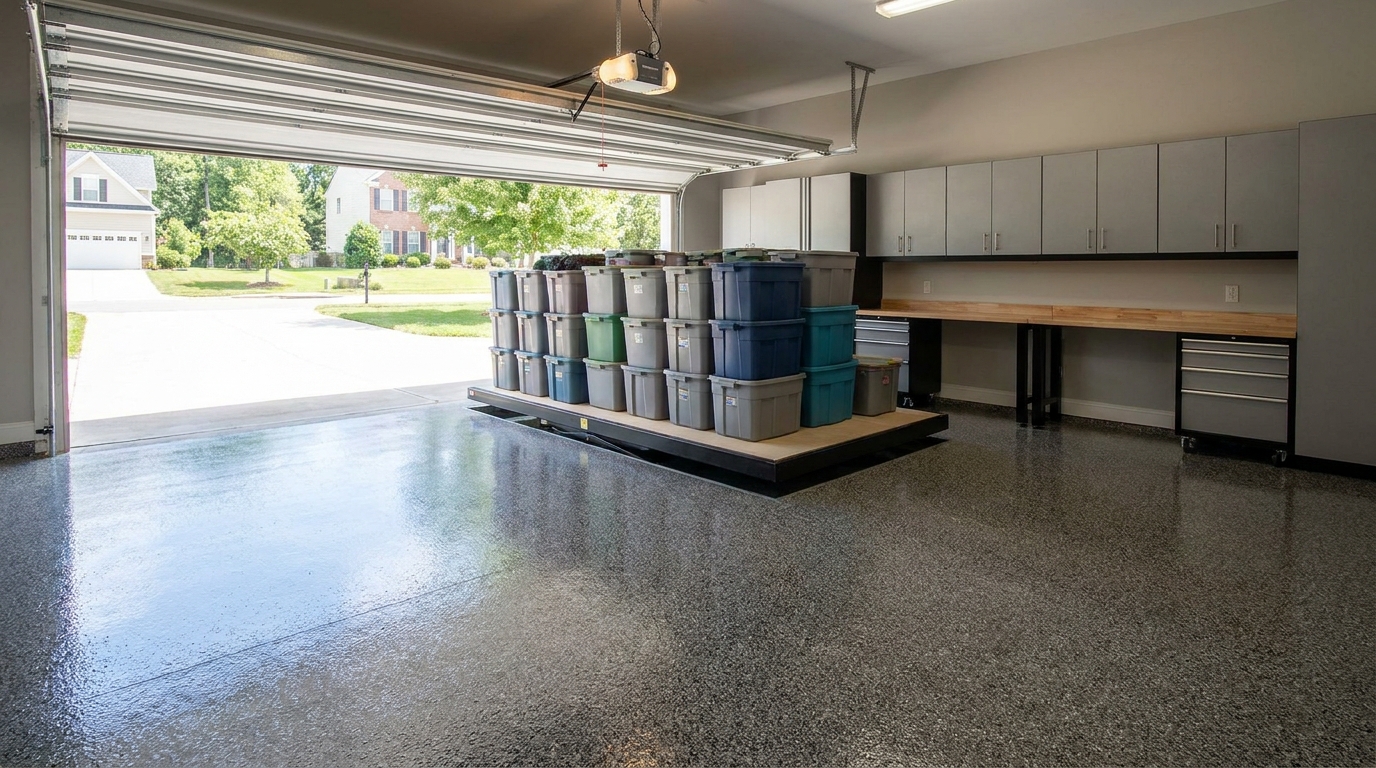
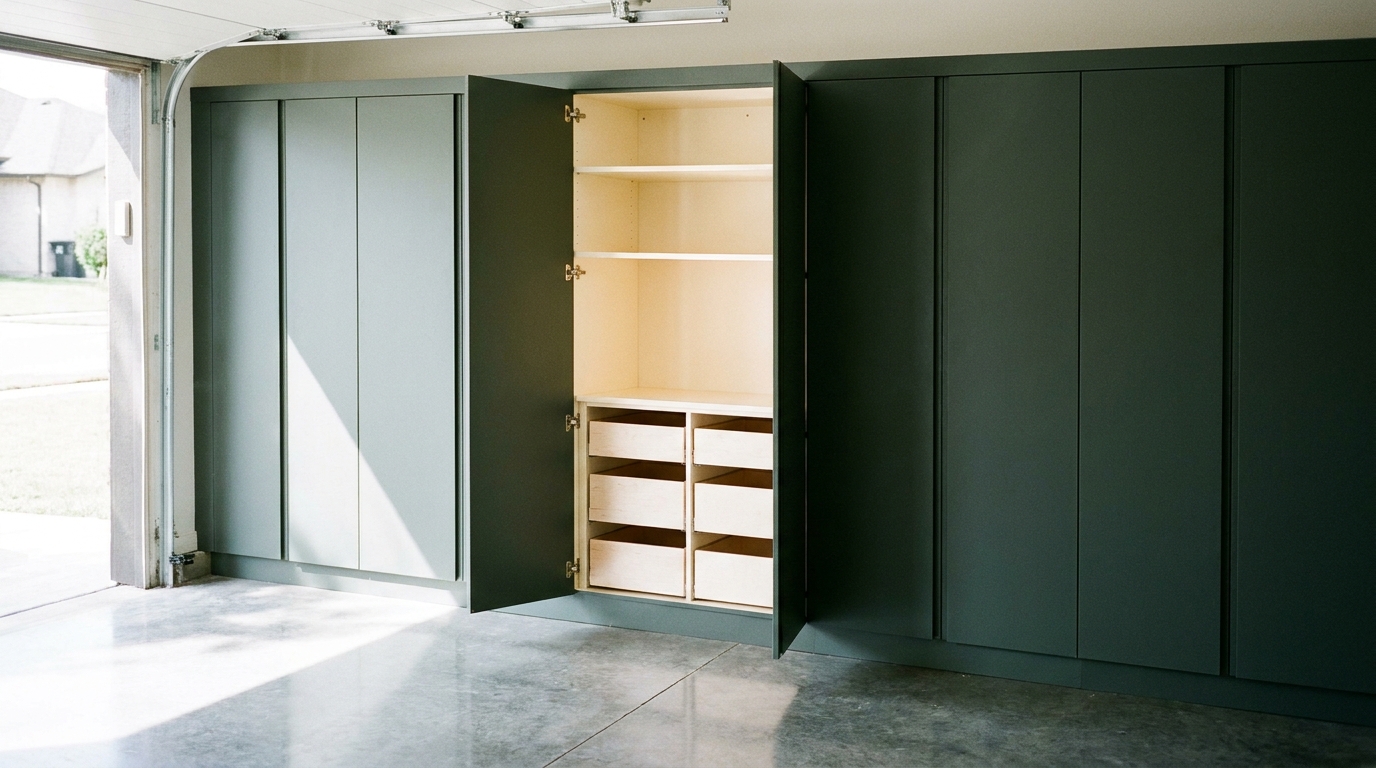
A garage boot storage cabinet is one tall module in the cabinet run, placed at the house door and built with the same door, color, and hardware as the cabinets along the parking bays. Boots stand on a shelf you can wipe, umbrellas get a narrow bay, and rain jackets hang on a bar behind that door. Close it, and the landing looks as finished as the rest of the garage. The decision is a matching cabinet, not a set of hooks left in the open.
One tall door in the same run
The module only works if it belongs to the run. Same height. Same door thickness. Same hinge and the same pull. From across the garage, it should read as the next cabinet, not as a locker someone stood in the corner later.
We set that height when we measure the whole wall. Ceiling height, the house door swing, the light switch, and the width left beside the entry all go on the same layout as the bay cabinets. If the tall cabinets in the plan are a given height, this door is that height. A shorter box would break the top line, and a deeper box would crowd the walk from the car to the house. Width comes from the clear wall, usually a single door, so you can open it with a jacket already in one hand.
Hinge side is part of the match. The cabinet door has to clear the house door, and it has to open toward the space where you are standing, not into the jamb. We swing it so the jacket bar is the first thing you reach, and so the open door does not slap the entry door or the cabinet beside it. The reveal between this door and the next door should look like every other reveal in the run. That is a small gap, and it only stays even if the box is square and the hinge is adjusted after the cabinet is on the wall.
Our garage cabinets are planned as a system for that reason. Signature Series doors are 3/4 inch, on six-way adjustable soft-close hinges, over a heat-fused laminate face. Whatever finish you choose for the bays, this door uses that face. The pull is the pull already chosen for the run. When the door is shut, boots and wet nylon are simply not part of the view.
Sized for Charlotte rain, not a snow locker
Charlotte weather is the reason the interior is a rain cabinet. The official 1991 to 2020 climate normals for the Charlotte Douglas Airport station show 43.60 inches of precipitation in a year.[1] February is the lightest month in that record, at 3.13 inches, and August is the heaviest, at 4.35 inches.[1] Every month in the normal is above 3 inches, so there is no long dry stretch that lets this module sit empty.[1]
The same normals count 112.4 days a year with at least 0.01 inch of precipitation, and 30.0 days with at least half an inch.[1] Measurable rain shows up often. Days at a half inch or more are fewer.[1] Snowfall for the year averages 3.5 inches.[1] January's normal daily low is 31.8 degrees Fahrenheit, so a cool morning still calls for a jacket, while the cabinet stays proportioned for rain gear rather than deep snow.[1]
Those figures are 30-year normals, not a forecast for next Tuesday. NOAA's National Centers for Environmental Information produces the official U.S. climate normals every 10 years, and the 1991 to 2020 set is the current series, first released in May 2021.[2] The gauge is at the airport. A garage in Matthews, Huntersville, or Fort Mill will not match it to the tenth of an inch. The pattern is the one we design around: rain in every month, light snow, and a tall cabinet for boots, an umbrella, and a jacket.
Boots, umbrellas, and jackets, and nothing else
This is one module. It is not a bench at the house door, not a pet station, and not a laundry wall. Those are different cabinets, or no cabinet at all, and they get their own plan. If they creep into this box, the door stops matching the run because the interior gets too busy to close.
Three zones are enough.
The bottom is for boots, one layer deep, so every pair is in reach and the shelf can be wiped in one pass. The shelf is hard, with a shallow pan or a lip that holds the drip until you empty it. Garden boots, rain boots, and the shoes you actually walk in from the car all stand upright. We do not line this shelf with carpet. A mat looks soft on day one and then holds water against the box.
The umbrella bay is a narrow slice of the same cabinet, not a second piece of furniture. A stick umbrella stands in that slice so it does not lean on a jacket sleeve. A short folding umbrella can sit in a small bin on the boot shelf if that is what you carry. The point is a home for the wet shaft, off the floor and off the door of the next cabinet.
Jackets use the hanging side. The bar sits high enough that a raincoat hem clears the boot shelf, and low enough that you are not fishing for a collar over your head. Space between hangers matters more than a long row of hooks. Two or three rain jackets, with air between them, dry in a way a packed wad does not. Hats and a pair of gloves can take a small shelf above the bar if the height allows. If the ceiling forces a shorter run, we still keep the hem off the boots, even if the coat you hang there is hip length. During the measure, we look at the coats you own, not at a catalog photo of a mudroom.
What stays out: the dog's towels, the laundry basket, the sports bin, and the bench you might want for tying shoes. A bench is a nice thing in some garages. It is not this cabinet. If we try to make one door do all of that, the door gets wider than the wall, or the interior becomes a pile, and the landing stops looking like the parking side of the garage.
A finished door that still lets gear dry
The door is supposed to be closed most of the time. That only works if the inside is planned for water, because a shut door over a soaking pile is a different object from a shut door over gear that has somewhere to drip.
EPA's Brief Guide to Mold, Moisture, and Your Home, on the page updated February 18, 2026, says wet items and wet areas should be dried within 24 to 48 hours, and that indoor relative humidity should stay below 60 percent when possible, ideally between 30 and 50 percent.[3] The guide also says mold on a hard surface can be scrubbed with detergent and water and then dried, while absorbent materials such as carpet may have to be thrown away if they become moldy.[3] EPA's mold course chapter on moisture, updated December 1, 2025, makes a related point: furnishings that get wet need that same 24 to 48 hour window, and increasing air circulation and temperature generally speeds drying.[4] The course also notes that mold can grow on wood, paper, and carpet when moisture is present.[4]
We treat those sentences as rules for this one cabinet. Jackets hang with air between them. The bottom is a hard shelf and a pan you can lift out, not a carpet liner and not a raw paper surface left to soak. You empty the pan. You wipe the shelf. A coat that is still shedding water can hang with the door open until the drip is in the pan. Then the door closes, and the landing is cabinetry again. The 24 to 48 hour window is about the coat and the pan.[3] It is not an argument for leaving hooks on an open wall.
The course's note on air circulation is about drying the wet thing faster, not about leaving storage open to the room.[4] We get that air between hangers. This module is not an exhaust fan for the garage, and it is not a sealed bin. The pan comes out, and the door latches once the water has left the fabric. If a jacket is soaked through, leave the door open while it drips. If it is only damp from the walk in from the car, hang it and close the door. The face of the cabinet still matches the run as soon as you shut it.
We also keep jackets off the back panel. A bar set off the back leaves a gap, so fabric is not packed into the rear corner and the panel stays easy to wipe. The cabinet does not control humidity for the whole garage. That stays with the room.
The box, the shelf, and the hinge
The public benchmark we borrow for a tall enclosed cabinet is ANSI/KCMA A161.1-2022, the Kitchen Cabinet Manufacturers Association performance and construction standard for factory-assembled kitchen and vanity cabinets.[5] Read the scope the way it is written. It covers kitchen and vanity cabinets. It is not a garage code, and this boot module is not a certified kitchen cabinet. It is still the clearest published test method we can point to for a tall box with a door, a shelf, and a finished interior.
The 2022 standard says utility cabinets meet the same construction rules as wall cabinets: fully enclosed backs, bottoms, sides, and tops.[5] The glossary describes a utility cabinet as a cabinet installed on or near the floor, typically 12 or 24 inches deep and 84 inches tall or taller.[5] Those are kitchen-world typical sizes, not a template we force onto your house-door wall. We match the height already chosen for the tall cabinets in your run, and we take the depth that still leaves a clear walk to the entry. The idea we keep is the enclosure. A back, a bottom, sides, and a top, with a door that closes, rather than an open frame with a panel screwed on the front.
Shelves in that standard are loaded at 15 pounds per square foot, and the load stays in place for seven days.[5] Passing shelves show no joint separation, and they deflect no more than 0.0625 inch per lineal foot between supports, with a maximum of 0.25 inch.[5] Doors are cycled 25,000 times. After that, the 2022 test still expects the door to operate, the catch or closer to hold it shut, and sag at the measured point to stay within 0.065 inch.[5] That is the behavior we want from a door you open on the way into the house: it keeps the same line as the door beside it. The standard also expects solid wood and composite wood materials to be dried to a moisture content of 10 percent or less.[5] It tests a door edge against detergent and water, and an interior shelf against residual water, and it looks for no delamination or swelling.[5] Exposed hardware finishes under the standard are held to ANSI/BHMA A156.9.[5] If the cabinet has a toe kick, the standard calls for a toe space at least 2 inches deep and 3 inches high.[5]
Our garage line is built for the garage, and we say so. On the Signature Series, tops, bottoms, and fully adjustable shelves are 1 inch melamine, doors and side panels are 3/4 inch, and the face is heat-fused laminate. Each interior shelf on that line is rated to 100 pounds, which is more shelf than a row of boots will ever ask for. The useful part of the rating, for this module, is that the boot shelf is a real shelf, fixed so it does not sag into the pan. Boxes mount to wall studs and use full backs. Optional legs are there when a wall mount is the wrong detail for that wall. For rain gear, we like the box up off the slab. Water that tracks in at the house door should not sit in a pocket under the cabinet, and a clear floor underneath is easier to wipe than a toe kick full of grit.
Soft-close hinges earn their keep here more than on a cabinet you open once a week. This door moves when you leave and when you come home. A hinge that shuts itself, and that we can adjust in six directions after install, is how the reveal stays even with the next door after a season of use. We are not claiming a kitchen certification for a garage cabinet. We are building one module to the same visual standard as the run, with an enclosed box, a stiff shelf, a door that cycles, and an interior you can wipe.
Practical takeaways
- Order this as one tall module in the cabinet run, with the same height, door, finish, and pull as the cabinets beside it.
- Keep the interior to three zones: boots on a hard, wipeable shelf, umbrellas in a narrow bay, and jackets on a bar with air between the hangers.
- Leave the hem of a hanging coat clear of the boot shelf, and keep the jackets off the back panel.
- Skip carpet and paper liners inside this cabinet. Use a pan you can empty, and dry wet gear within a day or two while room humidity stays in the range EPA describes.
- Hinge the door so it clears the house door and still lets you reach the jacket bar.
- Mount the box so the bottom is not a pocket on the slab. A shorter locker, or an open hook rail, will not keep the landing looking like the rest of the run.
How we can help
Have more questions or want to get in touch? Tell our team about the wall at your house door, and we will plan this tall module so the door, finish, and hardware match the rest of the cabinet run. You can reach us on our contact page.
Citations
- NOAA National Centers for Environmental Information, "Summary of Monthly Normals, 1991-2020, CHARLOTTE DOUGLAS AP, NC US USW00013881" (1991-2020)
- NOAA National Centers for Environmental Information, "U.S. Climate Normals" (2021)
- U.S. Environmental Protection Agency, "A Brief Guide to Mold, Moisture and Your Home" (2026-02-18)
- U.S. Environmental Protection Agency, "Mold Course Chapter 2" (2025-12-01)
- Kitchen Cabinet Manufacturers Association, "ANSI/KCMA A161.1-2022 Performance and Construction Standard for Kitchen and Vanity Cabinets" (2022)