Garage Bike Storage Wall That Still Parks Both Cars
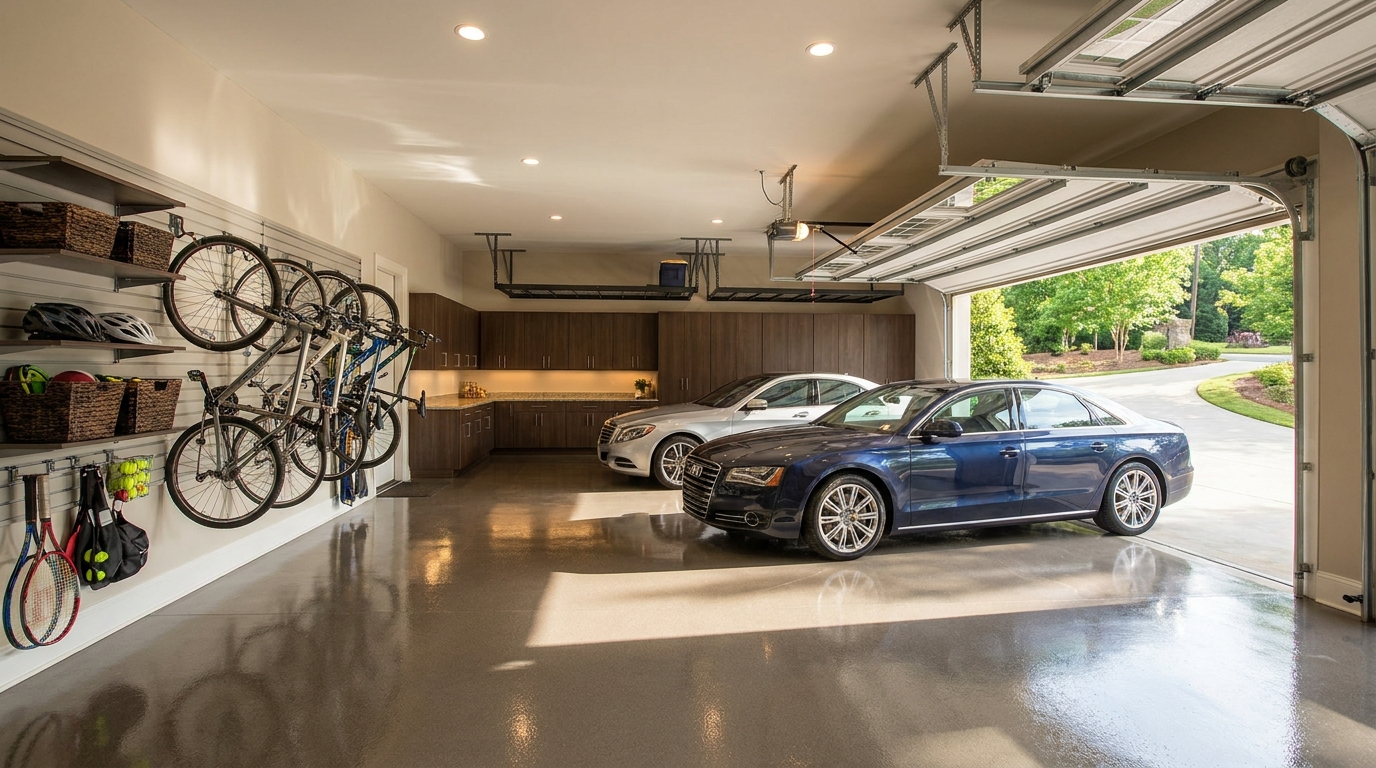
A garage bike storage wall is a designed elevation of PVC slatwall, locking hooks, and bins that parks bikes, helmets, and balls on one wall while both cars still sit in their bays. Our team starts with the parked vehicles, then hangs the sports gear in a shallow, planned band so the driving path stays as wide as the garage door opening. [3] That wall is part of a finished room, coordinated with heat-fused laminated melamine cabinets and a coated floor, not a leftover strip of hardware.
A sports wall, not a leftover strip of hooks
Walk into a Charlotte garage we just finished and the sports wall is what you notice after the cars. Two bikes hang in a staggered band. Helmets sit on dedicated hooks at grab height. Balls live in bins. The floor is an open, glossy plane. Both vehicles are in their bays, and the doors still open.
That wall is a specific design decision. It is not the lawn-and-garden elevation we build for trimmers and hose reels. It is not a pair of tall locker columns, and it is not a generic run of slatwall with a few hooks sprinkled on. A garage bike storage wall is one elevation planned around the bikes, helmets, and balls this household actually rides and plays with, built so the parking envelope stays intact.
We use extruded PVC slatwall with modular hooks and bins because the gear changes with the season. A locking bike hook can move two slots over when a new trail bike arrives. A helmet hook can sit next to a ball bin in March and next to a catcher's bag in May. The panels are PVC, water and mildew resistant, with color through the material, so the sports wall reads as furniture on the wall.
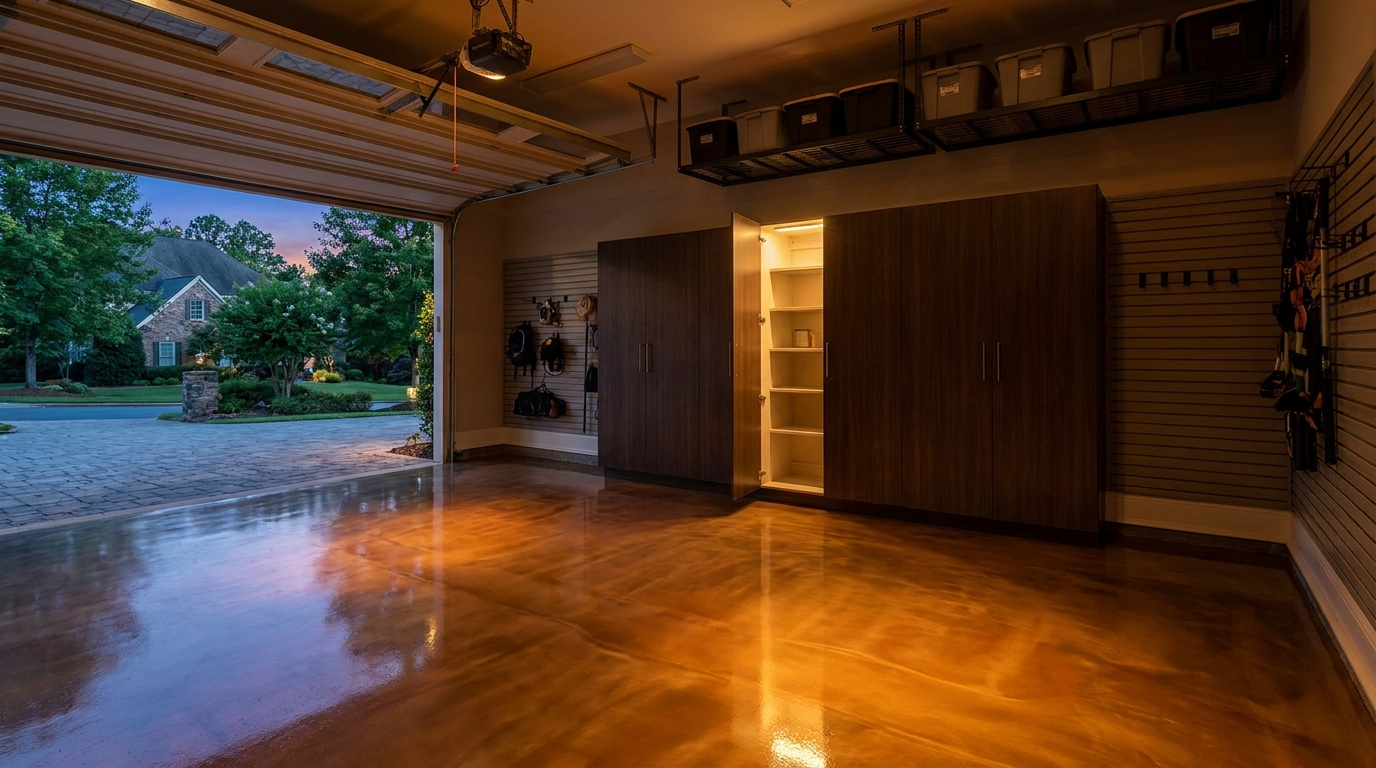
On the back wall, we often run heat-fused laminated melamine cabinets for closed storage: off-season helmets, extra pads, a pump, spare tubes. Signature Series boxes are wall-mounted, with 1-inch tops, bottoms, and shelves, 3/4-inch doors and sides, soft-close hinges, and full-extension drawers. The sports wall stays visual. The cabinets hold what you do not want on display.
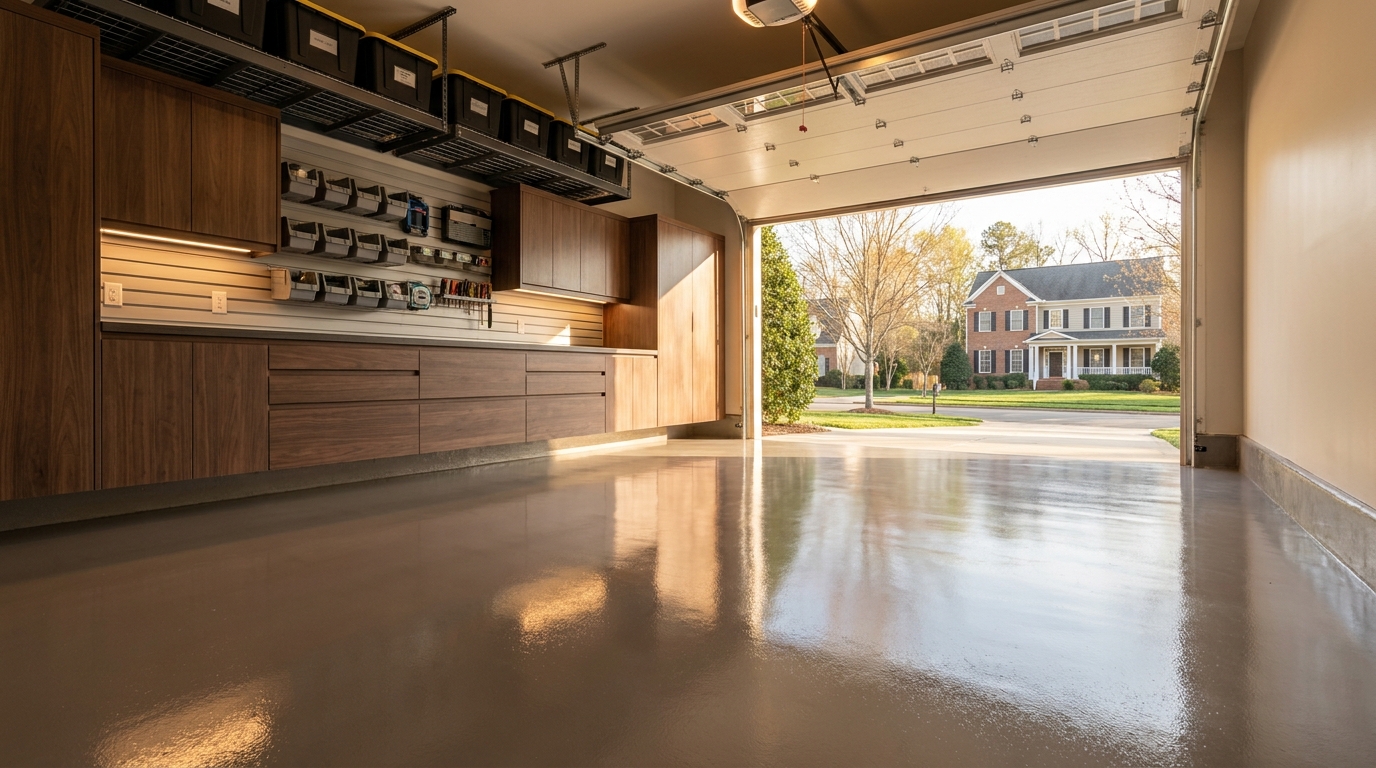
Underfoot we specify an epoxy primer, a decorative chip broadcast, and a polyaspartic top coat. That coated floor is the plane both cars roll onto every evening, which is why the sports wall has to keep the parking envelope.
Start with the two cars that have to stay
The finished dream is two vehicles parked, doors able to swing, and a sports wall that still looks designed. We get there by measuring the cars that actually live in the garage, not by guessing a standard stall.
The vehicles themselves have been getting larger as a fleet. In model year 2024, 34 percent of new light-duty vehicles were cars and 66 percent were trucks under National Highway Traffic Safety Administration definitions, and truck SUVs alone accounted for half of new vehicle production. [1] Between model year 2008 and 2024, the average new-vehicle footprint (wheelbase times average track width) rose 5.4 percent, from 48.9 to 51.5 square feet, and the average new-vehicle weight in 2024 was 4,354 pounds. [2] Those are national production numbers. They are why we do not design a sports wall around a compact sedan from fifteen years ago if the household now parks a pair of crossovers.
Even the published width of a vehicle is not the width that has to fit next to a hung bike. Federal motor vehicle safety rules define overall vehicle width as the widest part of the vehicle excluding outside rearview mirrors (along with signal lamps, marker lamps, flexible fender extensions, and mud flaps), measured with doors and windows closed and the wheels straight. [4] Mirrors fold or they do not. Doors swing. A passenger still has to step out. Our team measures the parked envelope with the mirrors in the position you actually use and with a door open far enough to get in and out. The sports wall's hooks, bins, and bike frames have to stay out of that envelope.
The model building code gives us a second, door-based line. In the 2024 International Residential Code, the "normal driving path" in a garage is the space from the garage vehicle opening to the interior face of the back wall, to a height of 48 inches above the finished floor, and its width is equal to the width of the garage door opening. [3] That definition exists to locate vehicle-impact protection for energy storage systems, but it is also a clean description of the travel lane we protect when we hang bikes. We do not invent a typical two-car garage width. We take the door opening you have, the two vehicles you park, and we keep the sports gear out of that lane.
On the side wall, the same code section treats a band within 36 inches of that driving path (and within 24 inches of the back wall) as a vehicle-impact zone for equipment. [3] We hang bikes, not energy storage, but the lesson still holds: the first 3 feet off the driving path is not a place for a handlebar, a pedal, or a ball bin. The garage bike storage wall lives on the remaining side-wall real estate, with each bike's projection drawn in the plan before a hook goes up.
Hang the bikes so they occupy wall, not floor
A bicycle on the floor is a long, wide object. Fairfax County's May 2024 bicycle parking guidelines, drawn from Association of Pedestrian and Bicycle Professionals practice, call for a standard adult bicycle parking space of 8 feet in length and 2 feet in width, with a 6-foot by 2-foot footprint as the minimum, and 10 feet by at least 2 feet for cargo bikes and bikes with attachments. [5] Lay two adult bikes on the slab of a two-car garage and you have given up a parking stall, or you have given up the walk between the cars. Hang those same bikes on a designed wall and the floor footprint collapses to the projection of the tires, pedals, and handlebars.
That is the move. Vertical storage on locking slatwall hooks puts the wheel on the wall and the frame in a shallow band. We stagger the hooks so one bike's handlebars sit beside the next bike's downtube, and we set hook height from the actual bike length so the lower tire is off the coated floor and the upper tire does not fight a header or an opener rail. A heavy e-bike gets a locking hook on a stud line and a lift someone in the house can actually make.
Horizontal hangers have a place when the wall is long and the bikes are few. They are the wrong default when two cars still have to park. A bike stored parallel to the wall still needs room at the ends for the wheel and the bars, and that rectangle has to clear the nearest door swing.
The wall is PVC slatwall, not a scatter of independent hooks in drywall. Slatwall lets us lock the bike hooks, then slide helmet hooks and bins into leftover slats without drilling a new hole every season. Bikes get the stud-aware, locking positions. Helmets and balls fill the band around them.
Helmets and balls as a grab band
Helmets belong on the wall so you can pick one up on the way out the door. Bicycle helmets sold in the United States have to meet the Consumer Product Safety Commission standard in 16 C.F.R. part 1203, which tests peripheral vision, positional stability, strap retention, and impact attenuation. [6] All bicycle helmets manufactured after 1999 must meet that federal standard, and the chin strap is part of the test because it has to keep the helmet on the head in a fall. [9] Helmets are not interchangeable. A bicycle helmet is the right helmet for bicycling (and for recreational skating or a kick scooter). A skate, snow, or team-sport helmet is built for a different impact. [9] On a sports wall, that means separate hooks for bike helmets, skate helmets, and batting helmets.
North Carolina already treats kids' helmets as a daily object. Under G.S. 20-171.9, it is unlawful for a parent or legal guardian to knowingly permit a person under 16 to operate or ride a bicycle on a public roadway, public bicycle path, or other public right-of-way unless that person wears a protective bicycle helmet of good fit, fastened securely with the straps. [7] We put those helmets at grab height near the man door or the path to the driveway. Adult helmets sit in the same band.
Balls do not need a locker column. They need a bin or basket that holds a round object. We group them by sport, lock the bins into the same PVC slats as the bike hooks, and let a muddy Union County soccer ball dry over the coated floor instead of under a car. Bikes occupy the tall slots. Helmets and small gear occupy the band you can reach without a stool. Seasonal overflow (the extra pump, the tournament bag) moves into the cabinets on the back wall.
Keep the walk from the car to the house
A sports wall that parks both cars still has to leave a walk. The path from the driver's door to the house door is a circulation path, even in a private garage. The U.S. Access Board's ADA Accessibility Standards, section 307.2, limit objects with leading edges between 27 and 80 inches above the floor to a 4-inch maximum projection into a circulation path. [8] Section 307.4 calls for at least 80 inches of headroom along those paths. [8] A private residential garage is not a public building, and we do not treat the ADA as a permit checklist for this room. The dimensions are still the right way to think about a shoulder and a forehead moving past hung gear after work.
A bike hung by the wheel will project more than 4 inches. That is expected. The response is to put that projection on a dedicated sports wall, not on the wall you walk along to the house, and to keep the walk itself clear from floor to 80 inches. If a bike has to hang above a walk, it hangs high enough that the lowest point clears 80 inches, or it does not hang there.
Door swing is the other test. We open the nearest car door in the plan and in the garage. A hook that looks tidy on an empty wall can sit inside a door arc once the SUV is home. The sports wall works when the door opens, the person steps out, and the bike is still on the wall behind them.
How our team lays it out in Charlotte, Waxhaw, and Monroe
Every household's mix is different. A Waxhaw family with four bikes, a cargo bike, and a wall of soccer balls is not the same job as a South Charlotte couple with two road bikes and a pair of helmets. We measure the door opening, the side wall, the vehicles, and the gear, then draw the sports wall as one elevation in a coordinated design with the cabinets and the floor.
A layout we use often in two-car garages in Mecklenburg and Union County looks like this. The back wall, facing the overhead door, is the cabinet run. One long side wall is the garage bike storage wall: PVC slatwall from a base band up to a finished top trim, locking bike hooks on the studs, helmet hooks in the grab band, ball bins in a tight stack, and empty slats left for the next season. The opposite side wall stays quieter (a man door, a utility run, or a shorter slatwall) so the walk from the car to the house stays open. Overhead storage, when we add it, holds the totes that are not sports gear.
Slatwall in London Gray, Graphite, or a mapped cabinet finish lets the bikes sit on a wall that matches the cabinet run. The coated floor (epoxy primer, chip broadcast, polyaspartic top coat) runs under the wall-mounted cabinets and in front of the slatwall as one plane. You see cars, a sports wall, and a cabinet wall.
Bike hooks for the heaviest frames go to structure. Outlets and switches stay notched and usable. The first loadout happens with our team in the garage, so you can lift a bike onto the hook, set a helmet, and drop a ball in a bin before we leave. If a handlebar sits closer to a mirror than the plan allowed, we move the hook that afternoon. Garage organization of this kind is a layout discipline. The wall is allowed to change. The parking envelope is not.
Practical takeaways
- Design the garage bike storage wall from the two parked vehicles out. Measure the actual cars, including mirrors and a usable door swing, then hang bikes inside a planned projection so both bays still park. [4]
- Treat the garage door opening as the width of the driving path, and keep handlebars, pedals, and bins out of that lane and out of the first 3 feet beside it. [3]
- Hang adult bikes on the wall. On the floor, a standard bike wants about 8 feet by 2 feet (6 feet by 2 feet at a minimum), and a cargo bike wants about 10 feet by 2 feet. [5]
- Give helmets their own grab-height hooks, one style per activity, and keep kids' bicycle helmets on the way out the door. Bicycle helmets must meet CPSC 16 C.F.R. part 1203, and North Carolina requires a fastened helmet for riders under 16 on public roads and paths. [6] [7] [9]
- Keep the walk from the car to the house clear. Use a dedicated sports wall for the deep projection of a hung bike, and keep the walk itself open through the 27-to-80-inch zone people actually move through. [8]
How we can help
Our team designs and installs garage bike storage walls across Charlotte, Waxhaw, Monroe, and the surrounding Union and Mecklenburg County area, as part of a full garage: PVC slatwall, heat-fused laminated melamine cabinets, and a hybrid epoxy-and-polyaspartic floor. We measure your vehicles, your bikes, and your wall, then we hang the sports gear so both cars still park.
Have more questions or want to get in touch? Contact us
Citations
- U.S. Environmental Protection Agency, "Highlights of the Automotive Trends Report" (2026-02-19)
- U.S. Environmental Protection Agency, "The 2025 EPA Automotive Trends Report (EPA-420-R-26-001)" (2026-02)
- Washington State Building Code Council, "IRC TAG Significant Changes Report, quoting 2024 IRC R330.8.1 garage driving path" (2025-08)
- Legal Information Institute / 49 C.F.R. § 571.3, "Definitions (overall vehicle width)" (current)
- Fairfax County Department of Transportation, "Fairfax County Bicycle Parking Guidelines" (2024-05)
- U.S. Consumer Product Safety Commission, "Bicycle Helmets Business Guidance" (2026)
- North Carolina General Assembly, "G.S. 20-171.9. Requirements for helmet and restraining seat use" (2001-268)
- U.S. Access Board, "ADA Accessibility Standards, Chapter 3: Building Blocks (§307 Protruding Objects)" (2010 standards, page accessed 2026)
- U.S. Consumer Product Safety Commission, "Which Helmet for Which Activity? (Publication 349)" (2026-03)