A Narrow Cabinet Slot for Folding Tables and Chairs
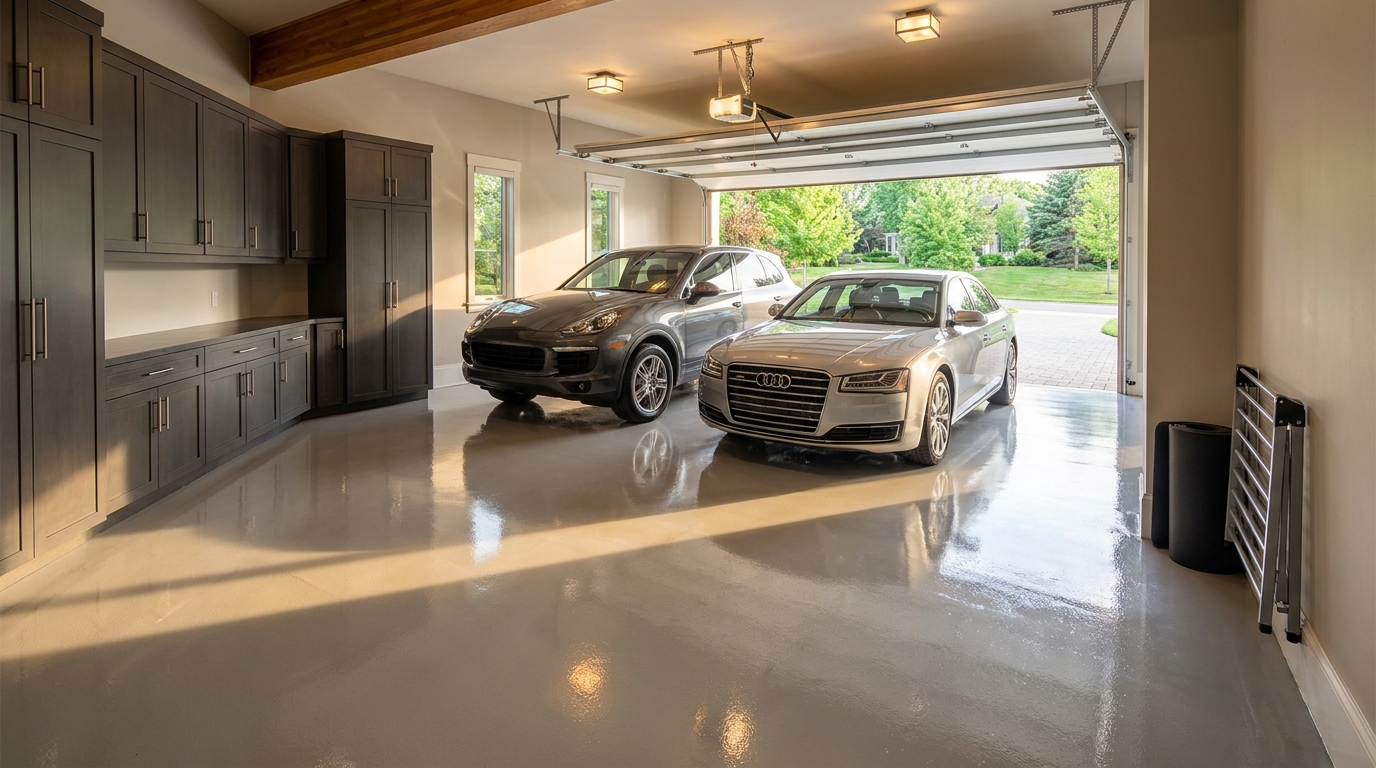
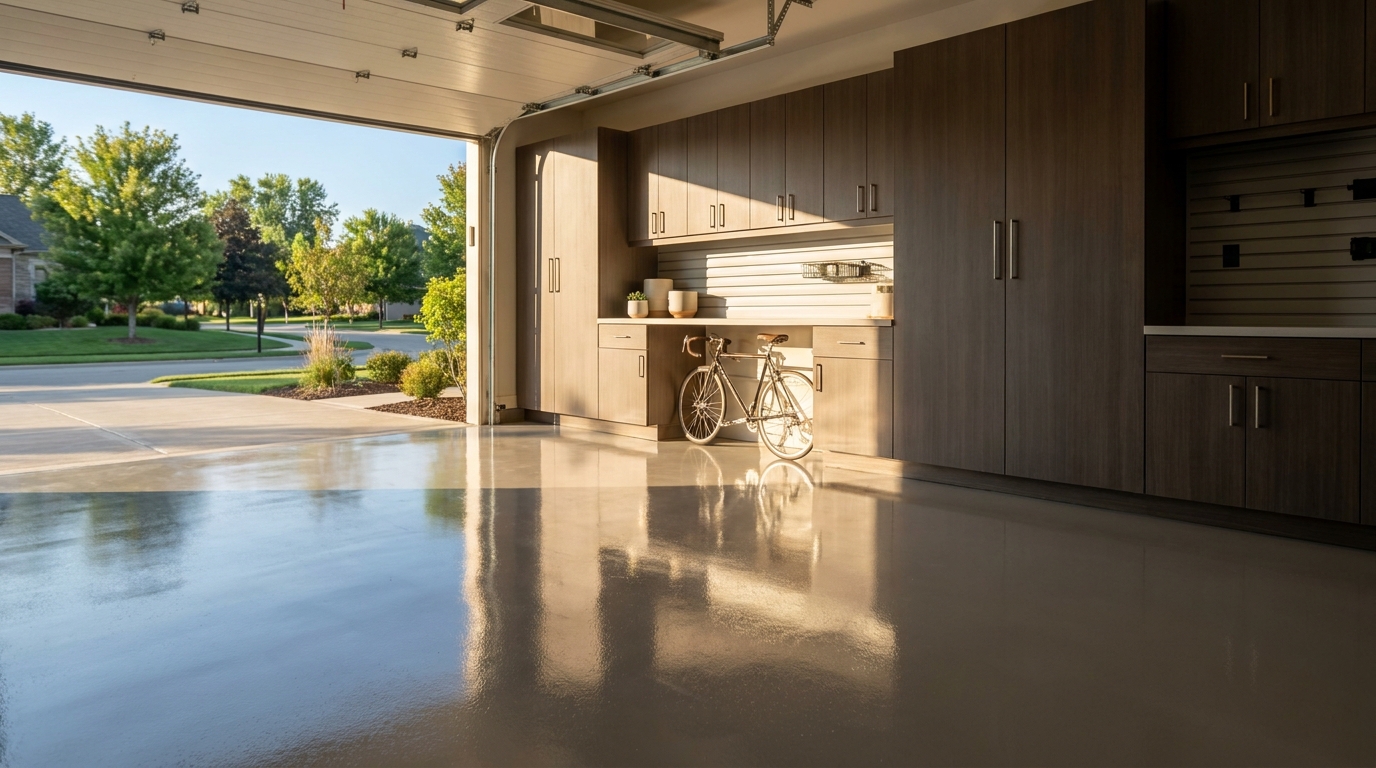
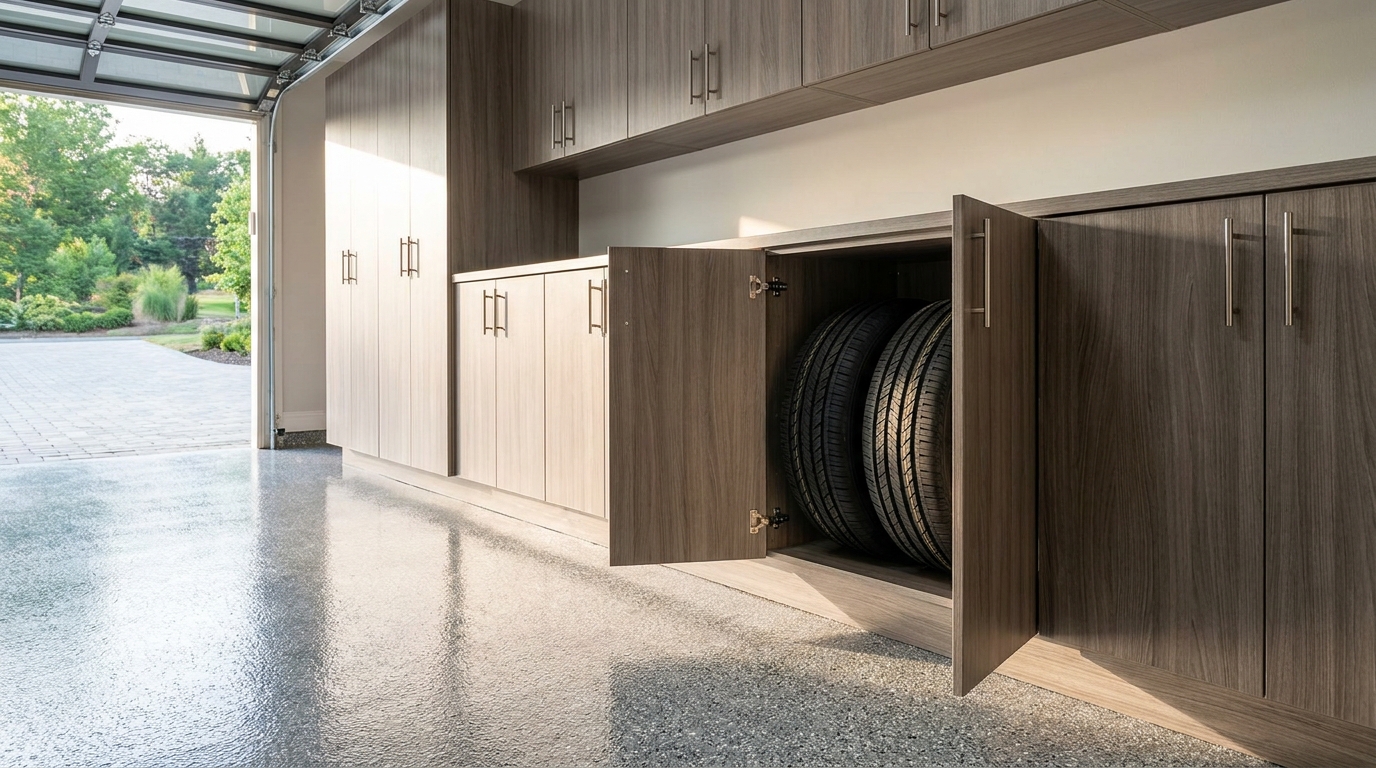
A folding chair garage cabinet, the way we build it, is a tall shallow slot in the cabinet run, with a door that matches the doors beside it. Folding chairs, folding tables, and other flat pieces stand inside that bay, so the wall reads as one finished elevation and the floor of the parking bay stays open. The opening follows the folded furniture. On a current Uline listing, a steel banquet chair folds to 18 1/4 inches wide, 2 1/2 inches deep, and 39 inches high, and that supplier's deluxe table line includes a 72 by 30 by 29 inch table that folds to 2 1/2 inches thick.[1][2]
The slot is a module, not a rack
We start with the finished room. The cabinet run already has a door style, a finish, and a top line, and the slot uses that same door and that same line, so a person walking in sees millwork with the chairs and the table behind one of the doors. The bay is one module: tall enough for the longest piece stood on end, and shallow enough that the face does not step into the parking side the way a deep base would.
The 2022 KCMA A161.1 standard covers factory-assembled kitchen and vanity cabinets, and it says it is a performance and construction standard only, not a specification for design or materials.[3] In that glossary, a base cabinet is typically 24 inches deep with a typical height of 36 inches to the top of the countertop, a wall cabinet is typically 12 inches deep and 12 to 42 inches high, and a utility cabinet is typically 12 or 24 inches deep and 84 inches high or taller.[3] We are not claiming a garage slot is a certified kitchen cabinet. The glossary is only the language for the choice: height for a table stood on end, and a shallow depth instead of that 24-inch base, so the floor in front of the doors stays with the car.[3]
Our runs are wall-mounted cabinetry, with optional legs, in heat-fused laminated melamine. Signature and Classic are the two tiers, both manufactured in the United States. The garage cabinets are planned from the wall we measure, including ceiling height, door clearances, and the gear that will actually live there. The folding slot is drawn with that elevation, not added after the doors are built.
What a folded chair and a folded table ask for
Uline's deluxe steel folding chair, model H-2227BL, lists an open size of 18 1/4 by 19 1/2 by 30 3/8 inches, width by depth by height, and a folded size of 18 1/4 inches wide, 2 1/2 inches deep, and 39 inches high.[1] A bay drawn from the 30 3/8 inch open height would stop short of that folded frame, so clear height for this chair follows 39 inches, with a little air under the cabinet top.[1] The listing states that the chair meets or exceeds ANSI/BIFMA standards, without naming one test number.[1]
Uline's deluxe folding tables fold to 2 1/2 inches thick, and the fixed-height chart includes a 72 by 30 by 29 inch table.[2] Closed, that top stays about six feet long, about 30 inches across, and 2 1/2 inches thick, so stood on end the 72-inch length is the height to clear and the 30-inch width is the clear width.[2]
That 2 1/2 inch figure is one line, not every table. MityLite's ABS rectangle brochure lists a folded thickness of 2.50 to 3.75 inches, heights from 29 to 38 inches, widths from 18 to 36 inches, and lengths from 48 to 96 inches, with 30 by 72 inches among the best sellers, and it names ANSI/BIFMA-x5.5 as the testing standard.[4] Uline's listing for a Mity-Lite ABS table at 72 by 30 by 29 inches says that model folds to 2 3/4 inches thick and meets or exceeds ANSI/BIFMA standards.[5] A 30 by 72 inch table might land near 2 1/2 inches, near 2 3/4 inches, or inside the 2.50 to 3.75 inch family span, so we measure the table that will live in the garage and cut the slot for that table.[2][4][5]
Depth is the stack of thicknesses
One deluxe table and four of those steel chairs, five pieces at the 2 1/2 inch thickness those two Uline listings share, come to 12 1/2 inches of material before any gap for the hinge, the door, and a finger.[1][2] A second table at that same 2 1/2 inch thickness adds another 2 1/2 inches, and the 2 3/4 inch ABS model asks for a little more depth.[2][5] A larger set, such as eight steel chairs and two full-length tables, wants two bays or one wider opening that still wears the same door. We settle that with the folded pieces on the floor during the measure.
The 2022 KCMA wall-load test is a picture of how a cabinet in this general width is held, not a lab report on our garage boxes.[3] The test applies to mounted wall cabinets and wall-mounted base cabinets 24 inches in height or greater, and wall cabinets and wall-hung base cabinets up to 36 inches in width shall accept 600 pounds with no visible sign of failure in the cabinet or the mounting system.[3] A bay drawn around a 30-inch table width sits near that width.[2] We fasten the run to the wall, with optional legs when the design wants the boxes lifted, so the slot is millwork rather than a loose chest on the slab.
The door belongs to the run
The slot looks finished only if its door could have been any other door in the elevation: same slab, same edge, same reveal, same finish. The 2022 KCMA door test operates a door through 25,000 cycles and then requires the door to remain operable, with the holding device still able to keep it closed.[3] BHMA's 2026 highlights for ANSI/BHMA A156.9 use 100,000 cycles as the example for a Grade 1 hinge, and they say pulls shall support a 75 lbf test load without chipping, disassembly, or breakage of the part or screws.[6] Those are laboratory examples, and we do not present our garage doors as certified to either document. Soft-close hinges are how we build the doors, including the door on this slot, so the tall panel meets the box quietly.
A single door wide enough for a 30-inch table swings a long arc toward the car.[2] Where that arc would crowd the parking side, a pair of doors is the cleaner draw. Each leaf is narrower, the pair still matches the doors beside it, and the interior stays one compartment. Chairs and tables stand on the cabinet bottom, on edge, with no shelf required in the middle of the stack.
Where the hand meets the door
The door can be tall. The pull does not have to live at the top of it.
The ADA Standards apply to places of public accommodation, commercial facilities, and state and local government facilities in new construction, alterations, and additions.[7] A private garage is not that building, and we do not treat the standard as a house rule. Where a forward reach is unobstructed, the high forward reach is 48 inches maximum and the low forward reach is 15 inches minimum above the finish floor, and an unobstructed side reach uses that same 48-inch maximum and 15-inch minimum.[8] The Access Board's guide adds that the 15 to 48 inch range applies only to portions that are operable, and non-operable portions can sit outside that range.[9]
The panel runs high enough to clear a table whose folded length is 72 inches, or a chair whose folded height is 39 inches, and the pull, which is the operable part, sits in that band.[1][2][8]
Smaller flat pieces in the same idea
Not every flat piece is a six-foot banquet table. The slot changes with the inventory. The elevation does not.
Uline's economy fold-in-half tables fold in half to a 4-inch thickness, and the line includes a 72 by 30 inch top.[10] That package is thicker than the 2 1/2 inch deluxe leg-fold table, and its stored length is shorter than the open length because the top folds.[2][10] The summary page does not print one folded length for that 72 by 30 inch model, so we measure the folded package before we lock the cabinet height.[10] If both a center-fold table and a full-length table are present, the full-length table sets the height and the thicker center-fold table takes more of the depth.
A smaller personal folding table on the same site opens at 30 by 19 5/8 by 28 inches and closes at 38 3/8 by 19 1/2 by 2 1/2 inches, length by width by depth.[11] Stood on end, that closed package is much shorter than a six-foot banquet top and about as thick as the deluxe steel chair, so it can share the tall bay as long as the stack still lets the door close.[1][11]
In Charlotte, Waxhaw, Monroe, and the rest of Mecklenburg and Union counties, we record folded height, width, and thickness on site, then cut the slot to that list, with the doors and finish staying on the cabinets beside it.
Practical takeaways
- Size the bay from the folded pieces: height from the tallest folded length, width from the widest folded edge, and depth from the stack of thicknesses plus room for a hand and the door.
- A published steel chair can fold to 39 inches high and 2 1/2 inches thick, a deluxe six-foot table on a related listing stays 72 inches long and 2 1/2 inches thick, and a specific ABS 72 by 30 inch table is listed at 2 3/4 inches thick.[1][2][5]
- Treat catalog thickness as a range. MityLite's ABS rectangle family spans 2.50 to 3.75 inches folded, with a 30 by 72 inch size among the best sellers.[4]
- A center-fold line described as folding in half to 4 inches thick still needs its stored length measured before the cabinet height is locked.[10]
- Match the slot door to the rest of the run, and place the pull where the hand actually meets the door.
- Fasten the bay with the wall-mounted run, then confirm the real chairs and tables fit the clear opening before the doors are built.
How we can help
Have more questions or want to get in touch? Our team will measure the folded tables and chairs with the wall and draw the slot into the cabinet run, with the door and finish matched to the rest of the elevation. See the garage cabinets we build, or contact us and we will plan the bay with the room.
Citations
- Uline, "Deluxe Folding Chair - Black" (2026)
- Uline, "Deluxe Folding Tables" (2026)
- Kitchen Cabinet Manufacturers Association, "KCMA A161.1-2022 Performance and Construction Standard for Kitchen and Vanity Cabinets" (2022)
- MityLite, "ABS Rectangle Table" (2026)
- Uline, "ABS Plastic Folding Table - 72 x 30 x 29 inches, Gray" (2026)
- Builders Hardware Manufacturers Association, "A156.9 - 2026 Cabinet Hardware" (2026)
- U.S. Access Board, "ADA Accessibility Standards" (2010 standards, page current 2026)
- U.S. Access Board, "Chapter 3: Building Blocks" (2010 standards, page current 2026)
- U.S. Access Board, "Chapter 3: Operable Parts" (2010 standards guide, page current 2026)
- Uline, "Economy Fold-In-Half Tables" (2026)
- Uline, "Personal Folding Table - 30 x 20 inches" (2026)