A Tall Cabinet That Holds Bikes Behind a Matching Door
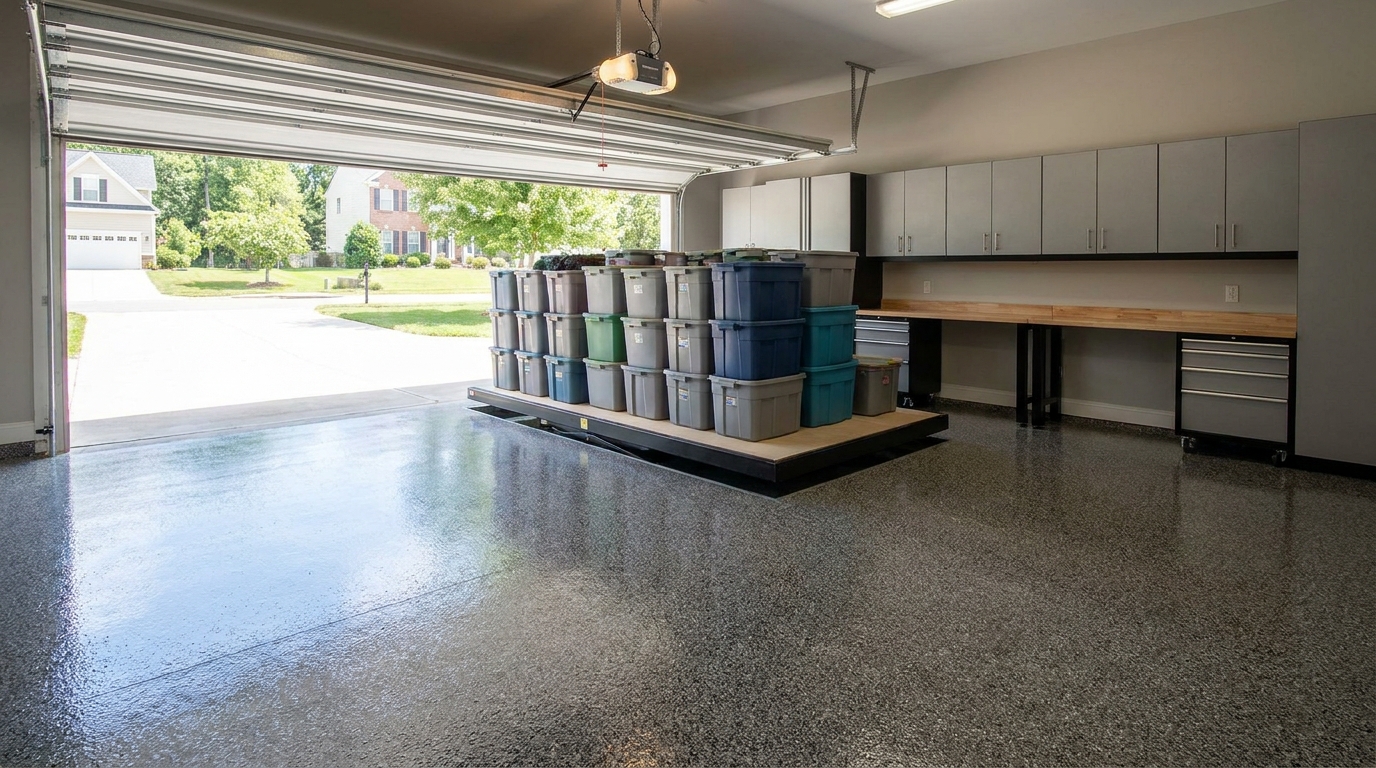
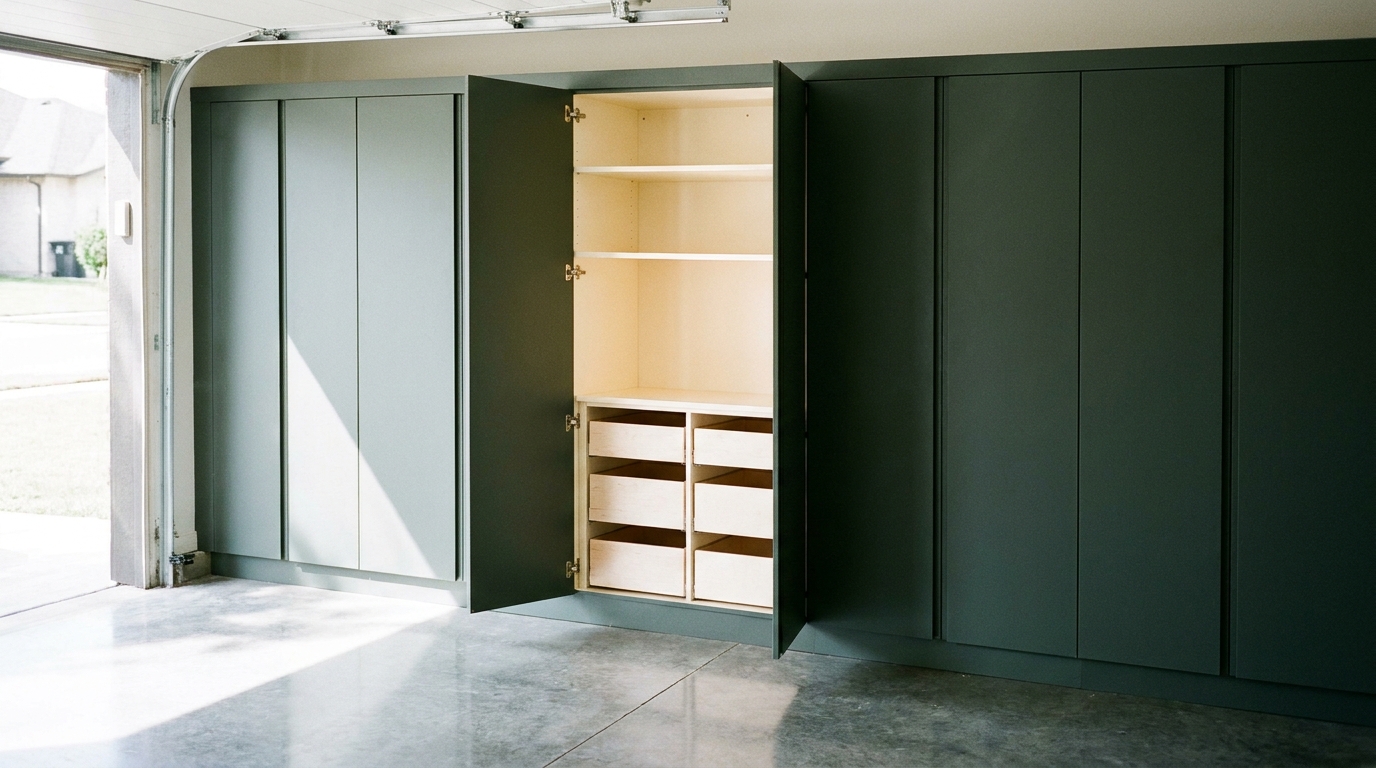
A bike storage garage cabinet is a tall section of the same cabinet run, with the same finish, the same door style, and the same hardware as the doors beside it. The bicycles stand inside on their wheels, the matching door closes, and the wall still reads as one piece of furniture. The garage floor in front of that door stays open for the car and for the walk through the bay.
The wall stays one piece of furniture
Picture the long wall after the cabinets are in. The doors line up. The pulls repeat. One section is tall, and nothing on the outside of that door announces that bicycles live behind it. Shut, the room looks finished. Open, the bikes are standing the way they stand in the driveway, not hooked on an open wall and not lifted toward the ceiling.
That is the design decision. Bicycle storage here is a closed cabinet in the run, deep enough and wide enough for the bikes you own, with a door that belongs to the furniture. The floor of the garage is not the storage surface. The interior of the cabinet is. A door that matches, on a bay that is an inch too tight, is not a finished room. It is a door that will not close. Our team settles the fit before anything is ordered.
What a bicycle asks of the cabinet
City and professional parking guides are written for sidewalks, bike rooms, and building lockers, not for a residential cabinet run. They are still the clearest public record of how much space a typical bicycle occupies. We use them as a starting check, then measure the bikes in the garage. We do not copy a locker.
A 2013 San Francisco Planning bulletin lists a standard bicycle at 6 feet long, 4 feet high, and 2 feet wide. In that same table a cargo bicycle is 8 feet long, 4 feet high, and 3 feet wide, a tandem is 9 feet long, and a bicycle with a trailer is 10 feet long. A child bicycle is listed at 5 feet long and 2 to 3 feet high, still 2 feet wide. [1]
The Association of Pedestrian and Bicycle Professionals, in its 2015 Essentials of Bike Parking, describes the footprint of a typical bicycle as about 6 feet by 2 feet, and notes that cargo bikes and bikes with trailers can extend to 10 feet or longer. [2]
A City of Rockville bicycle parking guide prepared in 2016 asks for perpendicular or diagonal spaces at least 6 feet long and 2 feet wide, with at least 7 feet of overhead clearance. For a locker, the same guide asks for an interior at least 6 feet long, 2 feet wide, and 4 feet high. It also allows a bicycle to be tipped upright, in a space at least 2 feet wide and 4 feet deep and no higher than 6 feet, and it says the bicycle is not hung above the floor. [3]
Read those as a family of checks. Length clusters around 6 feet for an ordinary adult bicycle and stretches toward 8, 9, or 10 feet for a cargo bike, a tandem, or a bike with a trailer. Width clusters around 2 feet at the handlebars, and closer to 3 feet for the cargo bike in the 2013 table. The height of the bicycle itself is 4 feet in that bulletin, which lines up with the 4-foot locker height in the 2016 Rockville guide. The 7-foot Rockville figure is overhead clearance above a parking space, not the height of the bike and not an interior height we assign to a cabinet. [1] [3]
Our bay follows the horizontal idea: both wheels down, the bicycle standing, the door in front of it. We do not tip the bike onto its rear wheel, and we do not hang it. Where your bike really is about 4 feet high, a tall cabinet can leave room for a shelf above the saddle line. A length near 6 feet is what makes the bike section a wide piece of the run, not a narrow pantry. A handlebar width near 2 feet is why depth gets tested first. The door, the pull, and a hand all need room beyond the bars.
Measure the bike you own, not a generic one
Those guides describe a typical bicycle. A road bike, a hybrid, a flat-bar mountain bike, and a step-through town bike can all be adult bikes and still differ at the grips, the pedals, and the saddle. Federal rules give a category check, not a cabinet size. Under 16 CFR 1512.2, a sidewalk bicycle has a seat height of no more than 25 inches when the seat is at its highest position. Seat height runs from the seat surface, along the seat-post centerline, to the ground. The same section defines a bicycle to include certain low-speed electric bicycles: fully operable pedals, a motor under 750 watts, and a top speed under 20 mph on level pavement when the motor alone powers the bike with a 170-pound rider. [4]
That 25-inch line is not a cabinet height. It separates a small sidewalk bicycle from a full-size one, which the 2013 table already does in the child-bicycle row. [1] We stand each bicycle where the cabinet will be and measure the stance it will keep inside the door: saddle where you are willing to leave it, bars straight, and bars turned. A child seat, basket, or bag that stays on the bike is part of the measurement. Gear that comes off every time belongs on a shelf, not in a larger bay.
Handlebar height has a federal limit that is easy to misuse. Under 16 CFR 1512.6, handlebar ends must be symmetrical, and they may sit no more than 16 inches above the seat surface when the seat is in its lowest position and the bar ends are in their highest position. Recumbent bicycles are outside that limit. [5] The sentence is a safety rule for the bicycle, not a depth or a height for cabinetry. It is also why we will not quote one interior dimension from a catalog. Bar height and saddle height move, within the limits the bike was built to. A recumbent sits outside that handlebar rule and outside the 6-by-2-by-4 picture in the older tables. If that is the bike, we measure that bike.
At the design visit we roll the bicycle through the opening we expect to build, wheel straight and wheel turned. The turned wheel is often what lets a bike enter a cabinet whose depth is close to the handlebar width. We watch the pedal at its widest point, the grip, the saddle, and the door swing beside the car. A bay that looks generous on a plan can still catch a pedal on the stile.
Two bicycles usually mean a wider section, a pair of doors, or two bays, and only after both bikes have stood in the opening without trading scratches. A cargo bike at the 3-foot width in the 2013 table, or a trailer bike at the 10-foot length in that table and in the 2015 guide, does not borrow a standard bay. [1] [2] If it will not live comfortably inside a furniture cabinet, we say so before the drawing is approved.
The door, the hardware, and the bays beside it
The bike door is not a special panel. It takes the same door style as the run, the same finish, and the same pull. Our garage cabinets are built in heat-fused laminated melamine, with soft-close hinges and full-extension drawers, in finishes and hardware selected for the room. The bike door gets that hinge and that pull. On a tall door, soft-close matters because the door is large and the bicycle sits close to the inside face.
Drawers belong beside the bike bay, or in the neighboring cabinets, where a pump, lights, and spare tubes can live in a shallow stack. A drawer under the bicycle, or a shelf across the pedal circle, turns the standing bike into an obstacle. The bike compartment stays clear: wheels on a stable base, frame upright, nothing in the bars. Above the saddle line, a shelf can hold helmets and shoes only when the measured bike leaves that room. If it does not, the helmets move next door.
Much of our cabinetry can be wall mounted, with optional legs so the floor under the boxes can be cleaned. A bicycle still needs a stable place to stand. We choose whether that section shares the leg line, with a deck the tires rest on, or comes down so the stance is simple and the doors still align. The outside result is one furniture face.
Paints, fuels, and fertilizers do not share the bike bay. They can live in their own cabinet. Lock-and-key hardware is available where you want a door secured, including the bike door if that is useful, but the chemicals stay out either way. The bicycle and the helmets stay cleaner, and the bay does not become a mixed closet. Metal-look laminates, wood-look laminates, and solid colors are all in the finish library, and the hardware (brushed chrome, black powder coat, or oil-rubbed bronze) repeats from door to door. If the tall door reads as a separate locker, the match is not finished.
A battery is not a cabinet accessory
A conventional bicycle is a frame, two wheels, and the gear you leave on it. An electric bicycle adds a lithium-ion battery. That battery does not become a cabinet accessory just because the bike fits the bay.
Current CPSC guidance on e-bikes and similar products is specific about charging. Follow the manufacturer's instructions, and unplug when charging is done. Be present while it charges. Do not charge these products while you are sleeping or away from home. Use the charger that came with the device, or one the manufacturer recommends. Use a replacement battery only if it was tested and approved for that device and the manufacturer confirmed it. Do not use a pack that was modified or rebuilt with repurposed cells. [6] A low-speed pedal bike may fall inside the federal definition of a bicycle, and that definition still does not make a cabinet a charging station. [4]
Cornell University's 2024 fire-marshal guidance, written for that campus, adds a storage rule. Follow the manufacturer's instructions. Keep the devices and batteries away from exits, and keep at least 3 feet between them and combustible materials. Use listed batteries and chargers (UL or ETL), the battery and charger that came with the device, and a plug straight into a wall outlet rather than an extension cord or a power strip. Disconnect once the battery is full. On that campus these devices are not charged in residential rooms, offices, or academic buildings. [7]
A heat-fused laminated cabinet is still a combustible box. It is the right shell for a pedal bicycle and a small kit. It is not a place to leave a lithium-ion pack on a charger, and it is not a substitute for the clearance in the Cornell guidance. We still design the standing bay around the bicycle, and we keep charging out of the crowded interior. The charger stays where you can see it, on the manufacturer's terms, not behind the matching door among helmets, cardboard, and spare tires. If the pack comes off for charging, the bike can stand in the cabinet while the pack charges somewhere that meets those notes. If the pack stays on the bike, tell us at the measure. We will not treat a closed bay full of gear as if it met a 3-foot separation from combustibles.
Where the bicycle stands, and where a battery charges, are two decisions.
From the first measurement to the finished bay
We measure the wall, the ceiling, the panels and outlets, and the swing of the garage door and the car doors. We stand the bikes in the opening, and we note which way the cabinet door should swing so it misses the car and you can walk the bike out. The layout and the 3D view show the tall door in the same face as the other doors, in the finish and hardware you picked. Widen the bike section, move a drawer stack, or leave a cargo bike out of the cabinet at that stage, not after the boxes are built.
The cabinetry is manufactured in the United States to the approved spec. Our local crew installs the run and walks the doors with you, including the bike door, before we leave. Garages across the Charlotte area, whether in Huntersville, Matthews, or Fort Mill, do not share a wall length, and the bicycles do not share one size. The decision stays the same. One tall cabinet, matching the run, holds the bikes behind a door, and the floor in front of that door belongs to the room again. If the measured bikes will not fit without a compromise you would feel every day, we say so on the drawing.
Practical takeaways
- Make the bike bay part of the cabinet run: same finish, same door style, same hardware, bikes standing inside, garage floor left clear.
- Use published sizes only as a check. A 2013 city bulletin lists a standard bicycle at 6 feet long, 4 feet high, and 2 feet wide. A 2015 professional guide uses a footprint of about 6 feet by 2 feet. Cargo bikes, tandems, and trailers run longer, and sometimes wider. [1] [2]
- Measure every bicycle in the stance it will keep, including a turned handlebar, the pedals, and anything that stays on the frame. Do not assume two bikes share one opening.
- Keep drawers and shelves out of the pedal circle. Add a shelf above the bike only when the measured height leaves room.
- Keep paints and fuels in their own cabinet. If the bike has a lithium-ion battery, follow the charging instructions and do not charge it inside a closed cabinet full of stored goods. [6] [7]
How we can help
Have more questions or want to get in touch? Our team will measure the wall and the bicycles, then draw the tall matching cabinet into the run so you can see it before it is built. Reach us through our contact page.
Citations
- San Francisco Planning Department, "Zoning Administrator Bulletin No. 9: Bicycle Parking Requirements: Design and Layout" (August 2013)
- Association of Pedestrian and Bicycle Professionals, "Essentials of Bike Parking" (September 2015)
- City of Rockville, Department of Public Works, "Bicycle Parking Guide" (2016)
- Legal Information Institute, Cornell Law School, "16 CFR 1512.2 Definitions" (2026)
- Legal Information Institute, Cornell Law School, "16 CFR 1512.6 Requirements for steering system" (2026)
- U.S. Consumer Product Safety Commission, "Micromobility: E-Bikes, E-Scooters and Hoverboards" (2026)
- Cornell University Fire Marshal, "Micro-Mobility E-Bike and Lithium-Ion Battery Safety Guidance" (2024)