Adjustable Shelves Inside the Cabinet Run So Storage Can Change
Adjustable garage cabinet shelves are the shelves inside a closed cabinet, carried on pins, so a bin or a seasonal box can take a new height without a new door. The face of the run stays finished: the same heat-fused melamine, the same hardware, and the same soft-close hinge. What changes is the clear opening inside the box. In Charlotte, Waxhaw, Monroe, and the rest of Union and Mecklenburg counties, we draw that interior with the cabinet, and you can still reset it after the doors are hung.
A finished face, and an interior that can still change
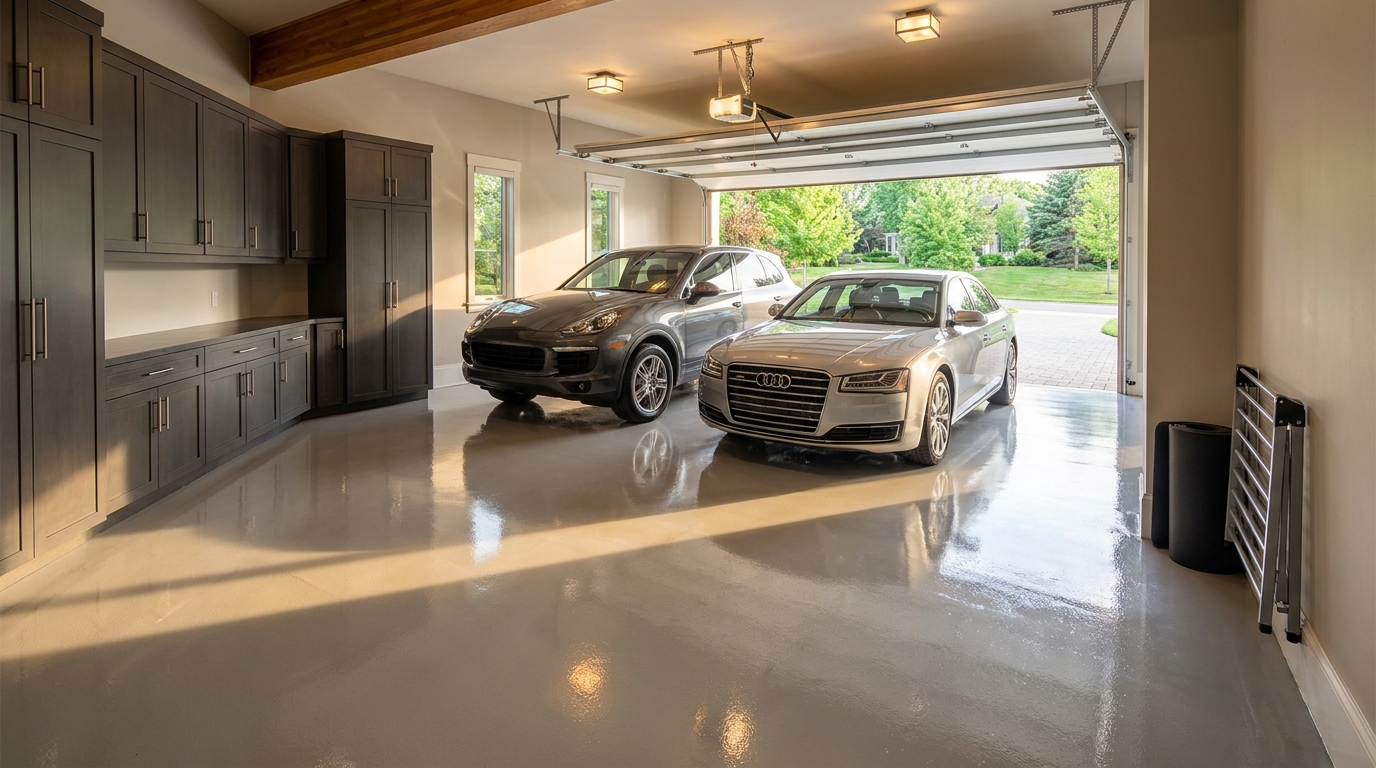
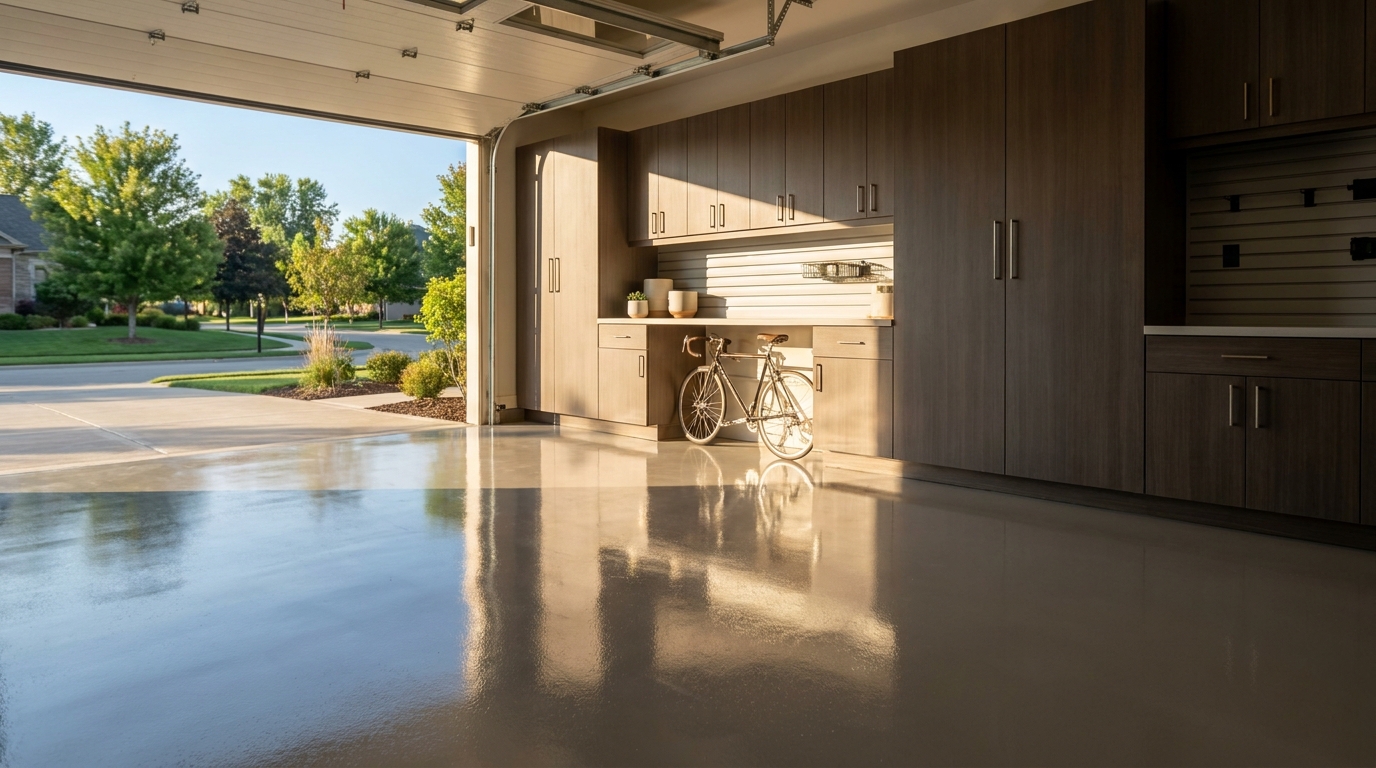
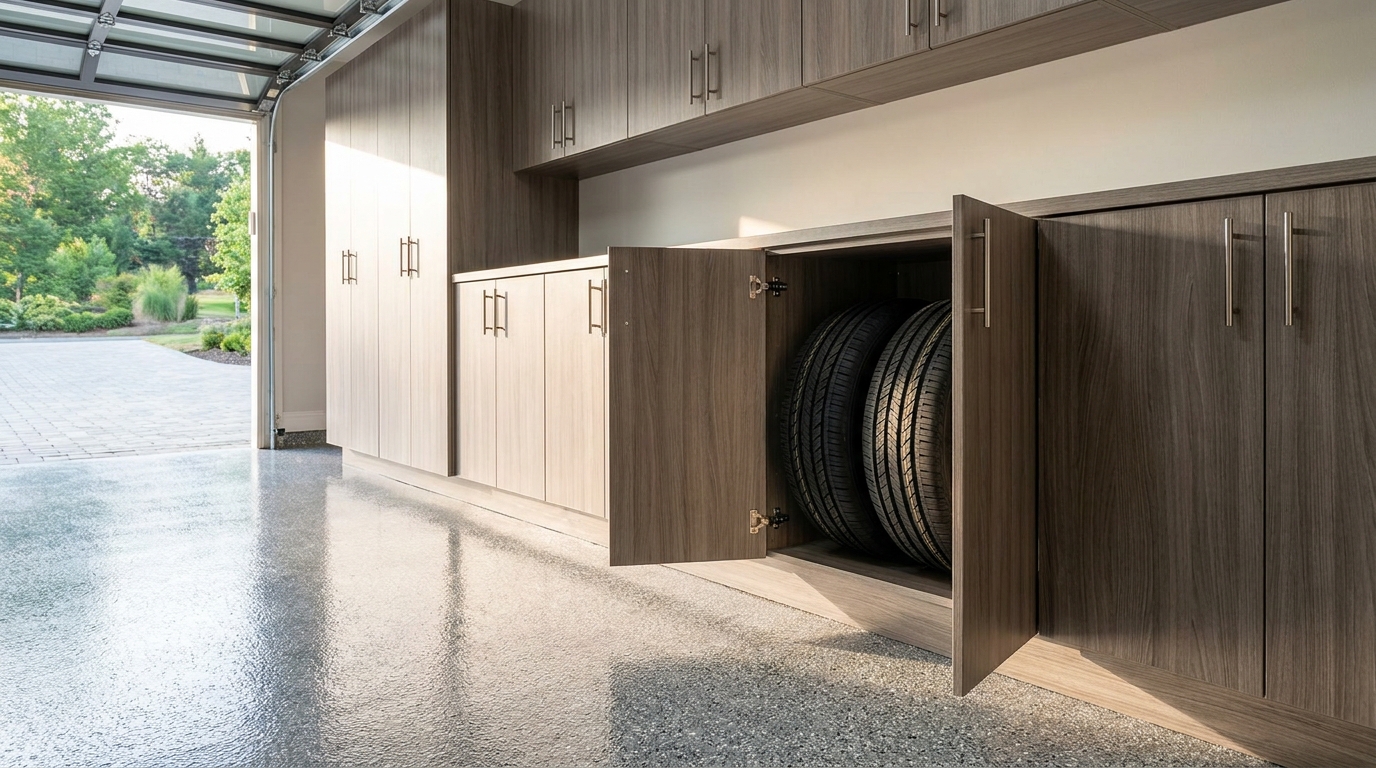
From the driveway, with the overhead door up, the wall should read as one run of doors. The pin holes never appear in that view. They are in the side panels, inside the box. Our team designs garage cabinets as that run: heat-fused laminated melamine, soft-close hinges, and hardware chosen once for the wall. The hardware set we publish is brushed chrome, black powder coat, or oil-rubbed bronze. A shelf that moves next season does not ask the door, the pull, or the gap between doors to move with it.
On the Signature line, the tops, bottoms, and fully adjustable shelves are 1 inch thick, and the doors and side panels are 3/4 inch. Classic is a different build, and we do not borrow that thickness for it. Finished runs, doors closed, are on our gallery. Wall-mounted or on optional legs, the pins stay inside the box.
Pins inside the side panels
A pin shelf rests on pins in vertical rows of holes, one row toward the front and one toward the back on each side. Lift the shelf, move the pins, and set it down. The door stays on its hinges.
Many frameless cabinets use the 32 mm cabinetmaking system, a pattern for ready-to-assemble and European-style frameless work that is not defined by any standardization body [1]. It lets shelves be placed again at a new height [1]. Holes are 5 mm across, about 0.20 inch, with centers 32 mm apart, about 1.3 inches, a listed depth of 12 to 14 mm, and a first row 37 mm from the front edge [1]. We do not claim every cabinet we build is bored to that card. We match the pins to the holes in the box.
A taller bin needs a taller clear opening. A flatter seasonal box can move up and leave the space under it for something else. The rows have to agree: front and back, left and right, starting at the same height, or the shelf rocks. Once they agree, any shelf in that box can use any height the holes offer.
What a shelf can span
ANSI/KCMA A161.1, as the Kitchen Cabinet Manufacturers Association described it on January 17, 2023, is the performance standard for kitchen and vanity cabinets [2]. Chuck Arnold, quoted in that article, calls it the only performance standard for kitchen and bath cabinets [2]. We do not treat it as a certification of our garage cabinets. Its structural summary loads shelves and bottoms at 15 pounds per square foot for seven days, checking for excessive deflection and for visible joint separation or failure of the cabinet or the mounting system [2]. It also describes a drop test: a 3-pound steel ball dropped from 6 inches above shelves and bottoms [2].
The Composite Panel Association's 2022 shelving bulletin gives maximum spans for raw particleboard and medium density fiberboard under a uniform load, calculated from ANSI A208.1-2016 [3]. CPA 5-25 points substrates to the 2022 edition of that product standard instead [4]. For a single-span shelf, simply supported at its ends and not fixed or fastened, Table 1 lists the maximum span for 3/4 inch board at 15 pounds per square foot as 30.0 inches in grade PBU, 31.5 inches in grade M-2, and 34.0 inches in grade M-3i [3]. The same M-2 row lists 26.6 inches at 25 pounds per square foot, 25.0 inches at 30, and 21.1 inches at 50 [3]. Grade changes the span, so an unidentified board does not get the longest number in the row.
The bulletin's examples put kitchen cabinet loads up to 25 or 30 pounds per square foot, and bookshelf loads at 50, with a uniform load meaning weight spread across each 144 square inches [3]. Those are examples, not a garage code. Spans hold deflection to the span divided by 240: 0.10 inches on a 24 inch span, and 0.15 inches, slightly more than 1/8 inch, on a 36 inch span [3]. Tables cover unfinished board and leave out the panel's own weight [3]. A shelf 12 inches or less deep, with continuous support along the back edge, can double the listed span, and overhang past a support is limited to 6 inches [3]. Thicker shelves and closer supports deflect less [3]. Concentrated loads are outside the tables [3]. A heavy item belongs spread over the pins, not perched on the front lip.
On our cabinet page, each interior shelf is rated at 100 pounds. That total is our rating, not the seven-day load of 15 pounds per square foot in the kitchen and vanity account [2]. The two figures meet only if you know the shelf area. The Signature adjustable shelf is 1 inch thick, outside the 1/2 inch, 5/8 inch, and 3/4 inch columns, so we do not read a 3/4 inch span as its limit [3]. At the visit we look at the bin, the width of the box, and the series.
A fused surface on the shelf itself
The shelf is a finished panel, in the same surface family as the door. CPA 5-25, the Composite Panel Association's Thermally Fused Laminate Panel Standard, issued May 1, 2025, is a voluntary standard for that decorative surface in interior use [4]. It covers panels fused to particleboard, medium density fiberboard, or hardwood plywood, on one face or both, and it does not apply to flooring [4]. The process uses a hot press to fuse resin-impregnated decorative paper directly to the substrate, with no intermediate adhesive, sealing the face [4]. Heat and pressure create a cross-linked bond, and the face may be a solid color or a printed pattern [4]. Our heat-fused laminated melamine is that family of surface, on the door and on the shelf you reset.
Section 4.9 says the substrate follows ANSI A208.1-2022, ANSI A208.2-2022, or ANSI/HPVA HP-1-2024, and shall comply with the formaldehyde rule at 40 CFR Part 770 [4]. As the eCFR displays 40 CFR 770.10, current as of October 1, 2026, those standards apply to composite wood sold or manufactured in the United States on or after June 1, 2018, as a panel, a component, or part of a finished good [5]. For particleboard the limit is 0.09 parts per million of formaldehyde, based on ASTM E1333-14 [5].
The association's 2023 dimensional-stability bulletin says moisture is always present in wood products and cannot be guaranteed out, so construction has to allow for movement [6]. Swell from high humidity or water is not fully recovered when the panel dries back [6]. Laminating adds restraint, and warp is still possible [6]. In the high-pressure laminate examples, equal thickness on both sides is the stable case, and a missing backing sheet can let the bare face swell more and warp the panel [6]. A shelf wants a finished face on both sides. The door does not balance a raw shelf.
The 1991 to 2020 U.S. Climate Normals for Charlotte Douglas Airport, station USW00013881, put July at a daily maximum of 90.3 degrees F, a daily minimum of 69.9 degrees F, and a mean of 80.1 degrees F [7]. July averages 18.0 days at or above 90 degrees F, and the twelve monthly normals for that count sum to 49.3 days in the year [7]. That is outdoor airport air, not the air in a garage or in a closed cabinet. A shut door does not cool the shelf. If a label wants a cooler room, that item stays in the house.
Heights set to the bins you already own
We set the first pins to the containers you will actually store. The bin you open most gets room for a lid or a hand. A flat seasonal box can sit higher. A taller bin later gets its opening by moving the pins, not by ordering a new cabinet. A heavier box goes lower because the lift is easier, not because that shelf is a stronger panel. The 2022 span bulletin ties deflection to thickness, to the distance between supports, and to how the load is spread [3]. Height in the box is not one of those.
After install, empty the shelf, move the pins, and set it down. The soft-close hinge still finishes the door, and the pull still matches the cabinet beside it. If a container is deeper than the box, pins cannot fix the depth. We compare containers to the cabinet before we order. The adjustable part is the height inside a box that already fits.
Practical takeaways
- Keep the door, the heat-fused finish, and the hardware fixed. Let the pins change the shelf height when a bin or a seasonal box changes.
- Reset height with pins. The 32 mm pattern, which no standards body defines, uses 5 mm holes on 32 mm centers [1].
- Do not mix a seven-day load of 15 pounds per square foot, from the January 17, 2023 kitchen and vanity account, with our 100 pound rating per interior shelf [2].
- A 2022 table based on ANSI A208.1-2016 lists a single-span 3/4 inch raw particleboard shelf at 15 pounds per square foot as 30.0 inches for PBU, 31.5 for M-2, and 34.0 for M-3i, and it does not cover a 1 inch Signature shelf [3].
- Finish both faces of the shelf. CPA 5-25, issued May 1, 2025, defines that hot-press interior surface [4]. Particleboard under 40 CFR 770.10 is held to 0.09 parts per million for goods made on or after June 1, 2018 [5].
- Plan for Charlotte Douglas Airport's 1991 to 2020 July normal, a mean of 80.1 degrees F and 18.0 days at or above 90, as outdoor air, not as the temperature inside the cabinet [7].
How we can help
Have more questions or want to get in touch? Tell us which bins and seasonal boxes the cabinet should hold, and which finish the rest of the run should wear. Our team will measure the wall and set the shelf heights to those containers, with the doors, the hardware, and the gaps decided once for the whole run. Start with our contact page.
Citations
- Wikipedia, "32 mm cabinetmaking system" (accessed 2026-10-04)
- Kitchen Cabinet Manufacturers Association, "Cabinets Certified to Last" (2023-01-17)
- Composite Panel Association, "Particleboard & MDF for Shelving" (copyright 2022; spans calculated from ANSI A208.1-2016)
- Composite Panel Association, "Thermally Fused Laminate (TFL) Panel Standard CPA 5-25" (2025-05-01)
- eCFR, U.S. Environmental Protection Agency, "40 CFR 770.10 Formaldehyde emission standards" (displayed as of 2026-10-01; standards apply on or after 2018-06-01)
- Composite Panel Association, "Dimensional Stability of Particleboard and Medium Density Fiberboard (MDF)" (copyright 2023)
- NOAA National Centers for Environmental Information, "1991-2020 Monthly Climate Normals, Charlotte Douglas Airport USW00013881" (normals period 1991 to 2020)