Floor Gloss and Cabinet Sheen Chosen as One Decision
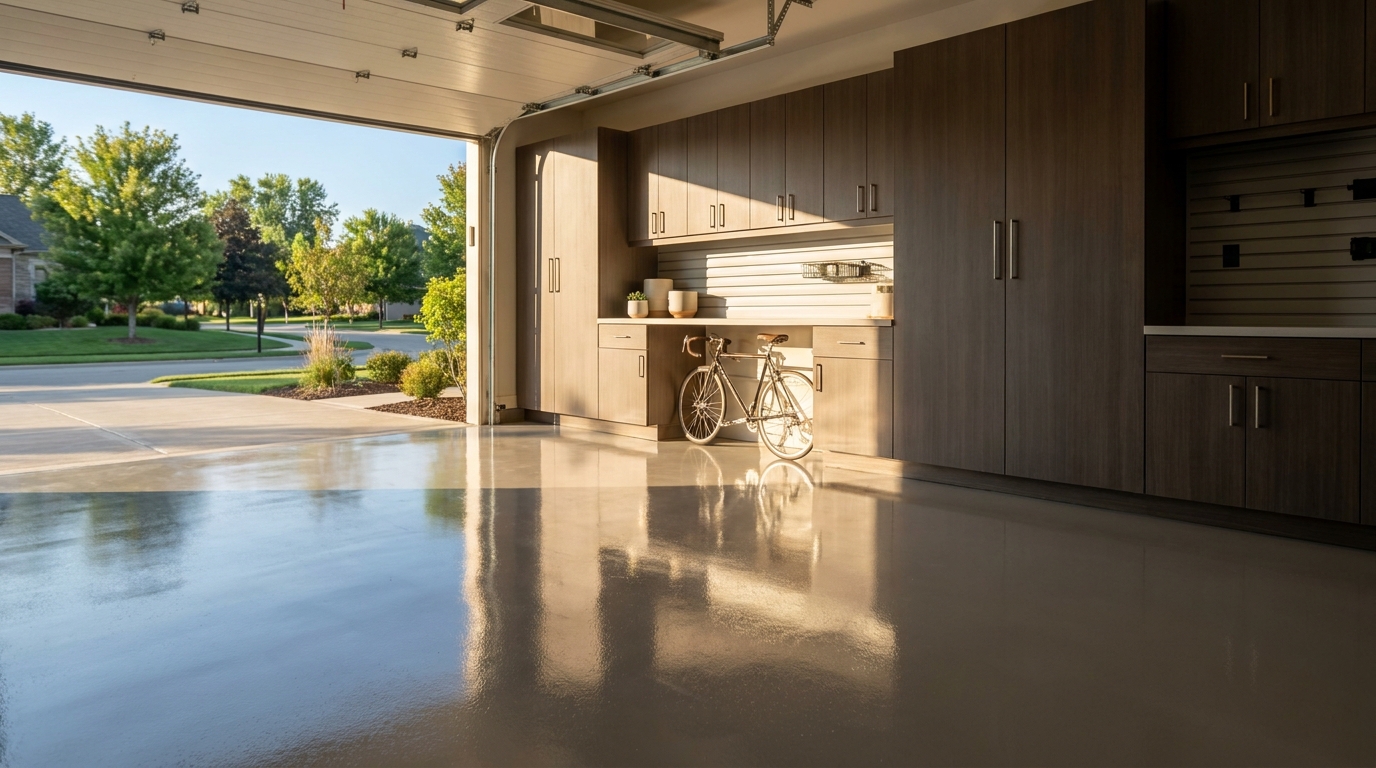
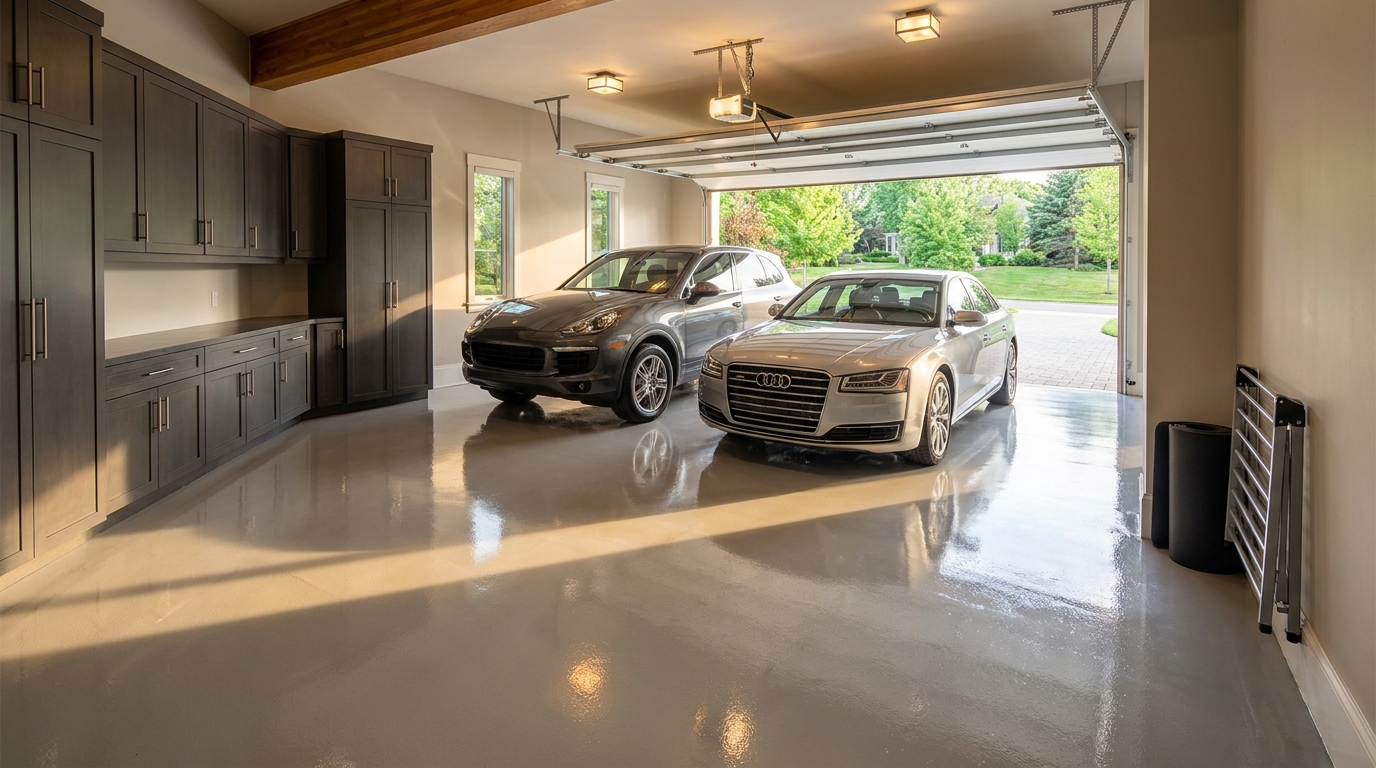
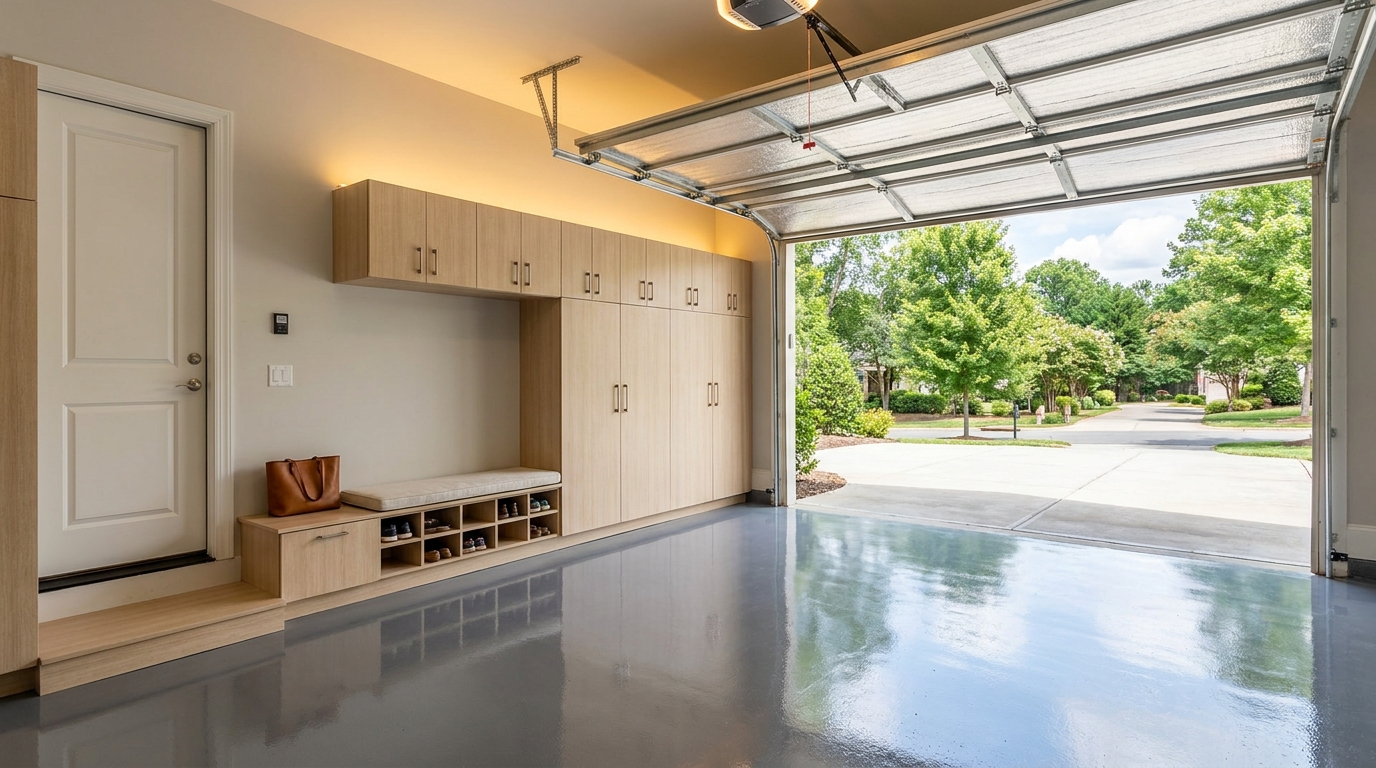
The finished garage feels like one room when the floor and the cabinets take daylight the same way. Garage floor gloss and cabinet sheen are one decision, made for the view with the overhead door open, not two finishes chosen on different days. A 2006 NIST special publication describes gloss as an observer's perception of a shiny surface, and it says that perception changes when the position of the light, the surface, or the observer changes [1]. Our team sets the clear floor film and the cabinet face together so a Charlotte garage still reads as a single room when that light moves.
One glance from the driveway
The view that settles the choice is the one a homeowner gets from the apron. The door is up. Daylight fills the bay. The floor runs back as one plane, and the cabinets stand as a row of faces above it. In that single look, the room either holds together or it splits into a bright slab and a quieter wall of storage.
The U.S. Census Bureau's 2024 Gazetteer lists Charlotte city at 35.209045 degrees north, the latitude of the city's internal point [5][6]. A 2006 NIST publication says that the perception of shine changes when the position of the light, the surface, or the viewer changes [1]. The sun moves in that open door through the day and the year, so a pair that feels balanced at one hour deserves a second look later.
This is not a fixture layout, and it is not a chip-color or stone-look choice. Where lamps go is a different drawing. Two surfaces can share a color family and still feel unrelated if one mirrors the opening and the other stays quiet. Whether a clear coat holds its color in the sun is also separate from how shiny that coat is. We make this same daylight check in Charlotte, in Waxhaw, and in the other communities on our cabinet page, across Mecklenburg, Union, and the nearby counties where our crews install.
What the measurements are actually sorting
ASTM D523, in the 2025 edition, is the standard test method for specular gloss of nonmetallic specimens, and it uses glossmeter angles of 60, 20, and 85 degrees [2]. The method associates gloss with the capacity of a surface to reflect more light near the mirror angle than in other directions, and it says those measurements correlate with visual observations of shininess made at roughly the corresponding angles [2].
The number is a comparison, not a nickname. Measured gloss ratings come from comparing the specular reflectance of the specimen with a black glass standard, and those ratings change as the surface refractive index changes [2]. Visual gloss comparisons are customarily made between specimens with similar refractive indices [2]. A clear floor film and a pigmented melamine door are not the same material, so a ranking against black glass cannot promise they will look equally shiny from the driveway.
Distinctness of reflected images, reflection haze, and texture are frequently part of judging gloss [2]. Little has been published on how evenly the numerical scale matches what people see, and when specimens differ widely in perceived gloss or in color, or in both, the link between a visual difference and an instrument difference can be nonlinear [2]. Two finishes can sit close on a meter and look far apart in the bay, especially when one surface is textured and the other is a smooth door.
The 2006 NIST publication lists the common angles in plain language: 60 degrees covers the ranges of gloss for paint and plastics, 20 degrees is for the high gloss of plastic film and of appliance and automotive finishes, and 85 degrees is for the low gloss of flat, matte paints [1]. The theoretical black-glass standard is assigned a specular gloss of 100 at each of the three standard angles, 20, 60, and 85 degrees [1]. Those are instrument angles, not a claim that a person views a garage floor from 85 degrees [1]. A floor seen as a long plane from the driveway and a cabinet door seen closer to straight on are not the same view, so one sheen word cannot cover both.
Architectural paint specifications try to name the steps in between. The Master Painters Institute's April 2022 exterior painting guide defines paint gloss as the sheen rating of applied paint, and its table puts a traditional matte, or flat, finish at 0 to 5 units at 60 degrees with a maximum of 10 units at 85 degrees [3]. In that same table, a satin-like finish is 20 to 35 units at 60 degrees and at least 35 units at 85 degrees, a traditional semi-gloss is 35 to 70 units at 60 degrees, and a traditional gloss is 70 to 85 units at 60 degrees [3]. Those bands describe architectural paint. They are not a gloss-unit label for our heat-fused melamine doors, and they are not a label for a polyurea film or a polyaspartic film. The names also overlap: that 2022 table lists an eggshell-like finish from 10 to 25 units at 60 degrees, which shares part of the range with the satin-like band [3]. Calling both the floor and the doors satin does not make them a pair.
The 2022 guide notes that glossy finishes tend to enhance the textures or defects of the surface they cover [3]. A chip broadcast is texture on purpose. The clear film can be shiny while the chips break the doorway into small flashes, and a smoother door holds a broader reflection of that same opening. We do not publish a gloss-unit number for either surface, and a paint-fan word will not close that gap.
Brightness is a different property from shine
How much light a surface sends back is not the same thing as how mirror-like that return is. A 2022 University of Minnesota briefing on the Minnesota B3 daylighting guidelines recommends area-weighted average reflectance of at least 85 percent for ceilings, at least 60 percent for walls, and at least 25 percent for floors in regularly occupied interiors, to raise perceived brightness and lighting efficiency [4]. Those figures are total reflectance. They are not a gloss rating, and they are not a code we apply to a Charlotte garage. A floor can be only moderately reflective and still mirror the door opening. A light cabinet face can return a lot of light and still look quiet.
Homeowners often start with a shared color, a gray door beside a gray floor, and expect the room to follow. Color agreement matters, and we still choose it on the samples. It does not set the sheen. A quiet light door beside a clearer floor can make the slab feel separate, and a very shiny door above a quieter floor can make the wall flash. The finished room is the one where both surfaces take the daylight in a related way.
That same 2022 briefing lists at least 45 percent average reflectance for work surfaces [4]. A workbench top is a horizontal plane in the same daylight as the floor, so its sheen belongs in the conversation. Our cabinet page includes worktop choices such as maple butcher block, stainless steel, graphite black, and faux butcher block laminate. We do not assign those tops a gloss number. We do ask that the top, the doors, and the floor be seen together, because a bright metal top can outshine both if nobody looked at it with the door open.
The film daylight actually hits
On a coated floor, the shine is the clear film on top, not the name of the blend underneath. Our garage flooring page describes one system in layers: diamond-ground concrete preparation, a polyurea or epoxy base coat, a full broadcast of decorative chips, and a polyurea top coat. That page calls the final layer a clear coat. It is the surface the daylight meets. Our homepage describes polyaspartic and epoxy floor systems, and it describes a hybrid our team typically installs as a different stack: an epoxy primer for adhesion, a decorative chip broadcast, and a polyaspartic top coat. Polyurea, polyaspartic, and epoxy are not three names for one chemistry. The base and the top do different jobs. The gloss the room sees sits in whichever clear coat is specified for that garage.
A full chip broadcast changes the reflection because it changes texture, and ASTM D523 treats texture as part of gloss assessment [2]. The chips are a color and pattern choice. This decision is the sheen of the film over them. Two blends can sit in the same color family and still read differently if the clear coats do not behave the same way in the open door. We look at the film that will actually be installed.
The flooring page also describes modular polypropylene tile with traction patterns, including RibTrax, DiamondTrax, VinylTrax, and SportTrax. That surface is not a continuous clear film. A traction pattern scatters the doorway instead of mirroring it, so cabinet sheen is chosen with the tile, usually as the quieter agreement.
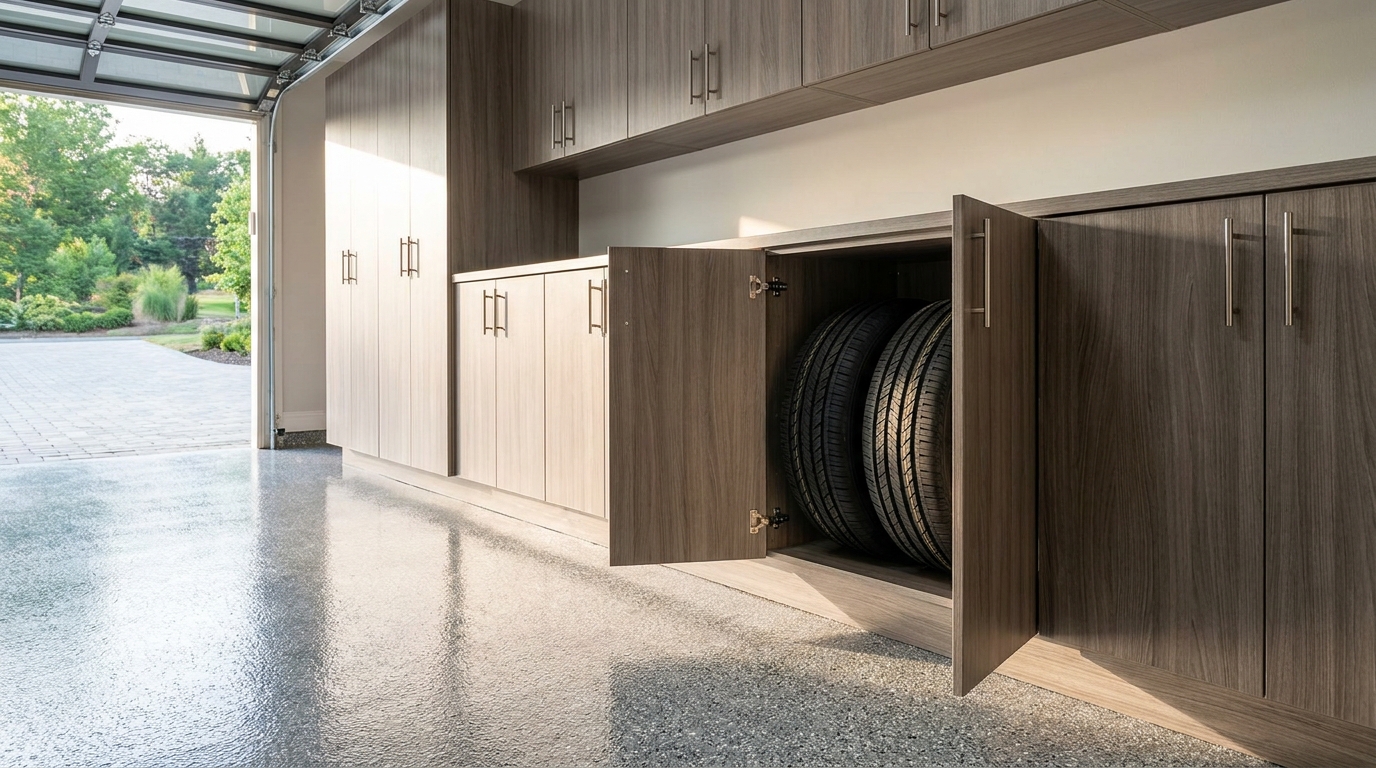
Wall-mounted cabinets keep the floor in the picture. Our garage cabinets page says both Signature and Classic series are designed as wall-mounted systems with optional legs, and that wall mounting keeps the floor clear. The coated plane stays in the same glance as the doors.
The cabinet face next to that floor
The cabinet faces are heat-fused laminated melamine, with soft-close doors, in a finish library rather than a single sheen. The cabinet page lists metal patterns such as Pewter, Bronze, and Silver Frost, wood patterns such as Breakwater, Timber Gray, and Warm Sand, and solid colors such as Charcoal, Slate, London Gray, Black, White, and Navy. A wood-look pattern and a solid color can share a project only if their sheen still agrees with each other and with the floor. Pattern is not sheen. A visible grain can soften a reflection that a solid light door will show plainly.
Because the doors are broad, their sheen repeats down the wall. If every door flashes the sky while the floor only sparkles in chips, the wall feels louder than the room. If the doors stay dull and the floor mirrors the car and the clouds, the floor feels dropped in under the storage. Both surfaces should acknowledge the open door, and neither one should take over the view.
Drawer fronts and end panels need the same sheen as the doors beside them. From beside the parked car the floor is a closer slant and the cabinet faces are more frontal, so a pair that only agrees from the center of the apron is not finished yet.
Choosing the pair while we are in the bay
Our consultations happen in the garage. The rendering shows arrangement and finish colors before anything is built. Shine is what we confirm in the daylight that will actually be there, because a screen compresses reflection.
Pick the relationship first, quieter together or brighter together. A satin label on a paint fan does not transfer to a melamine door or a clear floor film. The April 2022 paint bands stay in the paint specification, as a map of names rather than our product claim [3].
Ask which film is on top. For the system on the flooring page, judge the polyurea clear coat over the chip broadcast. For the hybrid on our homepage, judge the polyaspartic top coat. Epoxy may be the primer or the base in one of those systems. It is not a synonym for the clear coat you will live with.
Include the workbench and the floor by the driver's door. A sheen that looks right on a tall door can look harsh on a work surface seen at a slant, which is the observer moving in the way the 2006 NIST account of gloss describes [1]. Leave chip color, stone-look patterning, and color hold for their own decisions. If there is a side door or a second bay, that extra daylight should still leave the pair reading as one room.
Practical takeaways
- Choose garage floor gloss and cabinet sheen as one specification, judged with the overhead door open, so daylight reads as a single room.
- Treat shine and brightness as different properties. A light color can stay quiet, and a deeper color can still mirror the door opening.
- Judge the actual top coat, polyurea or polyaspartic, next to the actual melamine face. Do not borrow a paint-sheen name and assume both surfaces will wear it.
- Expect texture to change the reflection. A chip broadcast breaks mirror images into flashes, while a smooth cabinet door holds a broader one in the same daylight.
- Include worktops, drawer fronts, and the view from beside the car, not only the hero look from the center of the driveway.
- Keep epoxy, polyurea, and polyaspartic distinct. The film daylight hits is the clear coat on the system being installed, not a blended nickname.
How we can help
Our team designs the cabinet faces and the floor film as one finished garage, then builds the room from the pair you approved in your own daylight. Have more questions or want to get in touch? Visit https://garagecharlotte.com/contact/ and we will set a time to stand in the bay with you.
Citations
- National Institute of Standards and Technology, "NIST Measurement Services: Specular Gloss" (2006)
- ASTM International, "Standard Test Method for Specular Gloss" (2025)
- Master Painters Institute, "MPI Architectural Painting Manual, Guide Specification, Exterior Painting, Section 09 91 13" (2022)
- University of Minnesota, Center for Sustainable Building Research, "Daylight Design: Metrics and Methods for the B3 Guidelines" (2022)
- U.S. Census Bureau, "2024 Census Gazetteer Files, North Carolina Places" (2024)
- U.S. Census Bureau, "Gazetteer File Record Layouts" (2024)