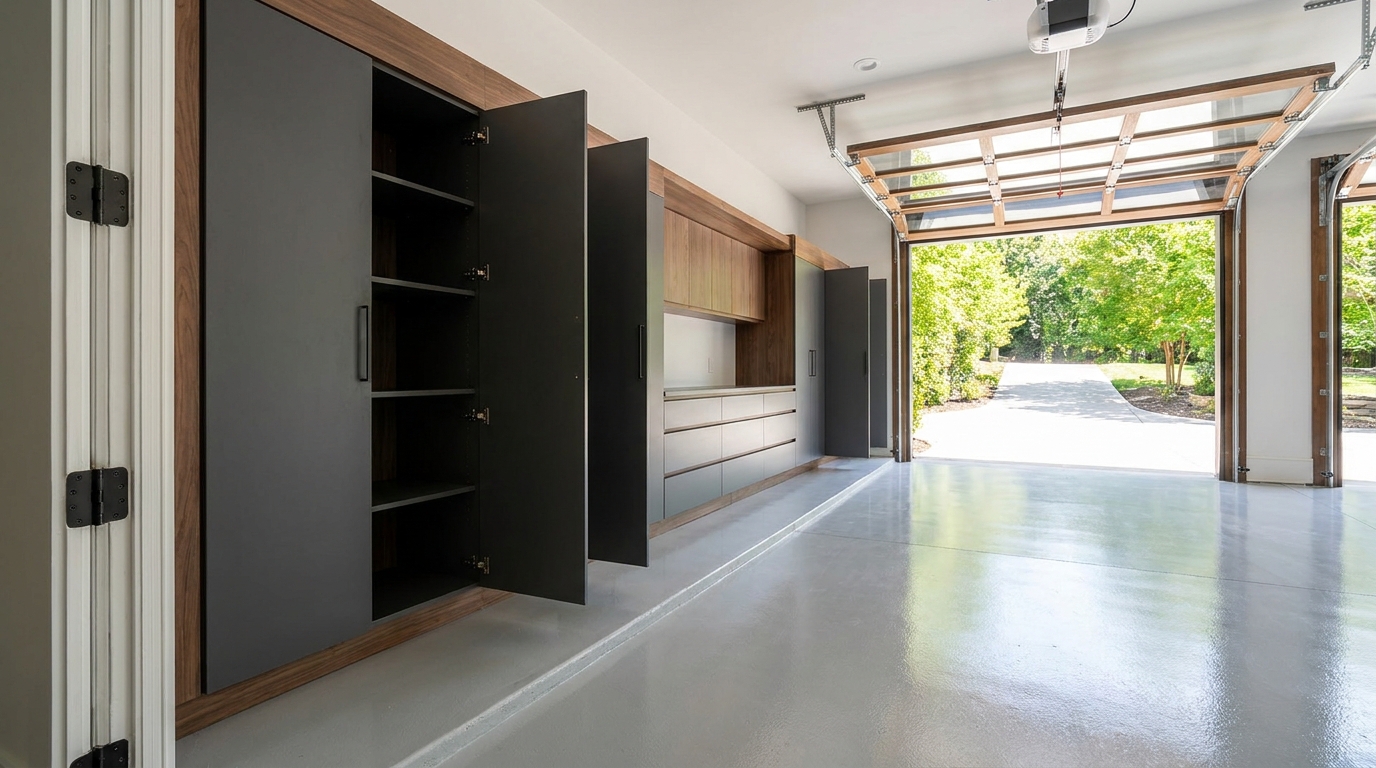
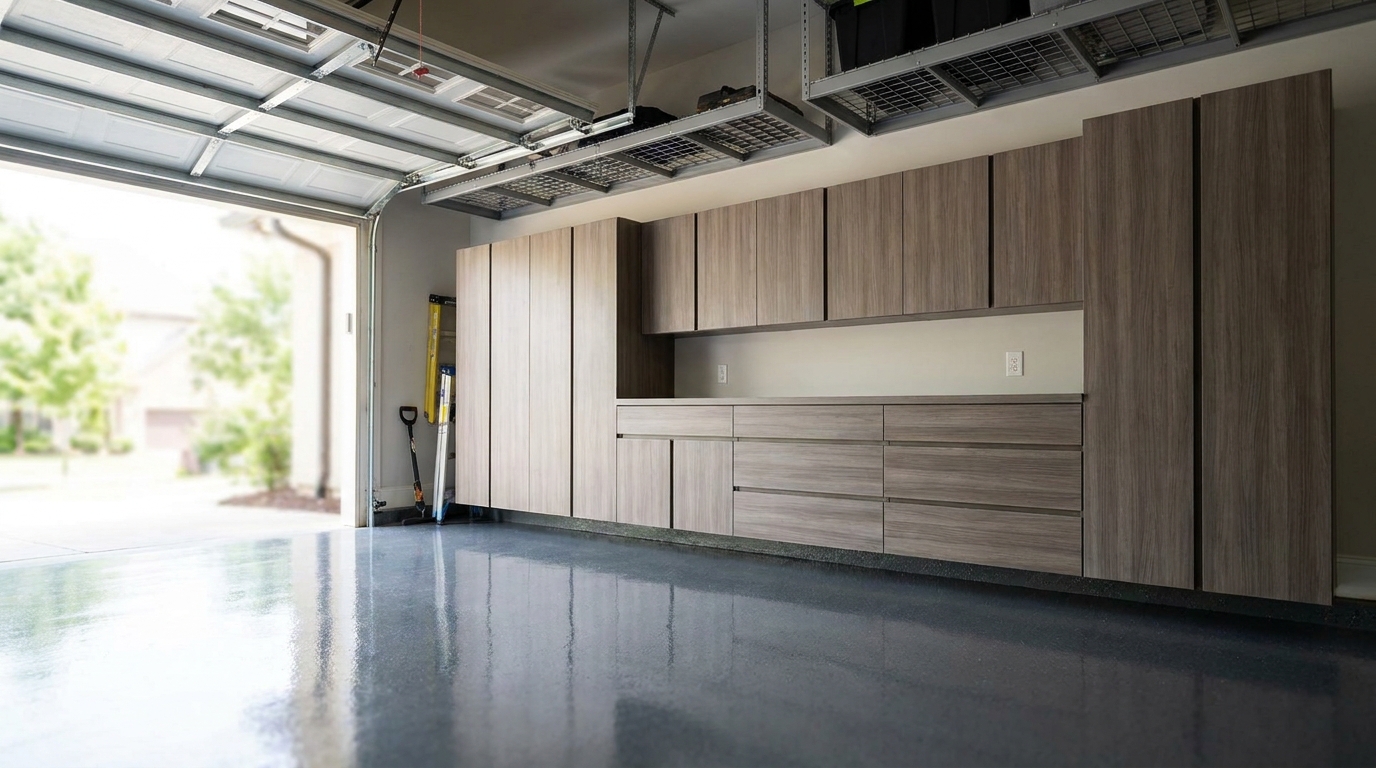
Monkey Bar Shelving Finished to Match the Cabinet Run
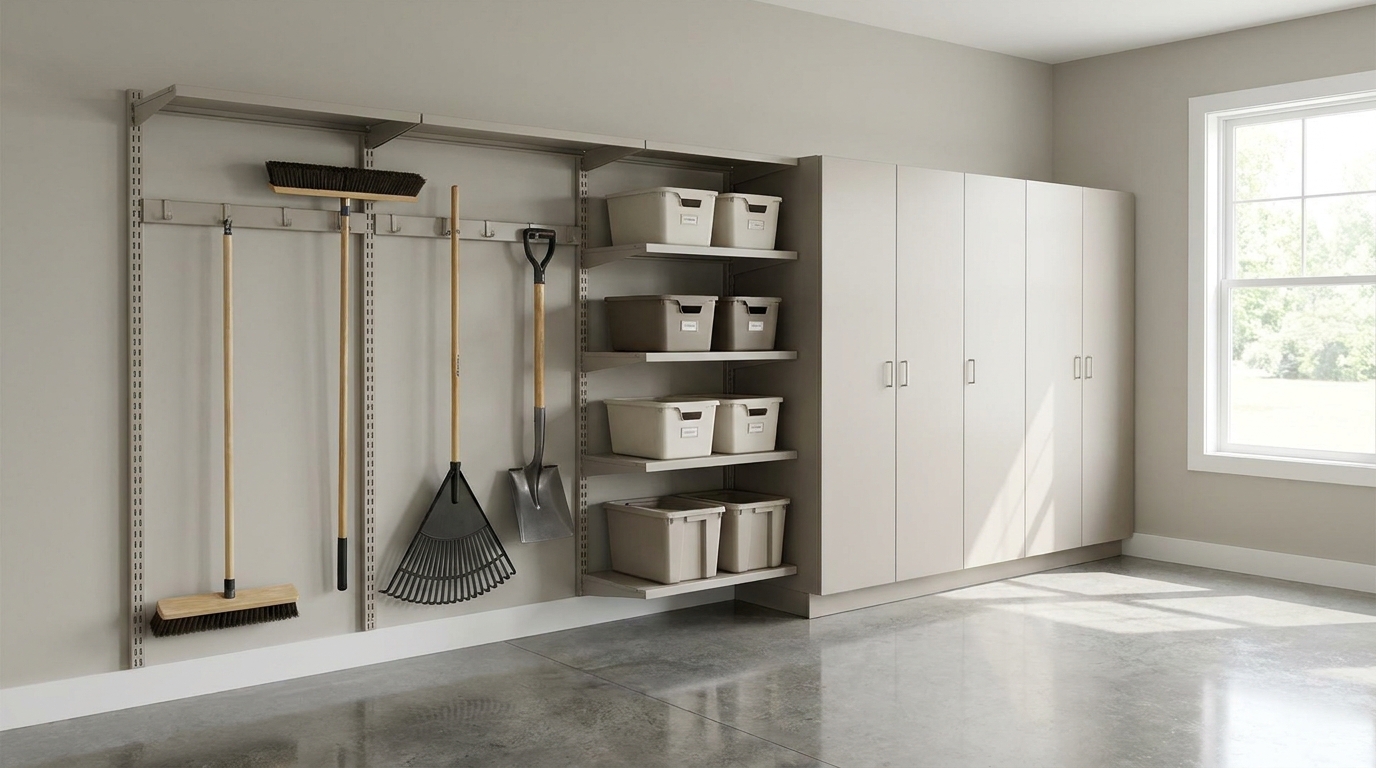
The finished garage holds as one room when the steel shelf-and-hook wall wears a finish from the same palette as the cabinet run. On the wall meant for hanging tools, our Monkey Bars shelves, hooks, and brackets take a Designer Series finish chosen to belong with the heat-fused melamine, not to impersonate it. Color family, undertone, and sheen do that work. A measured gap between two opaque samples is a useful check, and it still has to pass the eye once gloss and texture are in the room. [1]
The Wall That Holds the Tools
Cabinets are the closed side of a finished garage. Doors, drawers, and a worktop give the room the quiet face of the house. The wall beside that run, or the long stretch past the last cabinet, is the wall that wants things hanging: a rake, a bike, a ladder, a blower, the hose that comes down every week. Shelves above those hooks keep bins and boxes in the same vertical slice of wall. That pairing is the Monkey Bars layout our team installs, shelves and hooks planned as one wall rather than a scatter of brackets added later. The garage shelving we specify is built that way, with the bars under the shelves and the hooks on the bars.
That wall is not a back room. With the bay door up, it is often the first surface someone sees from the drive. If the cabinets are London Gray and the steel shows up in an unrelated factory gray, the garage splits in half. If the steel is chosen with the doors, the room stays one idea from the cabinet end to the hook end. We treat that choice as part of the design, in the same conversation as the cabinet finish, not as a hardware note after the cabinets are already on order.
One Palette, Two Materials
The cabinet face and the shelf are different materials, and they should stay different. Our garage cabinets use a heat-fused laminated melamine face. The U.S. Forest Service Wood Handbook, in its 2021 edition, describes melamine-formaldehyde resins as used primarily for decorative laminates, paper treating, and paper coating. [2] That is the family of the door you live with: a decorative surface, not a coat of wall paint, with a solid color or a grain held in the face. The same 2021 chapter notes that overlays and veneers can be added to enhance both structural properties and appearance. [2] A cabinet door has the depth of a printed or textured face. A steel bracket does not, and it does not need to.
The shelf-and-hook wall is steel. Shelves, bars, hooks, and brackets are metal parts. Metal does not take a melamine skin the way a door does. What it can take is a factory color in the same family as that door. On the shelving we install, Designer Series finishes are the ones that coordinate with the cabinet finishes, so the shelves, hooks, brackets, and accessories read as one system instead of a mix of parts from different bins.
The palette we match into is the cabinet library, chosen before the steel color is locked. Metal patterns include Pewter, Bronze, and Silver Frost. Wood patterns include Breakwater, Fort, Ore, River Rock, Seared Brown, Timber Gray, and Warm Sand. Solid colors include Charcoal, Slate, London Gray, Black, White, Antique White, Navy, and Cobalt Blue. Hardware finishes are brushed chrome, black powder coat, and oil-rubbed bronze. Those three hardware finishes are the bridge between the door and the hook. A warm wood door wants bronze hardware and a steel color pulled from the brown-gray in the grain. A charcoal or black run wants black powder-coat hardware and a steel finish in that same dark family. Pewter, Silver Frost, and white sit more naturally with brushed chrome, so the hook wall does not suddenly look yellow beside a cool door.
A wood-pattern door is not a request to print timber onto a hook. The steel stays steel. The match is the undertone: the gray in Timber Gray, the sand in Warm Sand, the brown in Seared Brown or Ore, the cooler stone in River Rock or Fort. When the undertone agrees, the hook recedes into the wall. When it does not, every hook becomes a small bright mistake, repeated down the run.
A saturated door is a separate decision, and we make it out loud. Cobalt Blue and Navy can carry a room. The steel can repeat that color if you want the whole wall to speak in one strong voice. More often, the steel stays in charcoal, black, or a quiet gray, and the blue or navy door remains the accent. Either way is a finished choice. An unmade choice, a bright door beside a default tan bracket, is the one that makes the garage look unfinished.
What a Match Means in the Room
Homeowners sometimes ask for the shelf to be the same color as the door, as if two materials could share one paint formula. They cannot, and the appearance standards explain why.
ASTM D2244-25 is the current practice for calculating color tolerances and small color differences between opaque specimens such as painted panels and plastic plaques. [1] It recommends the CIEDE2000 equation, used for coatings and plastics among other products, when a difference falls in the range of 0.0 to 5.0 units on the older ΔE*ab scale. [1] A single score can still hide the direction of the miss. The practice notes that production control often needs the three components of a difference, not only its size, so you can see whether a sample is lighter, darker, or off in hue. [1] A shelf a half-step lighter in the same gray can still belong with London Gray. A shelf at the same lightness and a step greener will not.
The same practice says the buyer and the seller have to agree on the tolerance, because other appearance factors, including how close the samples sit, plus gloss and texture, can change whether a measured difference is acceptable. [1] A matte charcoal door and a glossier charcoal bracket can measure near each other and still look unrelated. A textured wood-pattern door makes a flat steel part look harder and smoother, even when the color family is right. We are not trying to erase that difference. We are choosing the difference you want.
Light is the other half. D2244-25 says the equations were derived or optimized for daylight, and that a good match to visual judgment may not hold under other illuminants. Where two samples might be metameric, meaning they look alike under one light and diverge under another because their spectral curves differ, the practice points to a separate visual check. [1] Garage lighting is rarely pure daylight. Day comes in through the open door, and night is whatever fixtures are on the ceiling. Our team looks at cabinet and steel samples in that room, under both, before the finish is ordered. A photo on a phone is a starting point. It is not the decision.
Sheen needs its own honesty. ASTM D2457-21, the test method for specular gloss of plastic films and solid plastics, says specular gloss mainly measures how shiny a surface looks, and that precise comparisons of gloss values mean something only when they use the same procedure and the same general type of material. [3] It also says gloss is too complex for any single number to measure fully. [3] A melamine door sits in the resin-and-panel world that method is written for. A steel shelf finish is a different material. We do not chase one gloss unit across both. We set the steel sheen so it sits quietly next to the door, soft enough that the hooks do not glare, and the same from the shelf to the bar to the hook. The door keeps the grain. The steel keeps the undertone in a plain finish.
The Air This Finish Actually Lives In
The palette is chosen for a Charlotte garage, not for a showroom with perfect light and no weather. NOAA's 1991-2020 monthly normals for Charlotte Douglas Airport put July at an average high of 90.3°F and an average low of 69.9°F. January's normal average low at the same station is 31.8°F, with an average high of 52.3°F. [4] The twelve monthly precipitation normals at that station sum to 43.6 inches. [4] Summers are hot, winter nights still cross freezing, and rain is a year-round fact of the Piedmont. The bay door opens onto that air, and a wet car comes in with it.
EPA's brief guide for homeowners, updated February 18, 2026, says to keep indoor relative humidity below 60 percent when possible, ideally between 30 and 50 percent, because mold needs moisture. [5] The same guide treats condensation as a sign of high humidity and uses rust on a cold water pipe as the picture of condensation that has been sitting on metal. [5] A garage is draftier than the living spaces that guide is written around, and a shelf specification does not control the weather. We still take the hint the pipe gives. Bare steel announces moisture by changing color on its own. A factory finish is the color you picked, and it is the skin that lets that color stay put instead of staining in a way that breaks the palette.
There is a long-standing industrial description of how colored steel gets that skin. EPA's AP-42 compilation, in the general industrial surface coating section issued in 1981 and reformatted in 1995, says conventional coatings typically contain 70 to 85 percent solvents by volume. [6] The same 1995 reformatting describes powder coatings as containing essentially no volatile organic compounds, though some lower-molecular-weight organics may still volatilize, and it describes powder as a coating that can be melted after application so the particles flow together into a film. [6] That 1981 chapter is an emissions document, not a style guide. It still draws a clear line between a wet solvent paint and a fused color film. In the garage the question is visual: does this color, at this sheen, belong to the cabinet run, and is that same film on the shelf, the bracket, the bar, and the hook? A colored shelf with a raw hook is not a finished wall.
How We Set the Steel Finish with the Cabinets
Our team starts with the cabinet finish, on site, with the wall in front of us. We measure the garage, note the door clearances and the outlets, and talk through what actually hangs versus what belongs behind a door. You then see a layout and a rendering of the cabinets before anything is built. The steel finish is chosen against that rendering, not from a default gray that is supposed to go with everything. Very little goes with everything once London Gray, Warm Sand, and Cobalt Blue are real options.
Samples come next, in the garage rather than on a screen. We set the melamine chip beside the steel finish in daylight from the open door and under the night lights. That is the practical version of the daylight caution in D2244-25. [1] If the steel looks right at noon and green at 9 p.m., it is the wrong steel. If the sheen flashes while the door stays quiet, we step the sheen down.
Hardware is specified in that same pass. Brushed chrome, black powder coat, and oil-rubbed bronze have to agree with the shelf finish or they undo it. Bronze pulls on a cool gray door will fight a carefully chosen gray shelf. We pick one metal story and hold it across the pulls, the brackets, and the hooks.
The parts list matters as much as the color name. A Designer Series finish only reads as one system when the shelves, the bars, the hooks, and the brackets are all in it. If the shelf deck is the colored piece and the hooks are whatever was in the bin, the matched wall falls apart in the details. Several hook shapes on one bar still look intentional when they share the finish. They look like a hardware aisle when they do not.
We also draw the joint between the last cabinet and the first shelf on purpose. The materials change there, and the eye should be allowed to see the change. The cabinet run ends. The hanging wall begins. What should not change is the palette. A clean vertical break, same undertone on both sides, is calmer than a fade that tries to hide the joint and fails.
On the saturated colors, we ask the question in plain terms. Do you want Cobalt Blue or Navy to run onto the steel, or do you want those doors to stay the accent while the shelf-and-hook wall holds a charcoal, black, or gray from the same plan? There is no universal answer. There is a bad surprise, which is discovering the answer after the parts arrive. The rendering is where that surprise gets used up.
We do not claim the steel is a second slab of melamine, and we do not claim a gloss number can prove the match. Signature Series cabinetry carries a lifetime warranty on the boxes and the finishes. Classic Series carries a seven-year limited warranty. Monkey Bars shelving carries a lifetime warranty against manufacturing defect on the shelves, brackets, bars, and hardware in normal residential use. We install this pairing across Charlotte and nearby towns, including Huntersville, Matthews, Waxhaw, Fort Mill, and Rock Hill. A hot, rainy Piedmont garage wants the steel finish chosen with the cabinets, then left alone.
Practical takeaways
- Choose the cabinet finish first, then the steel shelf-and-hook finish, in one design pass.
- Match undertone and sheen. Do not ask a steel hook to become a melamine door.
- Put shelves, bars, hooks, and brackets in the same finish. A raw hook undoes a matched shelf.
- Let the hardware agree with both: brushed chrome, black powder coat, or oil-rubbed bronze, not a mix that starts a second palette.
- Look at samples in the garage, in daylight and under the night lights. A screen is not the room.
- On Cobalt Blue or Navy, decide whether the steel repeats the color or stays a quiet neutral before anything is ordered.
- Remember the room the finish lives in. Charlotte Douglas 1991-2020 normals put July's average high at 90.3°F, and the monthly precipitation normals sum to 43.6 inches. [4]
How we can help
Have more questions or want to get in touch? Our team will measure the garage, set the cabinet finish and the Monkey Bars finish in the same plan, and show you the room before anything is built. Start with a note on our contact page.
Citations
- ASTM International, "ASTM D2244-25, Standard Practice for Calculation of Color Tolerances and Color Differences from Instrumentally Measured Color Coordinates" (2025-06-10)
- USDA Forest Service, Forest Products Laboratory, "Wood Handbook, Chapter 11: Wood-based composite materials (FPL-GTR-282)" (2021)
- ASTM International, "ASTM D2457-21, Standard Test Method for Specular Gloss of Plastic Films and Solid Plastics" (2021-06-07)
- NOAA National Centers for Environmental Information, "U.S. Climate Normals 1991-2020, Charlotte Douglas AP, station USW00013881" (1991-2020)
- U.S. Environmental Protection Agency, "A Brief Guide to Mold, Moisture and Your Home" (2026-02-18)
- U.S. Environmental Protection Agency, "AP-42, Section 4.2.2.1, General Industrial Surface Coating" (1981-04, reformatted 1995-01)