One Bin Size Specified So Every Shelf Holds the Same Tote
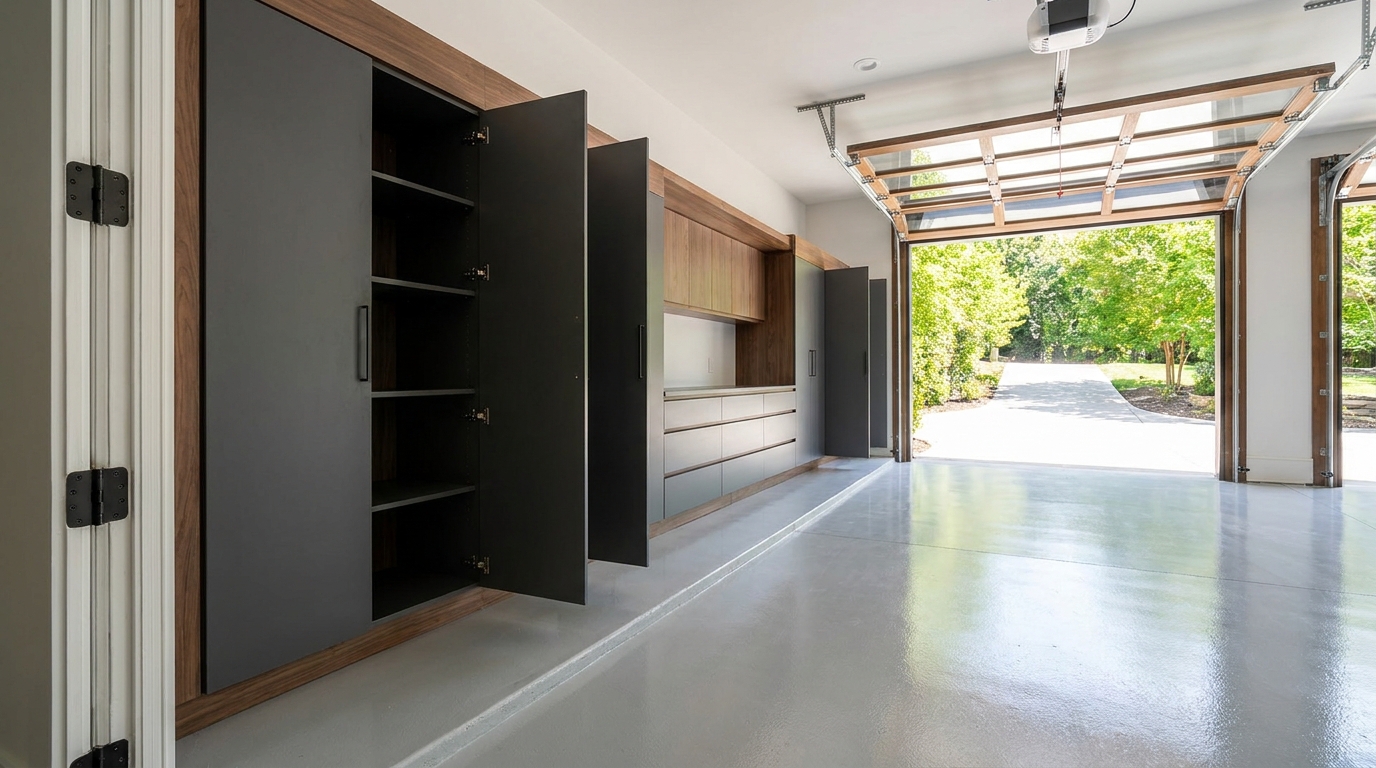
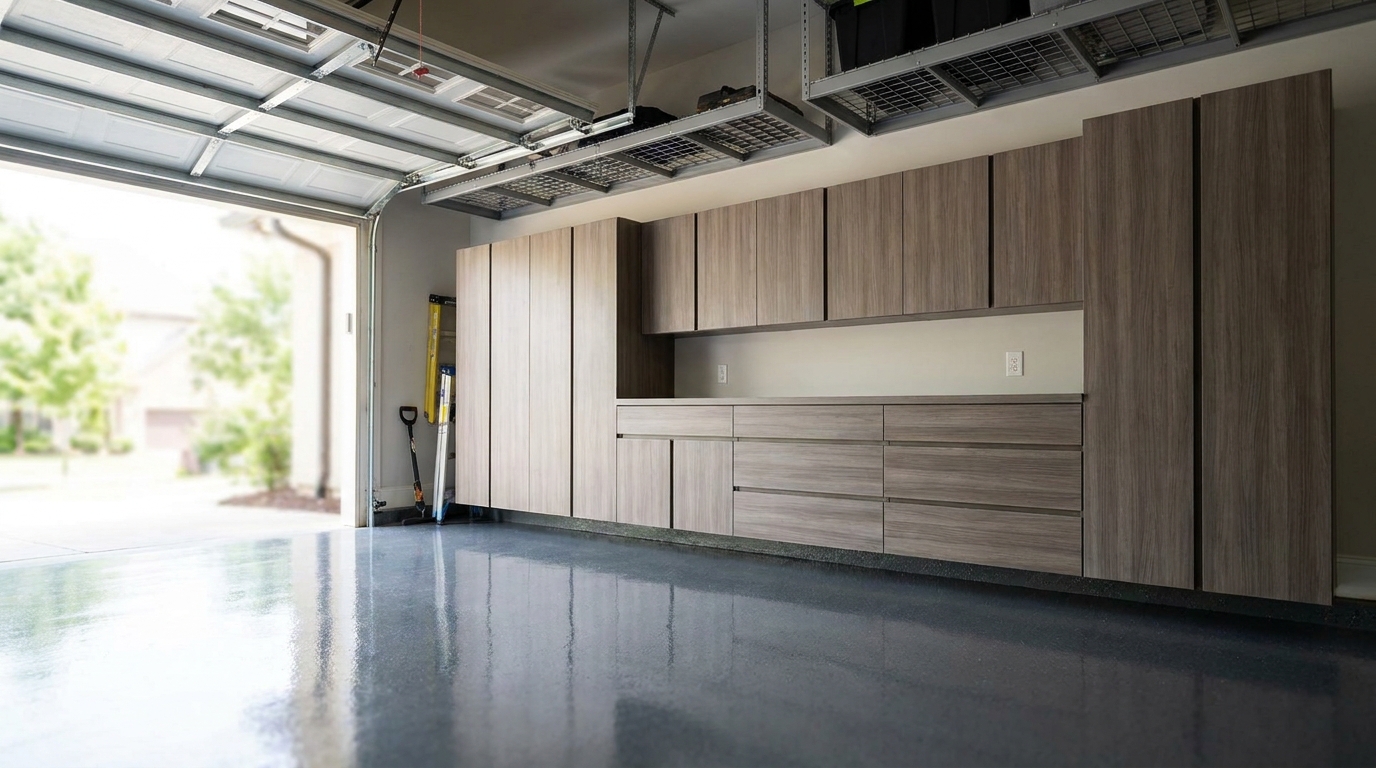
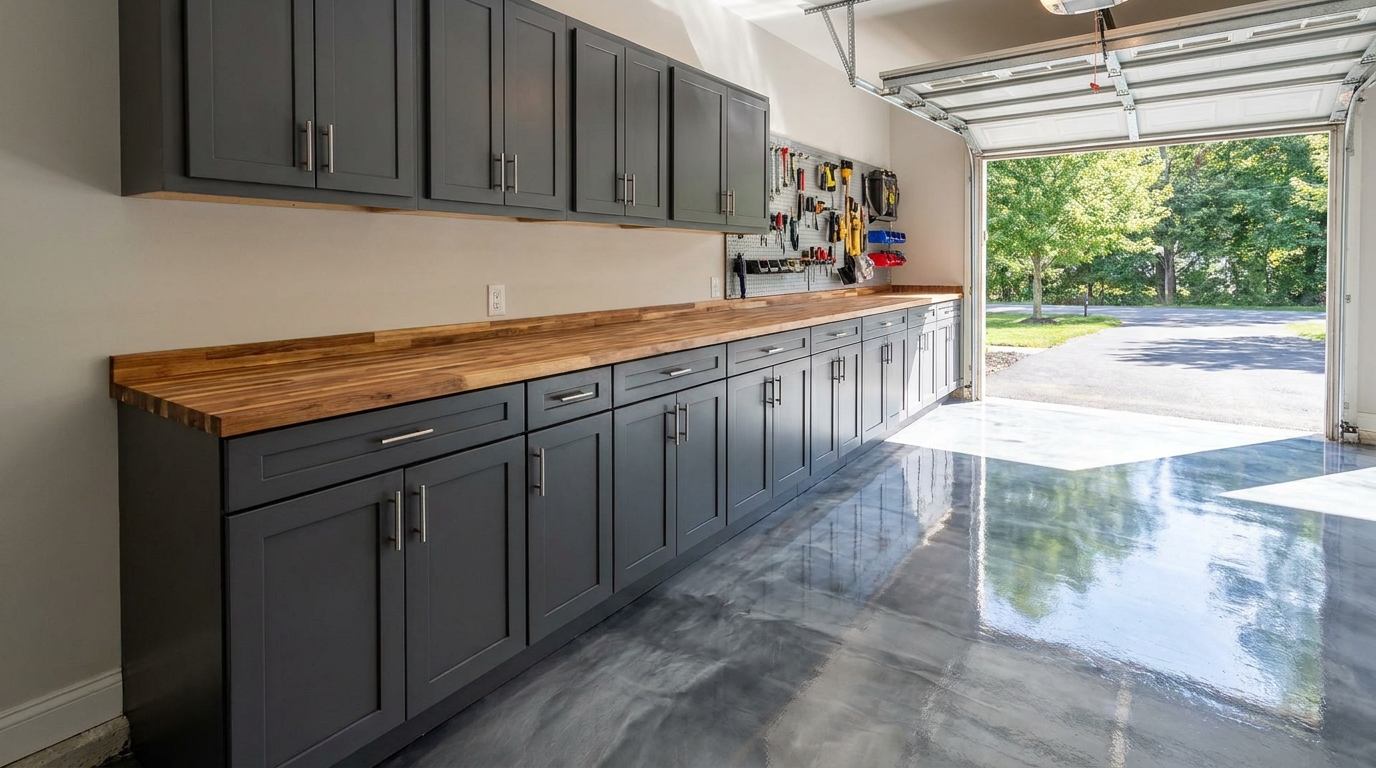
A finished garage cabinet run reads as one piece of furniture, and the decision inside it is quieter than the finish. We specify the garage cabinet bin size from a single tote the household already uses, then draw every shelf and every pull-out to that footprint. A bin taken from the tall cabinet lands in the base with the lid still on and the door still able to close. The same tote can change bays because the clear opening was drawn to it.
The tote comes before the cabinet
Our team starts with the bin that already earns a place in the house. It might be the sports tote, the holiday tote, or the one that stacks beside the mudroom door and gets carried in from the car. We look at the outside length, the outside width, and the height with the lid seated. We look at where the hands actually take hold, and at whether the lid needs to open while the bin is still on the shelf. That object becomes the module for the run.
We are not shopping a list of tote brands, and we are not assigning a different footprint to each bay because a catalog showed three heights. If the house truly owns two footprints, the one that has to travel between the tall cabinet and the base is the one we draw to. A specialty bin that never leaves a single bay can stay a specialty. It does not reset the shelf for everything else. The garage cabinet bin size, in this sense, is a specification we write down before the boxes are ordered, not a guess we correct after the doors are hung.
The test is physical. The tote should come out of the tall cabinet and sit fully on the base shelf or the base pull-out, with the door or the front able to close and a hand able to take it back out. If that works in only one bay, we drew two cabinets, not one system.
One footprint, because the shelf was drawn to it
Records centers have lived with this rule for a long time, and the reason is the shelf, not the paperwork. The National Archives Federal Records Centers page, reviewed on August 20, 2024, tells agencies to use a standard-size box of 14 3/4 by 12 by 9 1/2 inches for legal or letter files, and it states that boxes exceeding those dimensions will not fit on Federal Records Center shelving [6]. If the records will not fit that carton, the agency is told to call before choosing a different size [6]. The shelf was built to one carton. A surprise carton is not a storage plan.
A Charlotte garage is not a records center, and we are not asking anyone to buy that carton. The lesson is the one we use on a cabinet wall. The tall cabinet and the base share a plan view, so a tote from one is a tote for the other. A second footprint means a second clear opening, and the bins stop being interchangeable. What changes from bay to bay is the height of the opening, not the length and width of the tote. Seasonal totes can live higher. Daily totes can live lower. They are the same tote.
The clear opening, not the outside of the box
The outside width of a cabinet includes the side panels, the doors, and the gaps at the doors. The tote never lives in that outside dimension. It lives in the clear interior, on a shelf that has to carry it, with enough air for a hand and for the lid.
Casework standards describe that relationship from the interior out. ANSI/AWI 0641-2019, the Architectural Wood Casework standard, sets adjustable-shelf rules by aesthetic grade. At Premium and Custom grades, the minimum depth is no less than 6.4 mm, 0.250 inch, shorter than the interior cabinet depth, and the length is a maximum of 3.2 mm, 0.125 inch, less than the interior cabinet width, plus any extra offset from the shelf rests [5]. When that standard is referenced and no aesthetic grade is specified, it says the product is to meet Custom grade [5]. The length rule is the plain one. The shelf is allowed only a small gap across the width, aside from the rests. A tote that is wider than the interior will not become a fit because the shelf can move up or down.
We do not claim that a garage cabinet is certified architectural casework under ANSI/AWI 0641. We use the standard for the geometric point it actually makes. Shelf size is defined from the clear interior, so the clear interior has to be defined from the tote, including the lid and the place a hand grabs the rim. A short shelf that leaves the tote hanging past the front edge is not finished.
Our Signature cabinets make the same point in thickness. Tops, bottoms, and fully adjustable shelves are 1 inch, and the doors, drawer fronts, and side panels are 3/4 inch, in heat-fused laminated melamine. The side panels and the door take part of every nominal width, and the shelf still has to stop short of the door so the door can close. We account for that on the garage cabinets we design for the wall, the ceiling, and the door swings in the room. Both Signature and Classic are manufactured in the United States and mounted to the wall, with legs as an option when the floor wants them.
Adjustable shelves matter after the footprint is chosen. They let the vertical opening follow this tote, or a later tote of the same length and width with a different height. They are not the specification. A shelf that can be relocated is still the wrong shelf if the tote is too deep for the box. The hardware that carries the shelf only sets height. The footprint was already decided when we accepted the bin.
The same reach, because it is the same bin
Taking the tote out is a two-handed lift, and the width of the tote is part of how far the hands sit from the body. NIOSH presents the Revised NIOSH Lifting Equation, on a page updated October 28, 2026, as a way to calculate risk for two-handed lifting tasks [1]. The inputs include the horizontal location of the hands away from the midpoint between the ankles, the vertical location of the hands, and the coupling, which is the quality of the grip [1]. The recommended weight limit on that page is the amount most workers can lift during a work shift without the risk of a work-related musculoskeletal disorder [1]. We do not use that occupational limit as a household rule or as a rating for a cabinet shelf.
The applications manual was revised in September 2021. NIOSH states that the essential contents did not change, and that the formulas match the 1994 equation aside from a corrected recovery-time factor [2]. When the horizontal location cannot be taken directly, the manual allows an approximation from the width of the container in the sagittal plane: for hands at least 10 inches above the floor, 8 inches plus half that width [2]. A deeper tote, front to back as you stand at the cabinet, moves the hands farther from the body. That is why the tall cabinet does not get a deeper bin than the base. The object that moves is one object, so the reach stays one reach.
The manual sets a horizontal location under 10 inches up to 10 inches, because most objects closer than that cannot be lifted without interference from the abdomen or hyperextended shoulders, and it notes that objects more than 25 inches from the ankles normally cannot be lifted vertically without some loss of balance [2]. It also says the equation does not apply when the temperature is significantly outside 66 to 79 degrees Fahrenheit, or when shoe-to-floor friction falls below a 0.4 coefficient of static friction [2]. A residential garage is not the room that equation was written for. We keep the geometry.
Grip belongs in the same specification. The manual classifies hand-to-container coupling as good, fair, or poor [2]. For a container, a good coupling is handles or handhold cutouts of optimal design, and a poor coupling includes a bulky or irregular object that is hard to handle [2]. The tote the household already carries is a grip people in the house have already tried. We draw the cabinet to that grip instead of to a bin known only from a picture.
Height follows the tote, and the hands that take it
Where the tote sits vertically still starts from the bin, not from a row of holes. In the April 2007 booklet Ergonomic Guidelines for Manual Material Handling, NIOSH describes the power zone as above the knees, below the shoulders, and close to the body, and says heavier or bulkier containers should be stored so they can be handled there [3]. That booklet is for people who lift at work. In a house, the everyday tote still belongs where the hands meet it without a climb, not on the slab and not at the top of the tall cabinet only because a gap was left over.
A June 2007 guideline from the Automotive Industry Action Group, archived by CDC for small-lot delivery systems, puts the same idea in shelf language. When shelf heights are calculated, the container dimensions and the placement of the hand grips should be considered [4]. The guideline recommends shelves that let a person place containers at a hand height, not a shelf height, of 22 to 50 inches, also given as 56 to 127 centimeters [4]. Handles on returnable containers typically place the hands 4 to 8 inches, or 10 to 20.5 centimeters, or more above the shelf [4]. A home cabinet is not a factory rack, and that inch range is not a code we install to. The method is what we keep. If the grip sits above the shelf, a plan that only counts the shelf surface will put the hands higher than anyone intended.
Clear height includes the lid. If the lid has to open inside the cabinet, the opening above the tote is part of the specification, in the tall cabinet and in the base. If the lid stays closed until the tote is out, we still leave enough room for a hand on the rim. Daily bins take the opening that matches that habit. A flatter seasonal bin of the same length and width can sit on a tighter opening higher in the tall cabinet. The footprint did not change. Only the clear height did.
Pull-outs follow the same tote. The platform depth is drawn so the bin sits fully on it and still clears the closed front, in the base or higher in the run. The slide itself is a separate specification. It does not pick the bin. The bin picks the depth, and that depth matches the fixed shelf so the tote has one home shape.
The tote is a carrier, and the label stays on the product
One bin size is a storage module. It is not a reason to pour anything into an unmarked box. The U.S. Environmental Protection Agency page on household hazardous waste, updated June 1, 2026, says never to store hazardous products in food containers, to keep them in their original containers, and never to remove the labels [7]. It also says not to mix leftovers with other products, because incompatible products might react, ignite, or explode [7]. Paints, cleaners, oils, batteries, and pesticides are among the products that page names [7]. The label on the product is the instruction for storage. We follow that by leaving the product in the container it came in.
Inside the cabinet, those containers can ride together in the tote so they move as one unit from the tall cabinet to the base. The tote does not become the label. Empty product containers still deserve care, because that EPA page notes that residual chemicals can remain [7]. Lock-and-key hardware is available when something should stay out of reach, and it is a separate choice from the bin size. The locked cabinet still has to accept the same tote as the rest of the run.
What we draw once the tote is on the bench
Our team measures the garage with the tote in the room. Wall length, ceiling height, outlets, panels, and the swing of the garage door and the service door all stay in the plan, and so does the bin. We write down the outside size with the lid on, the way the hands meet it, and which bays have to accept it. Then the clear opening of each shelf and each pull-out is checked against that note, not against a generic interior from a previous job.
The finished run in Charlotte, Waxhaw, Monroe, and nearby towns in Union and Mecklenburg counties should read as one cabinet line: heat-fused melamine, one hardware finish, and doors that close over the same family of totes. A bin from the tall cabinet should set into the base without turning sideways or sitting proud of the shelf. That is the specification. One garage cabinet bin size, drawn through every bay that is supposed to hold it.
Practical takeaways
- Pick the tote the household already carries, and make that footprint the specification before cabinet interiors are drawn.
- Use that same length and width in the tall cabinet, the base, and the pull-out, so a bin can change bays.
- Judge the fit by the clear interior, the lid, and the place the hands grab, not by the outside width of the cabinet.
- Let the vertical opening follow that tote. A shelf that can move up and down does not repair a footprint that is too deep.
- Keep paints, cleaners, oils, and similar products in their original labeled containers inside the tote.
- Use workplace lifting guides for the geometry of reach and hand height, not as a home code and not as a shelf rating.
How we can help
Have more questions or want to get in touch? Our team will look at the tote you already use and draw the shelves and pull-outs so that one bin moves from the tall cabinet to the base. Visit https://garagecharlotte.com/contact/
Citations
- Revised NIOSH Lifting Equation. National Institute for Occupational Safety and Health, Centers for Disease Control and Prevention. Page updated 2026.
- Applications Manual for the Revised NIOSH Lifting Equation, DHHS (NIOSH) Publication No. 94-110, revised September 2021. National Institute for Occupational Safety and Health. 2021.
- Ergonomic Guidelines for Manual Material Handling, DHHS (NIOSH) Publication No. 2007-131. National Institute for Occupational Safety and Health. 2007.
- Ergonomics Guidelines for Small Lot Delivery Systems, OHS-5, Version 1.0. Automotive Industry Action Group. 2007.
- ANSI/AWI 0641-2019, Architectural Wood Casework, section 3.4 Aesthetic. Architectural Woodwork Institute. 2019.
- About the Federal Records Centers. National Archives and Records Administration. Page reviewed 2024.
- Household Hazardous Waste (HHW). U.S. Environmental Protection Agency. Page updated 2026.