Modular Tile Specified as Its Own Finished Floor
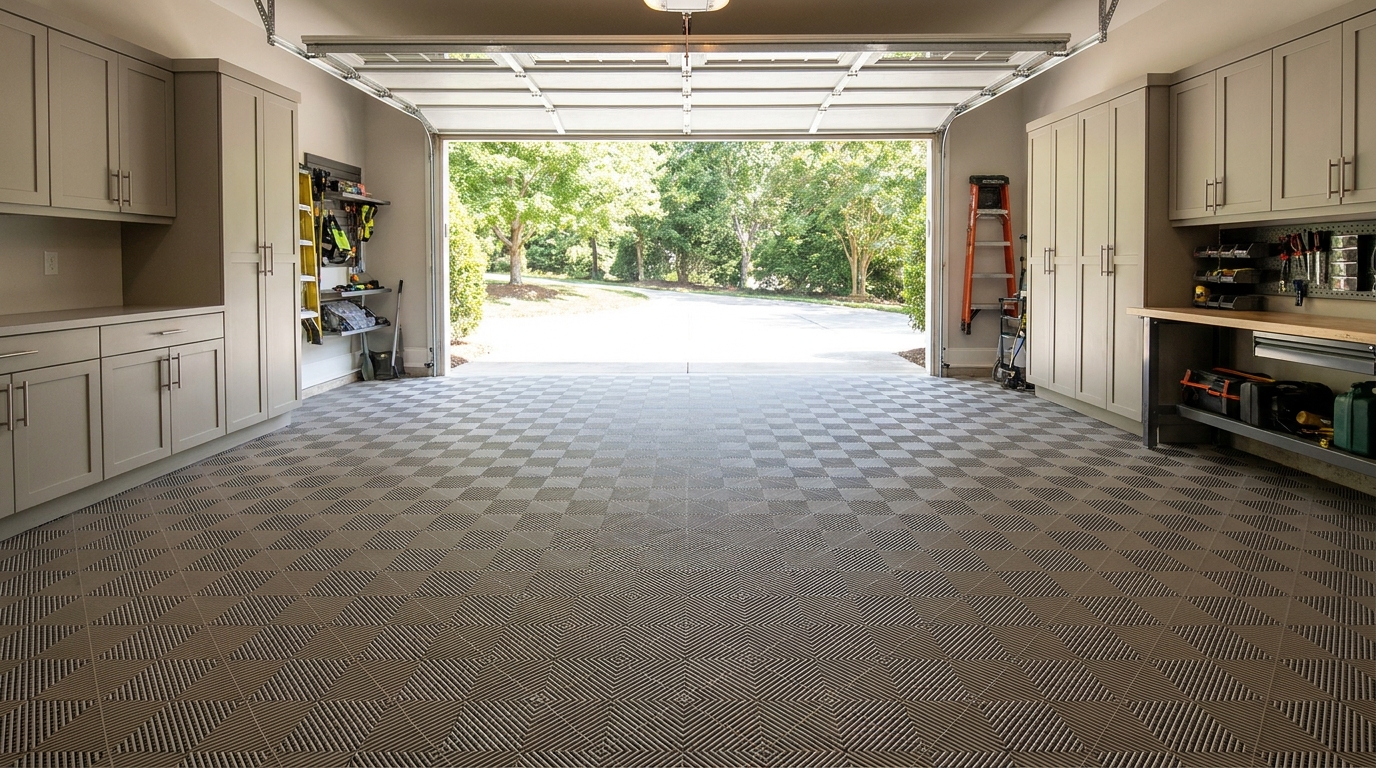
A modular garage floor tile is a finished floor we specify on its own, for color and for the pattern underfoot, in the same pass as the cabinet wall. The tiles snap together over the concrete, and a section can come back up later without grinding a film off the slab. That lift-out is part of the design, not a backup plan. A polyurea coating is a different system, bonded into the concrete, and we do not write the two as if they were one product with two names.
Chosen with the cabinet wall
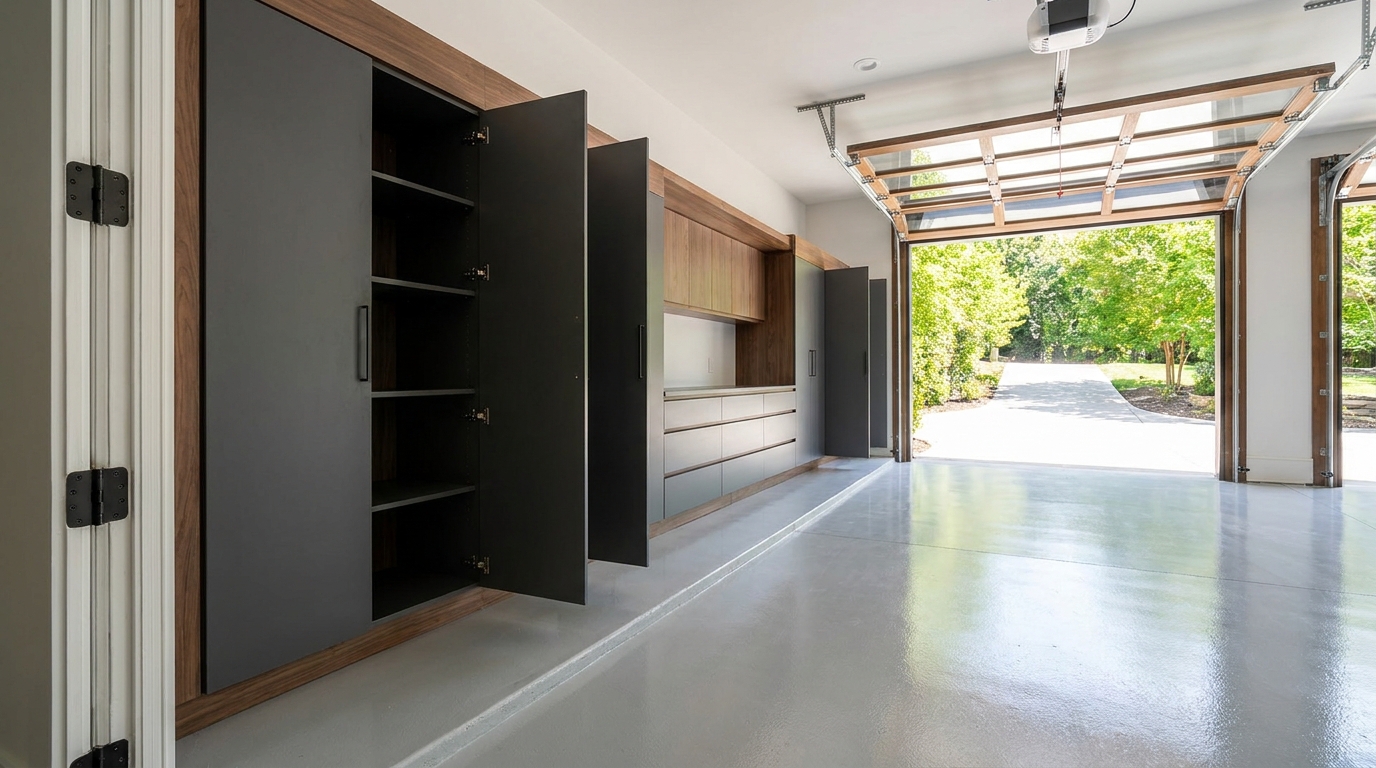
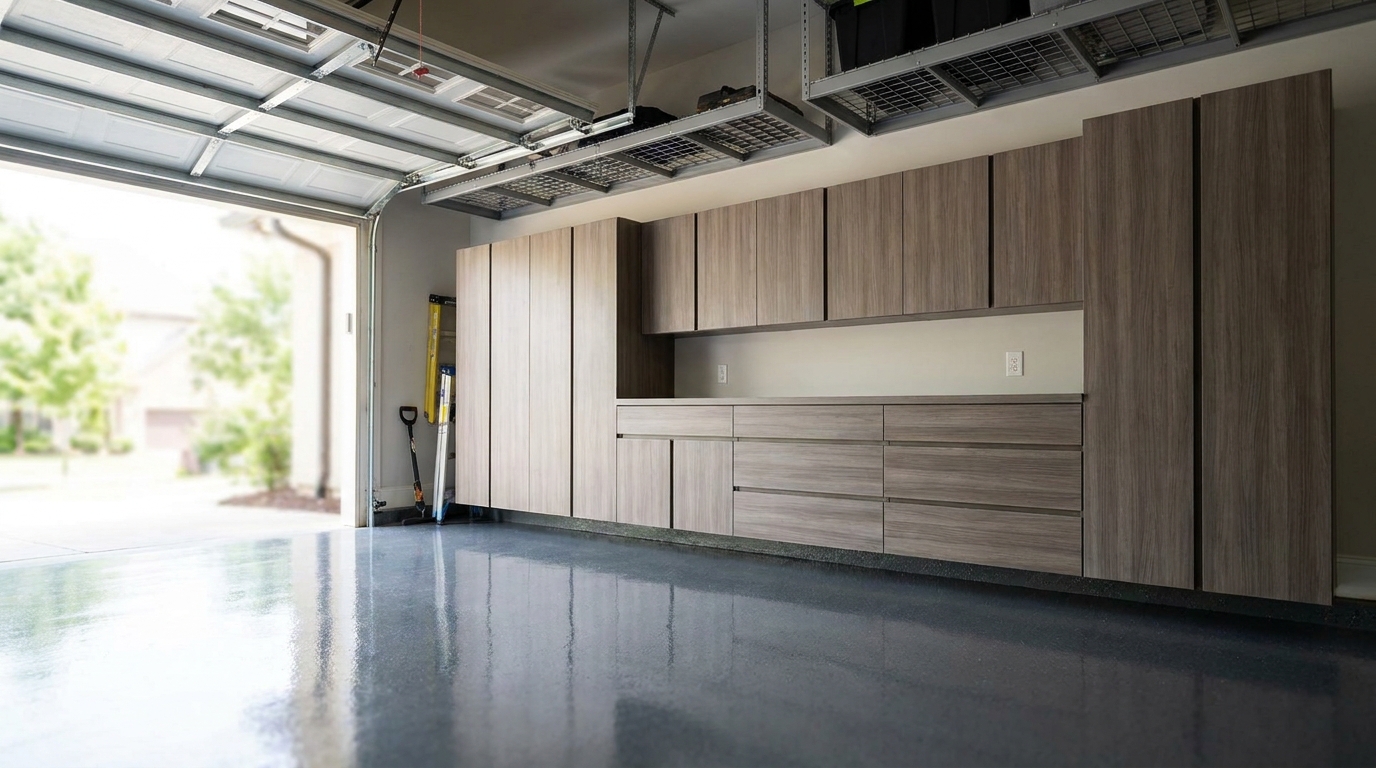
When the overhead door is up, the floor and the cabinet run are the picture of the room. Our team treats that picture as one specification. You already have a cabinet finish in mind, or we are choosing it with you: a metal pattern such as Pewter or Silver Frost, a wood pattern such as Warm Sand or Timber Gray, a solid such as Navy or Charcoal. The floor color has to sit with that door, not fight it from across the bay. We set tile samples on the slab, next to a door sample or next to the boxes if they are already on the wall, and we look at them with the driveway light coming in. Garage cabinets and the floor are specified as parts of the same room.
A darker tile can quiet a busy wood grain. A lighter tile can keep a charcoal or navy run from turning the bay into a cave. A gray tile can sit beside pewter hardware without trying to match the metal exactly, which usually looks forced. We would rather be a step off, on purpose, than one shade away and slightly wrong. Nineteen colors is a real library, not a brochure promise, and five designs give the face a texture as well as a hue [6]. The names we install include RibTrax, DiamondTrax, VinylTrax, and SportTrax [6].
This is not the chip-blend conversation, and it is not a gloss conversation. A liquid coating gets its color from a broadcast of flakes under a clear film. Modular tile gets its color from the molded piece itself. You are choosing a repeating module you will see at the size of a tile, with a joint you can find if you look, and with a pattern that your shoe can feel. That is the point of specifying it as its own finish. If what you want is one continuous coated field, we will say so and specify the coating. If what you want is a colored, patterned floor you can revise, we specify tile.
Pattern is part of the specification
Color gets the room. Pattern gets the way you use the bay. Our garage flooring page describes modular tile as snap-together polypropylene in multiple traction patterns, and the practical split is simple. A workshop corner or a sport bay wants a face with texture. A parking bay wants a face that still feels steady when you step out of a wet car. We do not hand you one pattern for every use and call it done.
Charlotte is not a dry showroom climate. NOAA's official climate normals are 30-year averages, and the 1991-2020 set is the latest release, first published in May 2021 [2]. At Charlotte Douglas Airport, those monthly precipitation normals add up to 43.60 inches a year, and August is the wettest month in that set at 4.35 inches [3]. An open door on a summer afternoon, or a car that just came up a wet driveway in Matthews or Huntersville, puts water on the floor. The tile has to live with that, not only with a styled photo taken on a dry Saturday.
The 2018 North Carolina Residential Code, which is the code built on the 2015 International Residential Code, says two short things about a garage floor. The floor surface shall be of approved noncombustible material [1]. The area used for parking automobiles or other vehicles shall be sloped to facilitate the movement of liquids to a drain or toward the main vehicle entry doorway [1]. The slope is how the slab sends water and spilled liquid out the door or to a drain, instead of back toward the house. When we lay tile, we follow that slope. We do not build a dead-flat platform that ponds water against the back wall. Ridges in the tile give a place to rinse, which matches the care note we give you: a household cleaner for a spill, or a spray between the ridges when the floor needs a deeper clean [6].
The concrete slab stays the floor
That first code sentence matters, and we do not blur it. The approved noncombustible floor in a Charlotte garage is the concrete slab [1]. Modular polypropylene tile is a finish we set on top of that slab. It is not a new structural floor, and it is not a substitute for the concrete the code is describing. The car still bears on the slab. The tile is the surface you walk, the surface you see with the cabinets, and the surface you can take up.
Prep follows that distinction. For a coating, our crew diamond-grinds the slab, fills cracks and joints, and builds a bonded system: a polyurea or epoxy base, a full broadcast of decorative chips, and a polyurea top coat. For tile, the prep is cleaning and leveling, then snapping the field together and cutting edge trim to the slab [6]. Grinding, chip, and a cured film belong to the coating. They are not steps we quietly rename and apply to tile. If a bay truly wants the bonded film, and the bay beside it wants a patterned tile, we can split the garage that way. The flooring page says the recommendation can be coating, tile, or a combination, depending on how each bay is used [6].
We also do not sell tile as a cover for a slab that should be repaired first. If the concrete is spalled, moving, or holding water in a way a finish should not ignore, we say that on the walkthrough, before any tile is ordered. Leveling for a snap-together floor is not the same job as pretending a bad slab is finished. You should hear that from us in the driveway, not discover it a year later under a grid that was never meant to be a structural patch.
A section you can lift later
The locks are mechanical. That is the feature people feel on day one, when the floor goes down in about a day and there is no cure window before you walk it, and it is the feature that still matters years later [6]. A coating is a film you live with until someone grinds it off. A modular garage floor tile is a field of pieces. Four tiles around a stain, a corner where you want to see the concrete, a strip along a future cabinet run: our team can unsnap that area, do what the slab needs, and put the same pieces back, or replace the ones that took the stain.
The same idea covers a move. Our tile can be lifted and reused if you sell the home [6]. The floor you specified with these cabinets does not have to be abandoned in a house you are leaving, and it does not have to be destroyed to come out. That is a design choice for people who think of the garage as finished rooms they might rework, not as a one-time pour. A sport bay that becomes parking, or a parking bay that becomes the place the bikes and the weights live, can change pattern in the area that changed use. The rest of the field stays.
The warranty we put on modular tile is fifteen years against warping and structural defect, and we honor it ourselves, locally [6]. A coating warranty is a different document: five years on adhesion and finish, because a bonded film fails in a different way than a molded piece [6]. We do not quote one warranty as if it covered both systems. When you are choosing, you should know which promise belongs to which floor.
Edge trim is part of the same spec. The field does not dangle in a rough cut at the overhead door or at a column. We cut trim to the slab so the tile reads as a finished shape, and so the slope of the parking area can still carry liquid toward the vehicle door [1][6]. The trim is a border, not a dam.
The plastic, the spill, and the shoe
The material is polypropylene, molded into a tile, not brushed on as a liquid. It is worth being plain about what outside research does and does not say about that plastic. A 2025 paper in the journal Polymers soaked 3D-printed polypropylene filament, not a garage floor tile and not a surface anyone parked on. After seven days, that printed polypropylene kept essentially all of its tensile and impact strength in distilled water and in 30 percent hydrogen peroxide [5]. In ethanol, in 8 percent acetic acid, and in 37 percent hydrochloric acid, tensile and impact strength stayed at least 97 percent of the starting values [5]. In acetone, both dropped to about 93 to 94 percent [5]. The author frames that as a result about 3D-printing filament. The test liquids did not include gasoline or motor oil. We do not borrow the paper as proof of how a fuel spill behaves under a parked car.
What we do tell you, from the way we build and clean these floors, is simpler. Both of our flooring families are specified to stand up to oil, gas, hot tires, and the dirt a real garage produces, and a spill still gets wiped up [6]. Tile cleans with a household cleaner, or with a spray between the ridges. Leaving a puddle because a laboratory filament survived a week in a beaker is not the care plan. The paper is useful only as a reminder that this polymer family is chosen, in other industries, where chemical contact is expected. Your floor is still a floor we maintain, not a lab coupon.
Traction belongs in the same specification as color, and we will not dress it up as a safety certificate we did not run. The U.S. Consumer Product Safety Commission tells households to keep floors slip-resistant and to remove tripping hazards [4]. That is housekeeping advice for a home, not a friction rating for a brand of tile. Separately, CDC reported 2024 unintentional fall death rates among adults 65 and older of 74.8 per 100,000 for men and 66.6 per 100,000 for women, with the highest rates at the oldest ages [7]. Those figures are national mortality rates. They are not a study of garage flooring, and a textured tile does not come with a promise that a fall will not happen. What we can do is refuse a slick, single face for a bay where people step out in wet shoes, and choose a traction pattern on purpose. If a smoother look is what the room wants, we say what you are trading, and we let you choose it with your eyes open.
We also do not quote a marketing pounds-per-square-inch number as if it were the engineering of your house. Vehicle weight stays on the concrete. The tile is the wearing surface and the color. If a use is unusual, a lift, a motorcycle stand, a point load from a heavy tool, we look at that spot in person instead of reciting a catalog rating.
A different system from a liquid coating
It helps to see the two floors side by side once, and then leave the coating details to their own specification.
A polyurea coating is diamond-ground into the slab, built with a base coat, a decorative chip broadcast, and a polyurea top coat, and it cures before a car comes back. On our schedule that is typically one to two days on site, then about a day before vehicle traffic. The finish is bonded. Minor concrete variation disappears into the chip field. The warranty conversation is adhesion and finish. If you want that floor, we are glad to specify it, and we will not pretend tile is a shortcut to the same look.
Modular tile is loose of that bond. It snaps, it has a visible module, it has no cure, and a piece of it can leave the room. The warranty conversation is warping and structural defect. The color is the tile, not a flake under a clear coat. The pattern is something you can feel. Neither floor is the cheap version of the other. They are two finished floors for two different intentions, and a Charlotte garage sometimes wants one in one bay and the other in the next.
If you are choosing tile, choose it as tile. Bring the cabinet sample. Walk the wet path from the car door to the house door. Decide which bays are parking, which bay is the sport or shop corner, and which area you might want to lift in five years because the use of the room will change. That is the specification. The slab remains the slab. The floor you see is the one we snapped in with the cabinets.
Practical takeaways
- Specify modular tile as its own finish: color with the cabinet doors, pattern with the way each bay is used.
- The concrete slab stays the noncombustible, sloped garage floor. Tile is the finish on top of it, not a replacement for it.
- Follow the slab slope so water can still move toward the vehicle door or a drain, and choose a traction pattern where shoes get wet.
- Plan on a same-day snap-together install, with edge trim, and on the option to lift a section later or take the floor if you sell.
- Keep the coating conversation separate. A bonded polyurea film and a liftable polypropylene tile are not the same system, the same prep, or the same warranty.
How we can help
Have more questions or want to get in touch? Our team will meet you at the garage, set tile samples next to the cabinet finish, and specify a modular floor for the bays you actually use, including any section you want to be able to lift later. Start from our contact page.
Citations
- UpCodes, "North Carolina Residential Code 2018, R309.1 Floor Surface" (2018)
- NOAA National Centers for Environmental Information, "U.S. Climate Normals" (2021)
- NOAA National Centers for Environmental Information, "1991-2020 Monthly Climate Normals, Charlotte Douglas AP, NC (USW00013881)" (1991-2020)
- U.S. Consumer Product Safety Commission, "Older Adults" (retrieved 2026)
- Kaptan, Polymers (Basel), via NIH PMC, "Investigation of the Effect of Exposure to Liquid Chemicals on the Strength Performance of 3D-Printed Parts from Different Filament Types" (2025-06-12)
- Total Garage Charlotte, "Garage Flooring in Charlotte" (retrieved 2026-11-05)
- CDC MMWR, "QuickStats: Death Rates from Unintentional Falls Among Adults Aged 65 and Older, by Sex and Age Group, United States, 2024" (2026-09-24)