A Lockable Cabinet Door That Matches the Rest of the Run
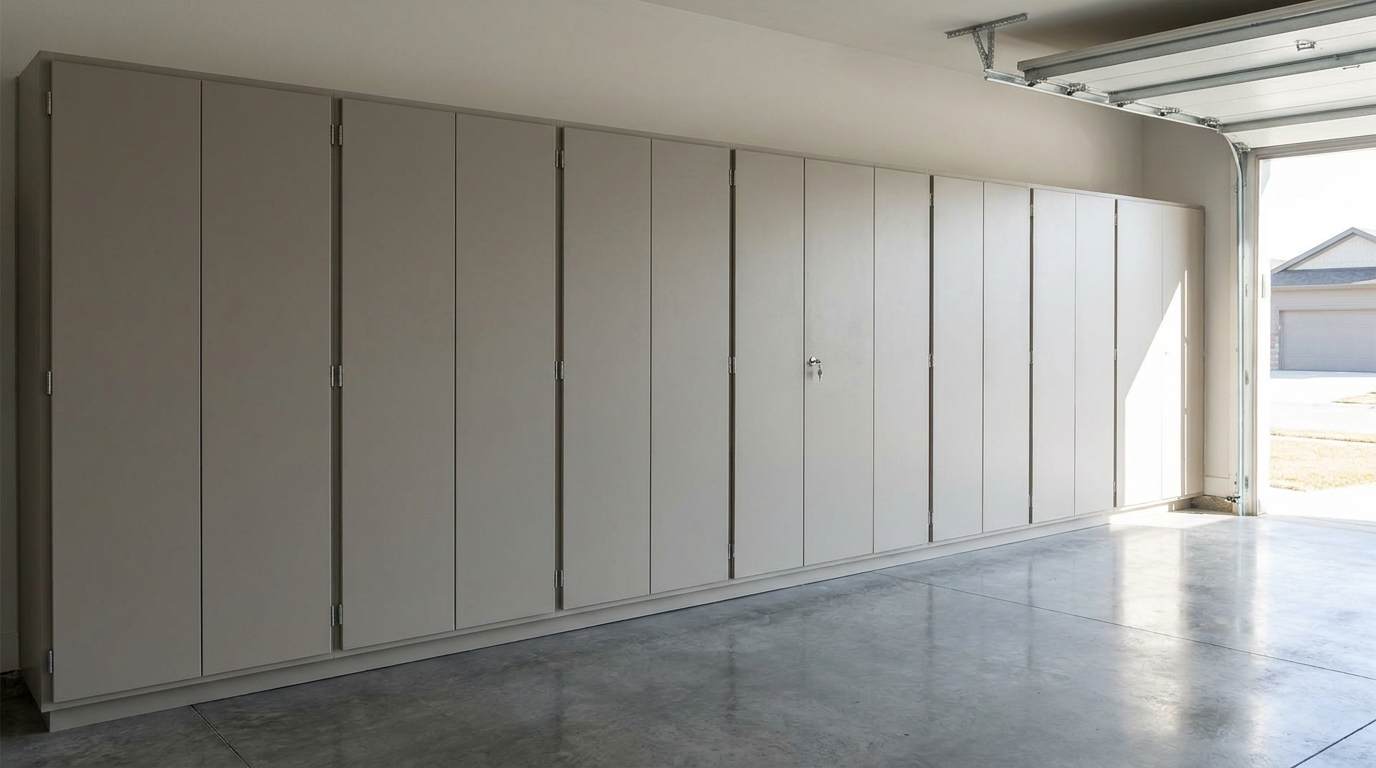
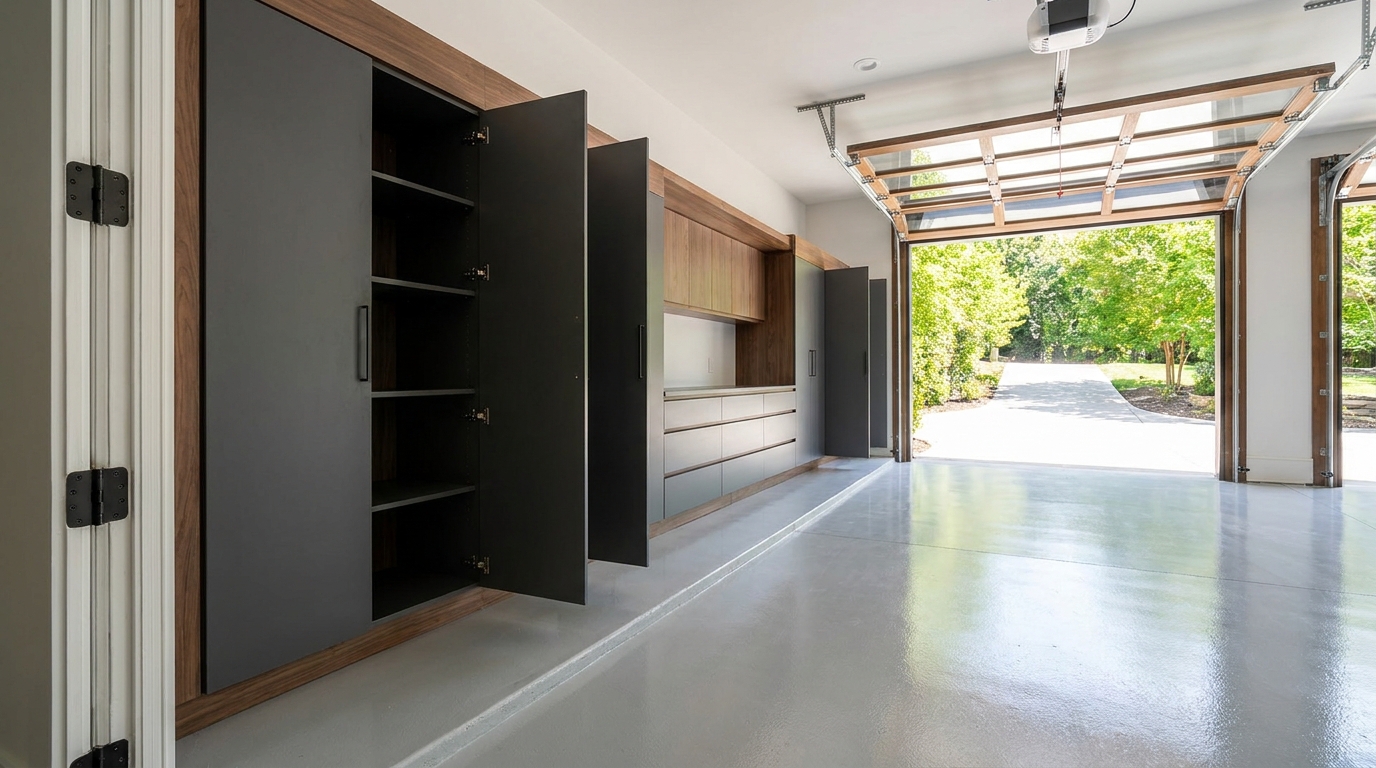
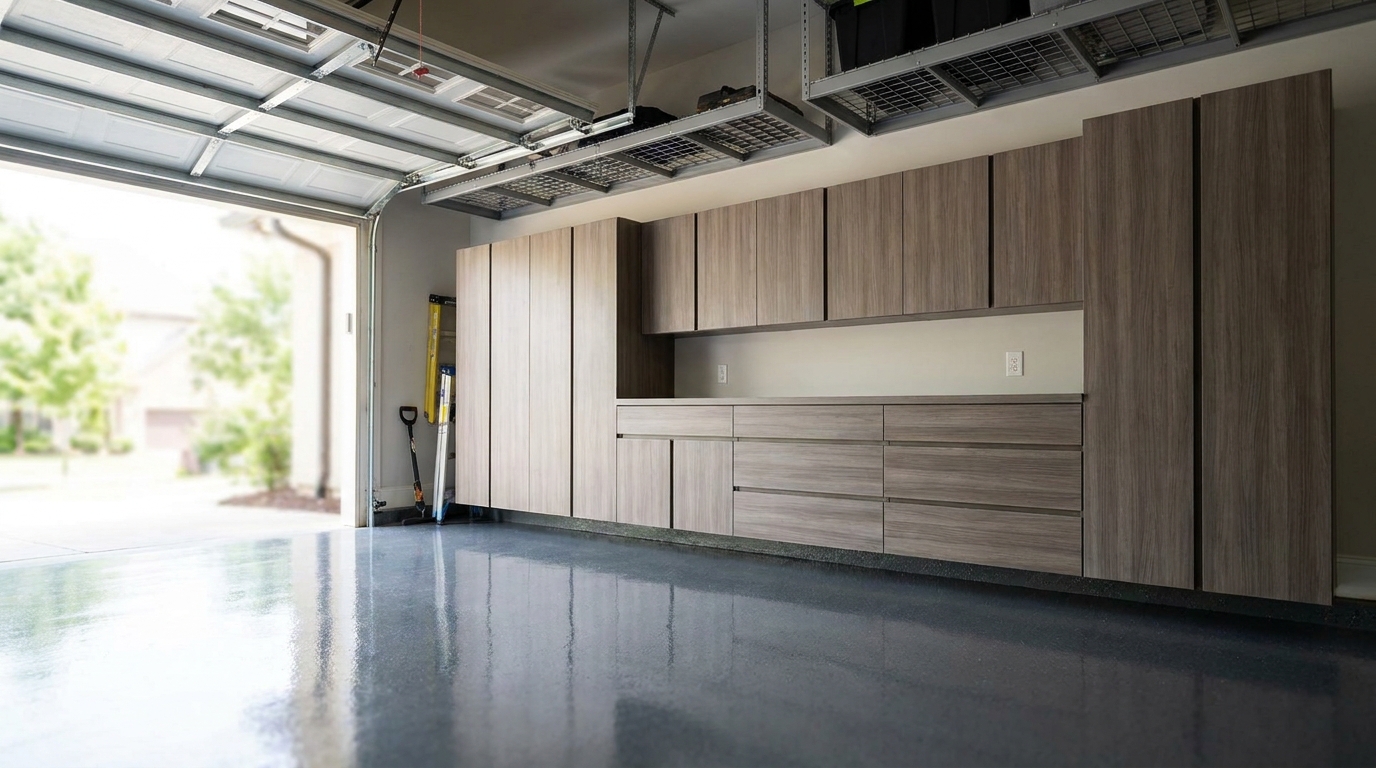
A lockable garage cabinet door is a door in the cabinet run, not a second cabinet parked beside it. It wears the same finish as the doors on either side, hangs on the same hinge line, and keeps the same reveal, the even gap between one door and the next. The lock is specified on the one door that gives paints, sharp tools, and a few other household products a closed home, so the wall still reads as one cabinet line when the opener light comes on. That is the decision we draw on a Charlotte garage before any box is ordered, and you can see the run, including a lock on the door that needs one, on our garage cabinets page.
The matching door comes first
A finished garage here is a room you walk through every day, with the cars, the bins, and the bench sharing one wall. That cabinet wall is the largest surface in the room after the floor. If one door is a different color, a different thickness, or a metal locker with a hasp across the face, the eye stops. We would rather it travel the whole elevation.
The locked door is cut from the same heat-fused laminate as its neighbors. Edge, sheen, and color stay with the finish you picked for the run. In the Signature Series, doors, drawer fronts, and side panels are three-quarter inch, and the tops, bottoms, and shelves are 1 inch. The door that locks is built from those same parts, not from a thinner special panel. Classic or Signature, the rule is the same. The door that takes the key matches the doors that do not.
The reveal is the shadow gap between doors, and between a door and the stile or filler beside it. When that gap stays even, the room looks drawn. A cabinet lock sits in the door. It does not add a strap of steel across the gap. A padlock on a hasp does. The hasp sticks past the face, the shackle catches the light, and the next door suddenly looks like the real cabinet while the locked one looks borrowed. We specify the lock so that does not happen.
Builders hardware already treats a cabinet-door lock as its own product. ANSI/BHMA A156.11-2024, the American National Standard for cabinet locks, covers cam locks, cabinet door locks, drawer locks, and several other types. It sets cycle tests, operational tests, and strength tests. Grade 1 locks under that standard, for example, are tested through 40,000 cycles, usually by working the key and the cylinder. [1] We are not naming a brand here, and we are not claiming that every residential garage lock is certified to Grade 1. The useful point is simpler. A lock made for a cabinet door can live in that door, and the door can keep the hinge line, the reveal, and the finish of the run.
The locked door uses the same hinge family as the doors beside it. At install we adjust those hinges so the faces land in one plane and the gaps stay even, the same adjustment we make on every other door. The lock does not ask for a different overlay or a door that sits proud of its neighbors. Sight down the faces from the end of the run, and you should see one wall.
Where the lock goes, and where it does not
Most doors in a working garage should open with a hand. The drill, the tape, the batteries, and the bag you grab on the way out stay in unlocked doors and drawers. The locked door is the exception, and it should look like it belongs to the rule. On our cabinets, key-and-lock options are available on most configurations. The doors we usually lock hold fertilizer, automotive fluids, paints, and sharp hand tools. When more than one door needs a key, we can key them alike, so you carry one key instead of a ring of padlocks.
The cylinder stays small, a modest circle in the door or a small housing at the edge. It is not a new pull, and it is not a reason to change the hardware on the rest of the run. If the neighboring doors have a pull, the locked door wears the same pull. The key is the difference you feel. It is not a difference you are meant to read from the driveway.
We settle placement on the drawing. A tall door in the run, or an upper whose lock an adult can reach without a step stool, keeps the locked bay inside the composition. A freestanding chest in the parking stall is a different object. Our boxes mount to the wall studs and use full backs, so the locked door is part of that mounted line and the floor stays open underneath. You can still sweep, and you can open the door without rolling a cabinet out of the car's way.
Sharp tools are the clearest version of this. Chisels, a handsaw, and a good pair of shears do not need a special chemical box. They need a door that closes, locks, and matches. The door in front of them is the same door a guest sees beside the broom locker. Nothing about the face says this one is different. Only the key is.
What the closed door is asked to hold
Household products are the other half of that door, and the storage habits for them are plain. The U.S. Environmental Protection Agency, on its household hazardous waste page updated June 1, 2026, treats some leftover household products as hazardous waste when they can catch fire, react, or explode, or when they are corrosive or toxic. Paints, cleaners, oils, batteries, and pesticides are the examples EPA names. The handling notes on that page are direct. Follow the instructions for use and storage on the product label. Keep the product in its original container and do not remove the label. Do not mix leftovers with other products, because incompatible products can react, and a mixed container may no longer be something a collection site will take. Products left around the house can also present hazards to children and pets. [2]
A locked door is how those products get a place in a finished garage without a break in the cabinet line. Poison Control's article on cold-weather poisonings, published in September 2025 and updated in January 2026, tells households to store antifreeze and windshield washer solution in a locked cabinet, where children and pets cannot get to them, and to keep medicines and household products locked up as well. [3] That is a door with a key. It does not replace the label, the original cap, or a careful look at what shares a shelf. We specify the lock on the door that needs one, in the same finish as the doors that stay unlocked.
Lawn and garden products often include pesticides, and those have a tighter list. Penn State Extension's pesticide storage page, updated May 28, 2025, says to keep pesticides in a locked area and only in the original container, with different types separated. Store dry products above liquids. If you can, keep pesticides stored in and around the home at least five feet off the ground. Shelves for those products should be metal or plastic, and liquid containers should sit in an extra plastic tray. The same page notes that most swimming-pool chemicals are strong oxidizers and do not belong under a fuel container that could leak onto them. Some chemicals lose effectiveness if they freeze and thaw. Others do not. The label is how you tell. [4]
Our interior shelves are heat-fused melamine, adjustable, and rated to 100 lb each. Laminate is not the metal or plastic shelf that pesticide guidance prefers, and we will not pretend otherwise. Inside the locked door, a plastic tray under the liquids, and a metal or plastic insert where the label wants one, lets that advice and the cabinet face agree. The door you see from the driveway does not change.
Five feet, where the product warrants it, is a shelf inside that same door, or an upper whose door still aligns with the doors below. A lock low to the floor does not, by itself, put a jug out of reach. We decide both things on the drawing: which door locks, and which shelf inside it is the high one. Fertilizer stays in the bag or jug it came in, not in a container that once held food. [2]
A matching door is not a flammable cabinet
There is a limit, and it belongs in the same calm conversation as the finish sample. Oregon DEQ's hazardous household products sheet, created in 2014 and still the file the agency posts, tells households to keep hazardous products out of the reach of children and animals, away from food, and in locked cabinets or in cabinets with childproof latches. It also says to separate flammables, corrosives, and poisons onto separate shelves. The sheet's storage table, which it describes as recommendations developed by EPA, puts flammable liquids such as acetone and methanol in a flammable storage cabinet, away from sources of ignition. Gasoline, on that same sheet, belongs in a safety-approved container, in a well-ventilated area, away from heat, flame, and spark. Rags contaminated with flammable solvents, including rags used with wood stain, paint stripper, or paint remover, are called out on their own, because they can start on fire by themselves. [5]
A lockable garage cabinet door that matches the run is not that flammable storage cabinet. We will not describe it as one, and we will not set a gasoline can behind a finished door and call the question closed. The 2014 sheet does allow a locked cabinet, or a cabinet with a childproof latch, for hazardous household products in general. The door we build is the locked version of that idea, and the lock is not an excuse for a mismatched face. When a label, or the class of the liquid, calls for a listed flammable cabinet, that cabinet is its own specification. It sits where the liquid requires it. It does not have to pose as a stile in the cabinet line, and the cabinet line does not have to pose as a yellow safety box.
What the matching door does well is the closed home the other products need. Leftover wall paint stays in the labeled can, lid seated, upright, on a shelf that can hold the weight. Sharp tools stay on their own shelf or in a tray. Antifreeze and washer solution fit this door when the label agrees. [3] A food jar is the container EPA says not to use. The original can, label still on it, is the one a collection site can identify later. [2]
A corroding can is a different problem from a sound can with a tight lid. EPA says corroding containers need special handling and tells you to call your local hazardous-materials official or the fire department rather than guess. Oregon's 2014 sheet, for a container that is already deteriorating, describes setting the whole container in a lidded plastic bucket with a non-flammable absorbent such as kitty litter. [2][5] The locked door is for containers that are still sound.
The door holds them until the county takes them
A closed cabinet is storage between uses, not a private landfill. Mecklenburg County's household hazardous waste page, current on the county site as of November 2026, offers residents free drop-off at its full-service recycling centers. Tell the staff you have brought hazardous material. The accepted list includes latex and oil-based paint, up to 100 pounds from residents, plus paint thinners and solvents, pesticides, fertilizers, adhesives, and a range of automotive fluids. Motor oil, antifreeze, and a few other liquids have their own stated limits. Business hazardous material is not part of that household program. For the drive, the county asks for the same habits the shelf already uses: original container if you can, contents labeled, nothing mixed, away from heat, no leaks, and a sturdy box. [6]
The four full-service centers named on that page are Compost Central at 140 Valleydale Road in Charlotte, Foxhole at 17131 Lancaster Highway in Charlotte, Hickory Grove at 8007 Pence Road in Charlotte, and North Mecklenburg at 12300 North Statesville Road in Huntersville. The cabinet is where those cans live, upright and closed, between the project and that trip. When a can is finished, the door opens, the box gets packed, and the shelf goes back to what you still want. The wall does not have to display the leftover in the meantime.
The locked door is not a warning stuck on an otherwise finished room. It is a door. It matches in finish, in hinge line, and in reveal. You use the key when you need the paint or the chisel, and you turn it again when you are done. The other doors stay ready. From the driveway, the run still reads as one cabinet line.
Practical takeaways
- Specify the lock on one door in the run, in the same finish, on the same hinge line, and with the same reveal as the doors beside it.
- Key the locked doors alike when more than one bay needs a key, so the wall does not collect a ring of padlocks.
- Keep paints, pesticides, cleaners, and automotive fluids in original labeled containers, and do not mix leftovers. Follow the storage line on each label. [2]
- For pesticides, use the locked door as the locked area, separate product types, set liquids in a tray, and use a metal or plastic shelf or insert. Five feet up is worth doing when the label and the layout allow it. [4]
- Do not treat the matching door as a flammable-liquids cabinet. Gasoline stays in an approved container, ventilated, and away from ignition. Liquids that a flammable-cabinet instruction names belong in that kind of cabinet. [5]
- When the leftover is ready to leave, Mecklenburg County residents can take household paint and related products to a full-service drop-off center. Tell the staff what you brought. [6]
How we can help
Have more questions or want to get in touch? Our team will walk the wall with you, mark the door that takes a lock, and keep that door in the same finish and the same line as the rest of the run. Start here: contact Total Garage Charlotte.
Citations
- Builders Hardware Manufacturers Association, "A156.11 - 2024 Cabinet Locks" (2024)
- U.S. Environmental Protection Agency, "Household Hazardous Waste (HHW)" (2026-06-01)
- National Capital Poison Center, "Prevent cold weather poisonings" (2026-01-22)
- Penn State Extension, "Safe Pesticide Storage" (2025-05-28)
- Oregon Department of Environmental Quality, "Hazardous Household Products Safety" (2014)
- Mecklenburg County Solid Waste and Recycling, "Household Hazardous Waste Disposal" (2026-11-02)